
How to Choose an Outdoor Chair in Japan and Compare Sitting Comfort
How to Choose an Outdoor Chair in Japan and Compare Sitting Comfort
Choosing a camping chair in Japan might seem overwhelming due to the variety available, but the process becomes much simpler once you decide what takes priority: dining, campfire time, relaxation, or portability on foot. For seat height, aim for 40–50cm for high-style chairs and 20–35cm for low-style chairs. When you combine this with storage methods—folding, collapsing, or assembly types—and match them to your use case, the right chair becomes clear.
Choosing a camping chair in Japan might seem overwhelming due to the variety available, but the process becomes much simpler once you decide what takes priority: dining, campfire time, relaxation, or portability on foot. For seat height, aim for 40–50cm for high-style chairs and 20–35cm for low-style chairs. When you combine this with storage methods—folding, collapsing, or assembly types—and match them to your use case, the right chair becomes clear.
This article guides both first-time buyers and those reconsidering their setup through the differences between high, low, and ultra-low seat positions, the practicality of different storage methods, and how to read weight, storage size, and weight capacity. It covers the fastest route to choosing chairs for four scenarios: solo camping, family camping, hiking, and campfire settings. The author herself frequently uses a 25–30cm low-style chair that works well with low tables for cooking, and based on hands-on experience—from the comfort difference when switching chairs between campfire and mealtime to being grateful for a sub-1kg lightweight chair on a site requiring a 300-meter walk from the parking area—this guide lays out practical judgment criteria that reduce the chance of regret.
The First Decision: What Are You Doing While Sitting?
Basic Framework
Camping chair selection is less prone to failure when you work backward from what you'll be doing while seated rather than starting with looks or brand. Four practical scenarios make good reference points: "dining and cooking," "campfire and relaxation," "traveling with children," and "hiking." Once these are clear, your priorities around seat height and storage method become much more obvious.
If eating, food prep, or table-based work will dominate, you'll want a high-leaning orientation. High-style chairs typically run 40–50cm, and for dining purposes, 35cm and above is a useful benchmark. Even on sites centered around low tables, a seat that isn't too low makes it easier to swap dishes around or lean toward a cutting board, keeping mealtime movements flowing. From a cook's perspective, sitting in a chair that supports an upright posture—rather than one where you sink deep—feels dramatically easier while preparing food.
Conversely, if you'll spend long evenings enjoying a campfire, a low-style chair in the 25–30cm range tends to work best. The full low-chair range is 20–35cm, with the mainstream sitting around 25–35cm. Your line of sight naturally aligns with the flames, and you can stretch your legs out comfortably, making it ideal for lingering after dinner. In the author's experience, fire-watching time feels much more relaxing in a low chair—your lower back and overall mood benefit from the easier recline.
With children, shift the priority from comfort to safety and stability. A low-seat-height chair with a low center of gravity is safer for kids than using an adult chair; their feet touch the ground more easily. For adults on child-care days, a low chair becomes impractical because you stand and sit constantly—to hand over plates, fetch drinks, and repeat. On days filled with these small back-and-forths, a slightly higher chair becomes invaluable.
For hiking, touring, or festival settings where portability is paramount, an assembly-style lightweight model is the clear choice. Storage methods split into three broad categories—assembly, folding, and collapsing—but assembly is most compact for hiking. For example, a Helinox Chair Zero weighs about 531g while a Helinox Chair One weighs about 960g; the roughly 429g difference feels like reducing your load by nearly one drink bottle—a significant relief on walks or when carrying gear on your back.
The narrowing process is straightforward: decide your main purpose first, then choose your seat-height band, move on to storage method, and finally examine weight, weight capacity, and storage size. Add details about seat material and backrest shape at the end. Reversing this order—starting with "looks light" or "design appeals to me"—often leads to chairs that are uncomfortable to eat in, hard to stand from, or awkward to carry. Working through these steps in order keeps your thinking steady.
💡 Tip
If meals are your focus, narrowing down the seat-height band first cuts candidates dramatically. For campfire-focused trips, lean toward low seats; for hiking, prioritize assembly-type storage. This makes comparison much easier.
A useful reference for grasping the height feel of eating-focused setups is the LANTERN guide "How to Choose a Camping Chair?", which frames the principle clearly: 35cm or higher seat height for proper dining. When deciding between high and low chairs, thinking "how many minutes will I sit in this chair and what will I do?" before "which table will it pair with?" makes numbers feel more usable.
The time you spend cooking or serving determines whether backrest angle or fabric tension matters most; ease of standing and sitting takes priority. Conversely, if you're spending long hours around a campfire talking, a slightly lower seat makes the experience noticeably more pleasant. Chair differences are hard to spot in spec sheets alone, but placed in a real camping scenario, they become quite clear.
Related article: Tent Size Selection Guide
The gap between high-style and low-style setups is more than just seat height. It reshapes how you move around the dining area, your distance from the fire, and even your site's overall layout. This difference isn't really "which is superior?" but rather "which camping style do you prefer?"
For example, Coleman's Compact Folding Chair—a folding type weighing about 2.1kg—isn't lightweight for hiking, but it's built to make posture easier and brings high satisfaction during meals and group relaxation. The Captain Stag Trekker Micro Easy Chair, by contrast, is an ultra-lightweight model at about 300g, truly shining when weight restrictions are strict. The difference isn't "which is better" but rather the quality of your seated time is fundamentally different.
If you're still torn between high-leaning and low-leaning, your comparison axis should be "how many times will I stand up?" and "how long will I sit continuously?" More standing favors high-leaning; long sitting sessions favor low-leaning. This perspective makes the spec-sheet numbers connect to what your actual camping day looks like.
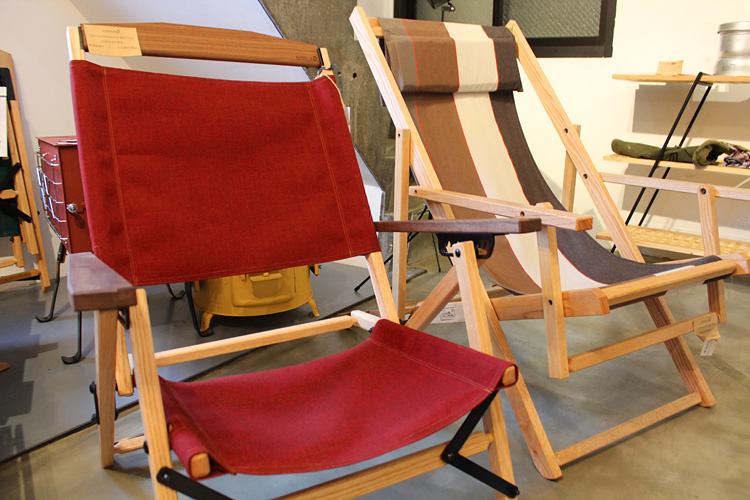
How to Choose a Camping Chair? Dedicated Campers Judge by Height and Angle for Each Purpose
www.lantern.campSeat Height Is the Biggest Factor in Sitting Comfort
High-Style Chair (40–50cm): Best for Standing, Sitting, and Dining Work
Where seat height makes the biggest difference is not appearance, but rather how easily you stand, sit, and move your hands. High-style chairs generally sit around 40–50cm, a height that avoids sinking too deep and lets you maintain an upright pelvis. This height especially matters when eating, serving, or doing light cooking prep—any task where you repeatedly reach toward a table.
The ease of standing is a major plus. Standing from a 45cm-ish seat feels close to getting up from a home dining chair, noticeably easier than rising from a 25cm-ish low chair. Campfires involve surprisingly frequent standing—handing over a plate, checking the pot, pouring drinks—so this difference gradually builds up. When setting out place settings or plating food, a higher chair genuinely makes the whole mealtime feel more organized.
The author finds that on days focused on plating and serving, a higher chair is dramatically better. Pairing a 45cm seat with a 70cm-class table makes dish arrangement, serving with tongs, and pulling a cutting board closer all flow smoothly, keeping the whole dining area neat. For meals-focused, BBQ-focused, or work-heavy camping, this height boosts overall satisfaction.
On the flip side, enjoying a campfire alone for hours can make your sightline feel slightly too high, making the fire seem a bit distant. High chairs suit people whose days center on eating, moving, and tidying rather than lingering by flames.
Low-Style Chair (25–35cm): The Gold Standard for Campfire and Relaxation
Low-style chairs fall into the 20–35cm range, with the mainstream hovering around 25–35cm. This band strikes a terrific balance between relaxation and function—which explains why it's become the heart of low-style camping. Your legs stretch out easily and your gaze naturally drops, making it perfect for gazing lazily at campfire flames.
The campfire is so comfortable at this height because your eye line aligns with the fire. A high chair often forces you to look down slightly; a 25–35cm low chair lets the flame height match your view, drawing you into the crackle and shimmering warmth. That quiet moment after dinner transforms entirely at this height.
Bonus: the 25–35cm band is low enough for comfort yet high enough for casual eating. The author often pairs a 30cm seat with a 40cm-ish low table and finds the elbow position settles naturally, making light knife work or plating straightforward. Not too sprawled, not too tense—this middle ground is remarkably practical.
Of course, standing up takes more effort than from a high chair. Still, if you want to blend campfire comfort with dining ease, 25–35cm is a very workable band. It's the "when in doubt, start here" height sitting right between high chairs and ultra-low seats.
Ultra-Low Seat (~20cm): Immersive Ground Connection, But Standing Is Tough
Drop to around 20cm and the world shifts instantly. Your sightline plummets closer to the ground, and your connection to the campfire and low table deepens. Minimalist sites and ground-level camping have a presence only this height can deliver.
For pure campfire alignment, it's incredibly appealing—you're close to the flames, can stretch out fully, and sink into deep relaxation while watching the fire. Sites kept low overall get visual unity, and satisfaction runs high.
But the downsides are stark. Standing up is genuinely difficult, and you feel the difference acutely. The gap from a 45cm seat is roughly 25cm—translating directly into effort. On days when you eat, then leave to tend the fire, then return for drinks, standing frequently gets exhausting. For mealtime activity or heavy cooking, discomfort comes before comfort at this height.
Pairing with tables gets finicky too. A low seat means even a moderately high table can cause your arms to reach upward, twisting your eating posture awkwardly. Ultra-low seats shine when you "want to be all-in on campfire" and "prioritize that ground-level relaxation feeling"—a very different personality from a dining-focused chair.
💡 Tip
If campfire time is your star act, a low seat delivers very high satisfaction. Conversely, on active camping days with lots of standing, even a few centimeters of height difference changes how tired you feel.
Table Height and Seat Height Pairing
Assessing a chair in isolation often leads to "why is this hard to eat from?" after purchase. Much of the comfort actually hinges on how the chair height combines with table height. Hand placement, elbow angle, and forward-lean depth are all governed by the gap between chair and table.
As a rough guide, low-style site tables vary by product, but a 25–35cm seat height generally pairs well with common low-style tables. (Since products differ, check actual table height against the specific chair.) Similarly, higher-set tables (typically around 60cm depending on the product) usually match nicely with 40–50cm seat heights. A 45cm seat with a 70cm table is a classic comfortable pairing for big plates and BBQ-style work.
When these misalign, dissatisfaction crops up. A low chair with a high table leaves your shoulders raised and meals feel unsettled. A high chair with a low table crowds your knees and makes forward-lean posture difficult. Seat-height-first thinking isn't just about the isolated feel of sitting; it connects directly to your whole site's height architecture. Including how you'll choose your campfire table resharpens this high-versus-low contrast significantly.
How Storage Method Shapes Usability and Sitting Feel
Folding Type: For Those Prioritizing Seat Stiffness and Stability
Folding-type chairs suit people who prize that "just-right" feeling the moment you sit down. Many use full-frame surface support, with firm seat tension and easy-to-use armrests built in for maximum comfort. MyBest and BE-PAL alike note that folding types tend to deliver good sitting comfort.
In exchange, they take up more floor space when folded—they get thin but stay broad, more like a flat board than a compact bundle. For instance, Coleman's Compact Folding Chair runs about 2.1kg with a storage size of roughly 54×8.5×56.5cm. While the thickness stays manageable, it's more "carry in the car trunk" than "sling on your back." For car-based camping, this "slightly bulky but very comfortable" trait actually feels natural.
Stability shows up in the legs too. Folding types often use wider-footed legs, resisting ground sinkage on soil, grass, or softer sites better than narrow-footed designs. The author recalls a narrow-legged chair catching on riverbed stones and feeling unstable, whereas switching to a folding type—with its broader ground contact—delivered obvious peace of mind. For people frequently shifting their weight while cooking or resettling during meals, this stability matters.
Collapsing Type: Fastest Setup and Breakdown—Perfect for Busy Families
The appeal of collapsing types is pure speed. Collapse means straightforward, often single-motion deployment; you're sitting within seconds of unpacking. On mornings when you're juggling gear breakdown and kids' schedules, this quickness is genuinely lifesaving.
Sitting comfort lands between folding and assembly types. Many offer a nice wrap-around feel, delivering solid relaxation, but they may slightly edge behind folding types in seat tension and posture control. Overall satisfaction is still quite high when you factor in setup-breakdown ease.
Weight typically hovers around 2.3kg with ~100kg capacity—a solid car-camping balance. Storage form is long and slender, fitting car cargo nicely. For example, Coleman's Healing Chair NX collapses to about 25×14×65cm, offering a "fits vertically" convenience different from flat-folding types. Families whose camping days involve frequent chair in-and-out cycles find this handling so practical that it directly boosts comfort. Through all the plating, drink-fetching, and mop-up chaos, a chair that deploys and stows in seconds becomes truly invaluable.
💡 Tip
For family use, sitting comfort isn't the only measure—"can anyone figure out how to open it without confusion?" actually drives satisfaction. Collapsing types excel here.
Assembly Type: The Lightweight Champion for Hiking, Touring, and Festivals
Assembly types prioritize lightness and compactness above all. Assembling the frame and stretching the seat does add steps, but storage volume beats the other two methods. For hiking, touring, or festival settings where distance traveled becomes actual burden, assembly types soar in value.
Weight differences feel substantial. Examples from Ameba Choices show the Helinox Chair One at about 960g and Chair Zero at about 531g—a ~430g gap that equals nearly a full drink bottle's weight in the pack. Over long walks, that gap compounds. Pushing lighter still, the Captain Stag Trekker Micro Easy Chair hits about 300g at 65×65×290mm, small enough to slide into a backpack gap with zero fuss. At this extreme lightness, true portability becomes itself a form of comfort.
The tradeoff: sitting feel depends heavily on seat tension and frame rigidity, and ultra-light models prioritize "portable brilliance" over "disappearing into the chair." Ground compatibility deserves attention. Fine leg tips work fine on hard ground but can catch on rocky or soft sites, feel less stable. The author has felt micro-wobbles on stony sites with lightweight assembly types while holding a plate—a minor nerve-taxing. For on-foot trips, they're undeniably appealing; for overall sitting security and comfort, car-based camping often gets better mileage from folding or collapsing types.
To summarize: carry by car and seek site comfort? Folding or collapsing types. Carry on foot? Assembly types. The division is quite clean. Those hunting lightweight models often find the 1kg-or-under class clears the field quickly.
Comparison Table: Outdoor Chair Selection Made Visual
Looking at numbers clarifies chair selection considerably. The biggest differences show up in weight, storage size, seat height, weight capacity, and suited scenarios. Current pricing wasn't available for verification at publication, so this table marks it "pricing unavailable" and recommends confirming current retail prices per retailer. Here, representative models illustrate which type fits which scenario.
| Model | Weight | Storage Size | Seat Height | Weight Capacity | Reference Price | Best For |
|---|---|---|---|---|---|---|
| Helinox Chair Zero | ~531g | Not disclosed | Not disclosed | Not disclosed | Pricing unavailable | Hiking, touring, festivals |
| Helinox Chair One | ~960g | Not disclosed | Not disclosed | Not disclosed | Pricing unavailable | Lightweight-focused auto camping to hiking |
| Captain Stag Trekker Micro Easy Chair | ~300g | 65×65×290mm | Not disclosed | ~160kg | Pricing unavailable | Maximum lightweight, backpack travel |
| Coleman Compact Folding Chair | ~2.1kg | ~54×8.5×56.5cm | Not disclosed | ~80kg | Pricing unavailable | Dining, work, car-based camping |
| Coleman Healing Chair NX | Not disclosed | ~25×14×65cm | Not disclosed | Not disclosed | Pricing unavailable | Campfire, relaxation, fast setup/breakdown |
The takeaway isn't just "light versus heavy." For backpack hiking, that 1kg difference directly translates to fatigue; a 65cm storage length determines whether it fits sideways or needs vertical packing in your car. The author once faced a storage length that wouldn't quite fit her vehicle's width, forcing a complete repack. Numbers that look small matter enormously on-site. Weight capacity similarly: having 10kg or more cushion above your actual weight lets you relax into the chair with real confidence.
Lightweight Tier (500–1,000g Class): For Hiking and Touring
Hikers and tourers should start by narrowing down by weight. A useful range to eye is the 500–1,000g band, where the Helinox Chair Zero (~531g) and Chair One (~960g) offer a clear comparison. That ~430g gap registers as nearly one drink bottle in total pack weight—definitely felt over hours of walking. This band lets you chase weight savings while still enjoying the satisfaction of sitting to rest.
Pushing even lighter, the Captain Stag Trekker Micro Easy Chair at ~300g and 65×65×290mm storage feels pocket-sized—you slip it into a bag gap effortlessly. Weight capacity tops ~160kg, so lightweight doesn't force you to sacrifice reassurance. Light models do trade sitting luxury for portability, and that trade-off is real; yet when carrying the chair itself is the main event, that small, light form becomes genuine comfort.
For lightweight choices, compare in this order: weight → storage size → weight capacity. Smaller storage shrinks packing flexibility and tidies your overall load. On bike trips, centimeters decide horizontal-fit versus vertical-stack, so dimensions matter as much as weight. If ultra-light is your focus, the sub-1kg ceiling clears clutter fast.
Sitting Comfort Tier (High-Seat, Folding-Type Focus): For Dining and Work
For meals and cooking prep, your comparison axis shifts from weight to seat height. Eating-focused 35cm-and-up is one benchmark; high-style 40–50cm sits squarely in comfort territory. This height makes table gaps manageable and lets you eat or slice without over-leaning. From a cook's view, staying seated through item-plating and beside-burner prep becomes far easier.
Coleman's Compact Folding Chair is a natural reference: ~2.1kg, ~54×8.5×56.5cm storage, ~80kg capacity. Too heavy for hiking but great for car trips, leaning hard into stability and comfort. Folding types pack thin, fitting neatly against cargo-area edges or under tables.
In this category, note that a 45cm seat and a 25cm seat differ by ~20cm in ease of standing. Campfires have their charm at low heights, but eating and work reward higher seats. The author prioritizes "do I stay upright enough to stand and sit easily?" over "is it featherlight?" when placing a chair near the cooking station. Mealtime quality directly drives chair satisfaction.
Campfire and Relaxation Tier (25–30cm Low Seat): Choose Backrest Height by Preference
For fire-gazing, aim for 25–30cm low seats. Low-style mainstream is 25–35cm, fitting fire-distance nicely and letting legs stretch out. Too-high seats force you to gaze downward, making the fire feel distant and your posture restless. Long fire-watching hours improve dramatically with a few centimeters of drop.
The split here: how much backrest do you want? Low-back frees shoulders, making it easy to lean forward toward the fire, grab nearby gear, or tend the flames. High-back cushions neck to shoulders, letting you sink back fully—particularly lovely for post-dinner fire-gazing. BE-PAL mentions ~2.2kg lightweight hammock-chair examples with ~15×59×15cm storage and ~90kg capacity, realistic for car camping when backrest embrace matters.
Storage length counts here too. Coleman's Healing Chair NX stores at ~25×14×65cm, neatly tall but 65cm long—an important car-fit consideration. The author mentally maps "where does this fit?" as carefully as "how does it feel?" Storage details reshape the whole table-read.
What Makes Sitting Comfort Tick
Fabric Material: General Rules for Breathability, Drying Speed, and Weather Resistance
Even with matching seat height, time spent sitting varies based on seat width, depth, angle, and tension. Wide seats offer body room; deep seats cup your hips. Shallow seats favor forward-lean and standing. Angle determines whether you're propped for rest or postured for work. Strong tension feels perky and work-ready; softer tension wraps you cozily.
Atop these foundations, fabric choice colors experience noticeably. Per Hondaキャンプ framework, mesh beats sweat: breathability and rapid drying cut heat buildup, especially on steamy days. The author notices on humid lakeside trips that a mesh seat doesn't trap back warmth, feeling notably fresher. Summer humidity and waterside camping find good partners in mesh. Teslin-grade meshes withstand sun and moisture, suiting leave-it-deployed setups well.
Polyester is light, handy, and forgiving with dirt and water, needing less fussing. Lightweight and assembly types use it often—unsurprisingly, since it pairs well with portability. Weave and thickness shift impressions, but think "balance of easy care and reasonable weight."
Cotton feels lovely to touch and looks right at a campfire. That natural warmth is genuinely satisfying on first contact. Yet cotton gets distinctly heavier when wet. The author remembers cotton seats staying damp long after autumn rain, turning breakdown a chore. Sitting comfort shines; seasonal fit narrows.
💡 Tip
When reviewing fabric, don't just ask "does it feel nice?" Go further: would a sweaty back stick, or would morning dew dry quickly? Imagining these real-world moments closes gaps between first impression and actual use.
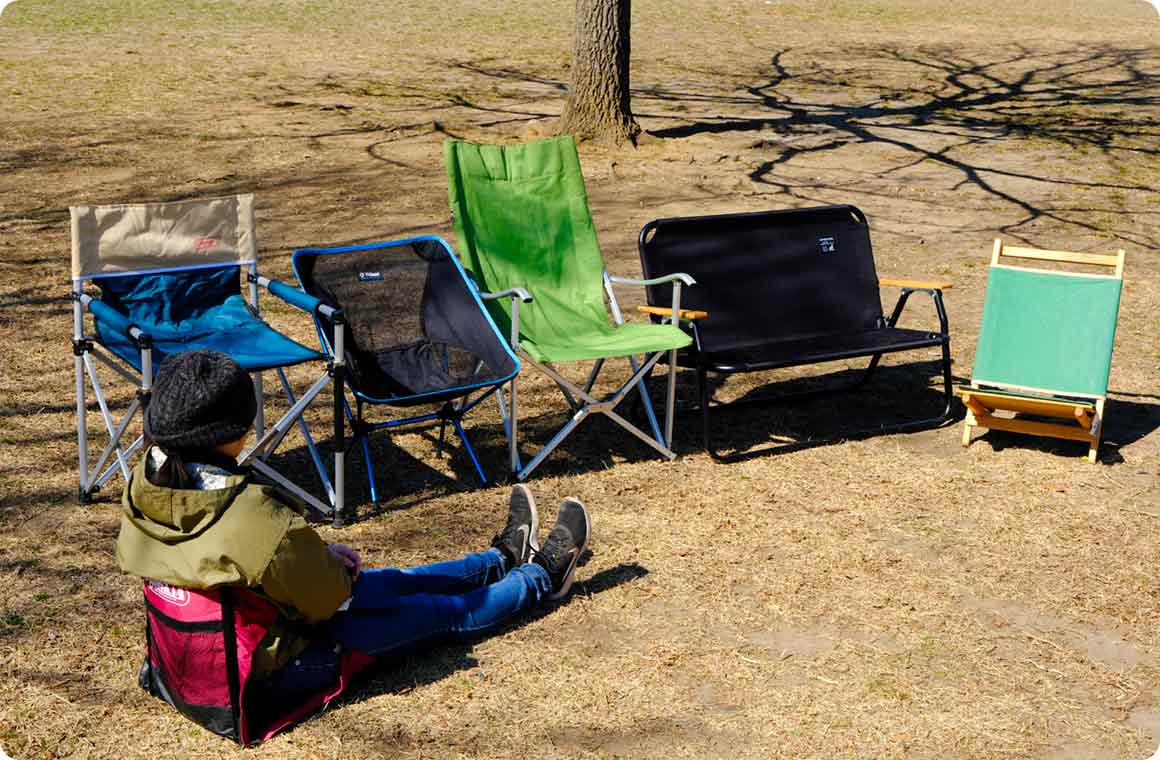
Camping Chair Styles by Height, Backrest, and Material: What Works When?|Hondaキャンプ
All-day outdoor comfort hinges on a good chair. Seat height, tension, and fabric all reshape relaxation level and setup ease. This breakdown by style clarifies which chair traits matter for your trip.
www.honda.co.jpFrame and Leg Stability, Ground Suitability
Comfort isn't just about fabric. Stiff frame construction prevents leftward twist when you lean back, maintaining seat tension and delivering that "safe to sink into" feeling. Nearly identical-looking chairs can split into "rock-solid to lean on" versus "a bit fidgety" depending on frame rigidity. Wide seats in particular need firm frames; flimsy frames under broad seats breed end-balance anxiety.
Leg shape matters hugely. Fine legs sink in sand or grass, causing your posture to shift slightly with every sit as the ground settles. That slow drop tires you gradually. Wide-footprint or flat-base frames hold level ground-wise, staying stable on soft sites. From a cooking angle, this difference looms large: standing to check a pot, returning to sit, then forward-leaning to plate—this cycle relies on solid footing.
Weight capacity enters the comfort story as "does my body settle without frame worry?" Ratings that leave 10kg+ cushion above your real weight let you truly relax into the seat. Strong frames under wider seats deliver this confidence better than ultra-light assembly models, which can feel unstable over uneven ground. Folding-type frames' extra weight earns trust through ground-contact stability; ultra-light assembly trades that security for carry ease.
Style-Specific Selection Paths
Solo Camping
Solo splits cleanly on walk-versus-drive. Parking-far or festival-mode trips call for assembly-style 500–1,000g basics. Helinox Chair Zero (~531g) versus Chair One (~960g) is a telling contrast—that ~430g drop-off equals one drink bottle, noticeably felt over longer carries.
If auto-camping dominates, dump lightness and boost campfire comfort. The author then picks a 25–30cm-seat low chair, loving how close the flames feel, how naturally legs extend, and how the evening unwinds. Cooking while fire-gazing suits this height: you flit between tasks and flame, chair never leaving your peripheral.
Solo's calculation is personal: ultra-light pursuit or on-site quality time? Choose accordingly.
Family Camping
Families need setup-breakdown speed and reliability over solo-style luxury. Collapsing or folding types handle this: flat deployment, obvious assembly, breezy packing. Parallel kid-wrangling and gear-handling shrinks turnaround time—a real mercy on hectic mornings.
Household weekend trips perpetually race the clock. Fast chairs let adults prep faster, children stay engaged longer, and group mood stays positive. Individual chair-speed differences compound across family counts.
Weight capacity should offer self-weight plus 10kg buffer, especially shared furniture. For kids' chairs, low-seat stability matters more than high-seated reach; CAMP HACK's child-chair breakdown underscores foot-contact and reassurance as essentials. Avoid size-transferring adult chairs to children; custom-fit low seats mean confident standing and sitting for young ones.
Must-See for Parents: Kid-Friendly Camping Chairs—Age-Matched Picks for Peace of Mind
CAMP HACK
camphack.nap-camp.comHiking and Touring
On-foot transport pivots on walk distance and backpack layout. Storage length and weight are primary—reality-check both against your actual gear setup. The threshold separating "totally workable" from "annoying squeeze" is often just centimeters or 100 grams.
The math is real: a 2.1kg folding type and a 531g lightweight model feel like different planets on your shoulders. Long walks amplify the gap. Storage length similarly: 65cm-long models fit sideways or need vertical positioning, reshaping whole cargo organization. Compact-class assembly types around 300g with 65×65×290mm storage vanish into backpack crevices with zero fuss.
Weight-light chasing trumps all here; portability without frustration is the goal.
Traveling with Children
Start with low-seat design. Fall height drops matter to kids; smaller gaps feel safer. Feet touch ground easier, rebuilding balance is simpler—confidence jumps noticeably.
Watch deployment safety. Folding-types with many joints or hinges can pinch young fingers. Simple, obvious structures—ones kids touch without mystery—beat complex designs. Straightforward = safer.
On-site, kids don't sit still. Frequent stand-sit-stand cycles demand easy-to-grip, stable seating over deep-recline comfort. Benches shine here: dual-capacity, cargo-friendly, low-profile-stable. Family camping often gains from bench flexibility beyond single-chair roles.
Campfire-Focused Trips
Center around 25–30cm low seats, as discussed: fire-height alignment, natural leg-stretch, the exact angle for flame-watching magic.
Material selection deserves care. Campfire spark exposure tilts toward cotton or flame-resistant synthetics, but recall cotton dries slowly post-rain, complicating breakdown. Fire-first picking means prioritizing heat-feel and aesthetics, then baking in drying-speed plans.
Long evenings demand low-height perfection; this investment in right-height selection pays pure dividends.
Cooking and Eating Focus
Center on 35–45cm seat height: elbow-near-table ease, forward-lean readiness, smooth food-handling rhythms. Low-chair relaxation appeals, but seated food prep at low heights tires arms and back; the burden compounds across meal-prep hours.
Folding types pair naturally here: seat tension supports posture, body doesn't sink, stance-shifts feel effortless. Coleman's Compact Folding Chair exemplifies this. Campfire-only low chairs aren't as meal-friendly despite charm.
Choose from a chair-plus-table height combo lens, not chair-alone. Standard camping table pairings suggest 35cm-plus seats fit well. Slurp, cut, plate, repeat—smooth motion decides satisfaction far more than backrest angle.
Eating-time comfort hinges as much on mealtime's standing frequency and the chair's ability to support 15-minute food-work stretches as it does raw comfort. High-seat postural support beats low-chair sprawl here.
💡 Tip
Torn between campfire and eating for one chair? Don't chase 100% both—tilt toward whichever time-block is longer. Mealtime-long? Pick higher. Fire-gazing hours? Pick lower. One use wins; design accordingly.
Failure Points and Pre-Purchase Checks
Chair regret usually isn't sitting comfort itself but "does this actually work at my site?" Showroom comfort or catalog photos lie easily; actual mismatch between chairs, tables, weight limits, or cargo space becomes real frustration fast. Eating-focused shoppers especially benefit from verifying surrounding gear alignment before buying.
The author particularly notices weight-obsession overreach. Ultra-light models shine on carries and feel genuinely liberating. Yet breezy ocean sites can flip them over easily, and food-prep days demand stability the lightest doesn't guarantee. Carrying ease is real gold; stability isn't automatic. Leg-tip caps and ground-grip matter as much as gram count.
Pre-Purchase Checklist
A few failure modes appear consistently:
Table-Height Mismatch tops the list. Low seats paired with high tables pitch elbows upward, wrecking mealtime calm. High chairs paired with low tables pinch knees and flatten posture. Eating-focused buys especially need chair-table height combos tested.
Insufficient Weight Capacity hides in specs. Capacity should be self-weight plus 10kg minimum, not exact-match numbers. Coleman's Compact Folding (~80kg) differs sharply from Captain Stag Trekker (~160kg). Light specs sometimes hide thin safety margins
Wrap-Up and Next Steps
Chair selection gets simpler when you decide the primary purpose first, then filter by seat height, fold-down method, weight/packed-size/weight-capacity, and finally material and backrest shape. I set my primary purpose as a ratio -- something like "meals 70% : fireside 30%" -- and that alone organizes the candidates. Putting your time-split into words first reveals whether you should lean high, low, or ground-level.
Your fastest path forward: decide your primary purpose, measure your current table height, and add a comfortable margin above your body weight for the capacity check. Once that's done, confirm car-trunk or home-storage dimensions, and if kids are in the picture, add a dedicated child-size chair to the shortlist instead of repurposing an adult model -- that avoids the most common family-camping regrets. For anyone looking to dial in overall site comfort including shelter choice, the tent selection complete guide ties things together.
Related links:
- Tent Selection Complete Guide
- Easy-Setup Tent Comparison and Buying Guide
Related Articles
High Style vs Low Style Camp Setup: 7 Factors That Actually Matter
The right camp setup height has less to do with looks and more to do with how you spend your time outdoors. We break down posture, standing frequency, fire proximity, cooking, vehicle loading, child safety, and winter cold across seven axes to help you decide between high, low, or mixed-height configurations.
Best Low Camping Chairs in 2024 — 8 Options Compared Across 6 Key Axes
Pick the wrong chair for a low-style camp setup and suddenly the campfire feels close but standing up becomes a chore, and your morning coffee turns into a back workout. This guide breaks down low camping chairs across 6 axes — seat height, posture and recline angle, ease of standing, storage design, weight and packed size, and fabric fire resistance — comparing 8 models as if you could try them all side by side.
Lightweight Chairs Under 1kg: 6 Top Picks for Hiking and Motorcycle Tours | Comparison Guide
A lightweight chair under 1kg isn't just about being light—it's a tool where weight alone doesn't guarantee the right choice. On a mountain summit, even a few minutes of sipping coffee becomes noticeably more restorative with a backrest, and on a motorcycle tour, a compact stored length means your saddlebags and rack space fit together so much more easily.
How to Choose a Camp Table | Compare by Height and Material
Camp tables come in many varieties, but comparing by height × material × size × storage shape makes the choice surprisingly simple. The key is deciding on your chair seat height and whether you'll use it mainly for dining, cooking, or campfire cooking.