
Tarp Buying Guide: Hexa vs. Recta vs. Wing Compared
Tarp Buying Guide: Hexa vs. Recta vs. Wing Compared
Hexa, recta, and wing tarps all get you out of the sun, but they differ significantly in usable shade area, setup footprint, and packability. For groups of 2–4, hexa is the sweet spot. If you want maximum shade and practical coverage, go recta. For solo or motorcycle camping where weight is everything, wing is the answer.
Hexa, recta, and wing tarps can all keep you sheltered — but they're far from interchangeable. The real differences show up in usable shade area, setup footprint, and how easy they are to carry. For groups of 2–4, hexa hits the best balance. Prioritizing deep shade and practical coverage? Recta. Solo or motorcycle touring where every gram counts? Wing.
I've made these choices myself: a recta on a hot August plateau where I needed serious shade, a hexa rigged close to my tent on an autumn campsite to keep traffic dry, and a sub-1 kg wing strapped to a motorbike when payload was the limiting factor. After running a large hexa with a family of four, I can say its balance of looks and livability holds up well.
This guide sorts through the variables that make tarp shopping hard — group size, transport method, weather, and site dimensions — covering everything from required setup space and pole counts to weight and waterproofing ratings. My conclusion: pick by five criteria, not by shape alone, and you'll rarely regret the choice.
What Actually Separates Hexa, Recta, and Wing?
The Short Answer
The bottom line first: solo campers should look at wing or small hexa; pairs work best under a mid-size hexa; families of four-plus are best served by recta or large hexa; and anyone traveling by foot or motorcycle should make weight the top priority.
The three shapes don't differ in whether they can shelter you — they differ in how comfortably they do it over time. The gap shows up most clearly in four areas: effective shade coverage, setup effort, packed size, and resistance to wind-blown rain.
| Shape | Best group size | Setup difficulty | Packability | Effective shade | Rain resistance | Versatility |
|---|---|---|---|---|---|---|
| Hexa | 2–4 people | Relatively easy | Moderate | Moderate | Manageable with technique | Good |
| Recta | 4+ people | More steps involved | Bulky | Wide | Handles well | Very high |
| Wing | 1–2 people | Easiest | Excellent | Smaller | Limited | More than enough |
Hexa's hexagonal shape strikes a nice balance between good looks and ease of setup. As noted in comparisons between hexa and recta styles, most hexa tarps run on two main poles — so even first-timers can get a clean pitch. The silhouette has a polished, "proper campsite" quality that pairs well with a couple of chairs, making it the natural default for groups of two to four.
Recta's rectangular shape means more of the fabric is doing useful work. The shade runs closer to the edges, which translates to real practical gains — lining up chairs for multiple people, stashing kids' gear in the shade, keeping the whole footprint organized. It typically requires more poles than hexa or wing, depending on how you rig it, but that also means more configuration options. If a sudden angle-change in the sun or a gust comes up, you have more ways to adapt. When I'm camping with four people and I need every chair and the table under cover, I almost always end up reaching for the recta.
Wing is diamond-shaped, and among these three it's the most packable and lightest. It's consistently listed as the go-to for solo and touring campers, and rightly so — less gear to carry means a better overall experience. On foot or by bicycle, sub-1 kg is realistic; on a motorcycle, 1–2 kg is the workable range. Some 290×290 cm lightweight wing tarps come in at around 360 g, which makes a real difference when payload is tight. The trade-off is limited shade area and poor suitability for large-group lounging.
The pole count question also ties directly into setup ease. Both hexa and wing lean toward two-pole configurations that get you to a working pitch quickly. Recta can be rigged with two poles, but getting the most out of its coverage usually means adding sub-poles, which slows things down. Packability follows the same logic: recta's larger fabric and more accessories tend to make it a car-camping-only proposition, while wing packs without guilt.
Aesthetically: hexa has a classic, finished quality; wing looks crisp and minimalist; recta reads as purposeful and functional. None of those is wrong — they just reflect different priorities.
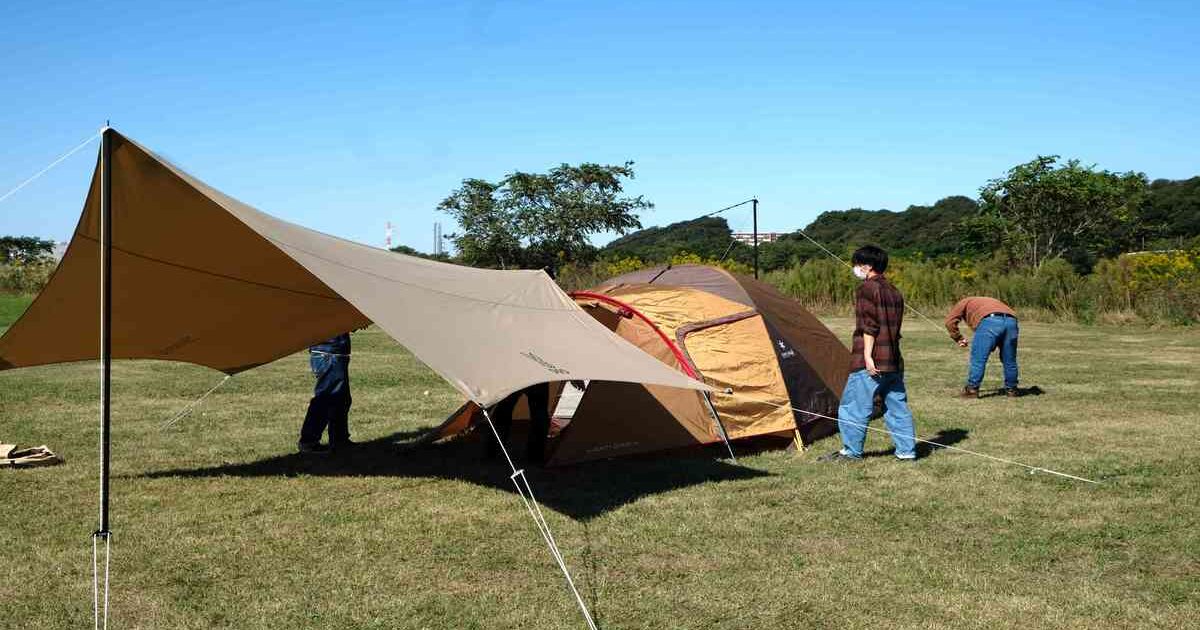
“ヘキサ”と”レクタ”ってどう違う?意外と知らないタープの基本と選び方 | タープ・シェルター 【BE-PAL】キャンプ、アウトドア、自然派生活の情報源ビーパル
代表的な2種類のタープと選び方のポイントをご紹介! キャンプといえば家族や友だちとお酒を飲み交わしながら、美味しい料理を食べるのが醍醐味。 そして、そんな団欒のひと時を過ごすのに必須といえるのがタープです。 しかし、ひとくちにタープといって
www.bepal.netThe Safest First Tarp
For a first tarp, the best overall pick is a mid-size hexa. The reason is straightforward: it balances shade area, setup ease, looks, and versatility across group sizes better than the other two. If you're mostly camping in groups of two to four, hexa rarely disappoints.
Part of what makes hexa forgiving is the shape itself. Most run on two main poles, and the silhouette comes together naturally. When you're still learning tarp rigging, getting a clean pitch quickly matters — you'll use the tarp more often if setup doesn't feel like a project. I was drawn to recta's flexibility early on, but in practice the tarp I reached for most was the hexa: quick to pitch, satisfying to look at.
Wing is a strong contender for small groups, but it's more specialized as a first tarp. For solo or duo use with a light kit, it's excellent — and for foot, bicycle, or motorcycle travel, it's arguably the best choice. The moment you add a table, spread out chairs, and want to keep gear in the shade too, wing fills up fast. It handles "one more person joined us" or "want to try it with the family" less graciously than hexa does.
Recta has real comfort advantages — especially for families or groups spending long stretches outdoors. If you need to get four chairs, a table, a cooler, and kids' bags all under cover, recta's extra margin is genuinely valuable. The catch is that it packs larger and feels more gear-intensive to set up than hexa. It's a great first tarp for people who are optimizing for practicality over convenience.
A quick sizing note: VISIONPEAKS lists their Fireplace TC Hexa Tarp 2 at roughly 460×435 cm (based on retailer pages). For any model you're considering, double-check the final specs on the manufacturer's official page before buying — dimensions and weight can vary between sales channels.
My practical takeaway: if you're undecided on a first tarp, a mid-size hexa for 2–4 people is the most broadly useful pick. Tight on payload? Go lightweight wing. Need maximum shade for four people with kids? Recta.
The Basics of Each Shape
Hexa: What It Does and What People Get Wrong
Hexa is, as the name suggests, a hexagonal-profile tarp. It's the mainstream choice among open tarps — most models pitch with two main poles, which makes it easy to get a clean silhouette even on your first try. It balances ease of setup with a polished look, and it functions naturally as a living space for two to four people.
The comfort here is better described as a good balance between openness and adequate shade rather than just "spacious." The tapered sides mean it doesn't use its full footprint as efficiently as a rectangle — you can't push usable area all the way to the corners. But that taper also means better sightlines and less of a closed-in feel when you're sitting in a chair. With three or four people, hexa often feels more spacious than its numbers suggest.
One thing people get wrong: "hexa is wind-resistant by design." Shape plays some role, but at the campsite level, pitch height and tension matter far more than geometry. On the same campground, pitching my hexa low versus high made a bigger difference than any shape comparison would. Pitch it tall for airflow and you get comfort — but crosswinds find more to push against. Drop it lower and it settles in. The lesson: hexa's real performance is defined by how you pitch it, not just what shape it is.
Versatility sits in the middle range. You can drop one side for afternoon sun, angle the guy lines to tighten the shadow — but you won't get recta-level layout flexibility. Hexa isn't the perfect answer for everything, but it holds its own across looks, airflow, and setup effort better than either of the other two shapes.
Recta: What It Does and What People Get Wrong
According to Snow Peak Store's comparisons, recta tends to outperform hexa on usable area within the same size class — though the specific dimensions and grommet placement of individual products affect the outcome. Take it as a general tendency rather than a universal rule.
On livability, recta's strongest point is practical floor space. Where hexa emphasizes openness, recta leans into building a real roof. It works well when the sun is directly overhead, and even as the light shifts later in the day, the layout options remain useful. The more people you have, the more that extra edge-to-edge coverage matters. If you're spending a full day at the site, the feeling of "I can use all of this" compounds.
A common misconception: "recta needs six poles." It's true that the classic configuration adds sub-poles to the four corners and along the sides beyond the two main poles in the center of the short edges. But pole count isn't a fixed requirement — with the right product and pitch method, two poles can work. The realistic framing is that recta tends to use more poles than hexa or wing, and that extra hardware also unlocks more configuration options.
The trade-off on openness is real, but recta compensates with configurability. You can drop one side to cut the afternoon sun, use sub-poles to build a partial wall, or adjust the opening based on wind direction. When I choose recta for a hot midsummer plateau, it's specifically because I can build dense shade. It may look more utilitarian than hexa, but seen as a tool for designing comfortable space, recta earns higher marks.
Wing: What It Does and Who It's For
Wing is a diamond-shaped tarp — the most packable and lightest of the three, and easiest to keep simple. It pairs naturally with solo and touring setups because it works with two poles and minimal accessories. If you're trying to shrink your kit, wing's efficiency is hard to beat.
The practical group size is 1–2 people. That's not a strict limit, but wing's appeal isn't spaciousness — it's that you can create usable shelter from the smallest possible kit. For foot travel or motorcycle camping, that directly translates to what fits on the bike or in the pack. At 360 g for some 290×290 cm ultralight models, a wing tarp can slide into a side pocket without a second thought.
The downside is that living space is the smallest of the three shapes. A chair or two and a small table fit comfortably, but once you spread out gear or add a second person's kit, the margins shrink. Shade depth is also limited — in strong late-afternoon sun the shadow doesn't reach as far as you might hope. Wing works well as a rest spot, but as an all-day living area for more than two people, it shows its limits.
Versatility is sufficient but intentionally narrow. Pitching is simple and forgiving, but it doesn't lend itself to the fine-grained space-building that recta enables. That clarity of purpose is actually part of wing's appeal. For solo, duo, touring, and day hikes, it's hard to beat. For family living space, it's not the tool for the job — wing trades spatial margin for lightness, and understanding that trade-off makes the choice feel right.
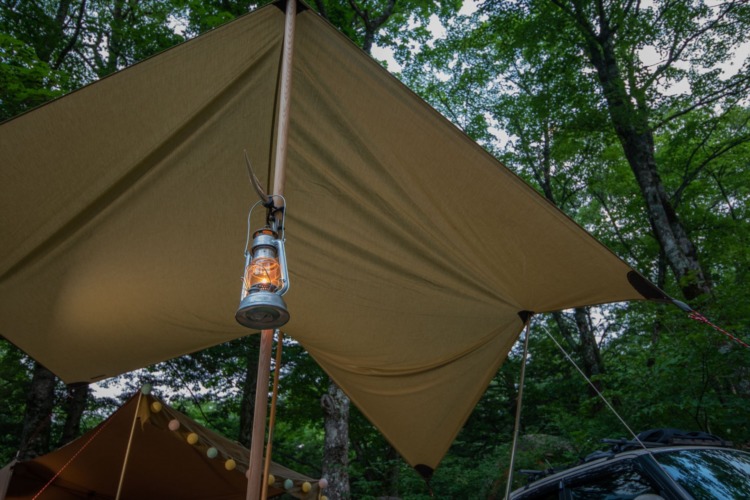
【全4種】タープの"種類"と"違い"徹底解説!レクタタープ、ヘキサタープは何が違う? - キャンプバルーン(CAMP BALLOON)
こんにちは、もめ(@momecamp0121)です! キャンプをしていると、一度は聞くであろう「タープ」。レク
campballoon.comFive Criteria for Choosing: Group Size, Transport, Setup, Weather, Site
Sizing by Group — and Why to Add a Buffer
Don't take manufacturer group ratings at face value. Size up by one to two people to get real-world comfort. Under a tarp you're fitting not just people, but a table, chairs, a cooler, and room to move. A hexa labeled "2–4 people" plays out very differently depending on whether you're eating lunch and leaving versus spending the afternoon with gear spread around.
A useful solo reference point is approximately 290×290 cm — large enough for a chair and small table without crowding, but not so big it feels like wasted space. At that size you have real shelter, not just a sunshade. Push the same footprint to two people and you'll be managing your layout carefully, with little margin left if weather rolls in.
For four to six people, a reference like 410×435 cm with ~240 cm height gives you something that functions as a proper living room. Families and groups should be looking at this range. But sizing to the exact headcount usually means you can sit but not spread out — a family of four is more comfortable under something rated for five or six.
Tarps differ from tents in a key way: the right size depends on how you're using the space, not just how many people are sitting in it. A quick lunch stop might work with something smaller. If you're set up from midday through evening and need to rearrange as the sun moves, size up. Building in that buffer makes the rest of the comparison easier.
Weight Limits by Transport Method
One of the easiest things to overlook in tarp shopping is how you're getting it there — before thinking about coverage area. A practical rule of thumb: under 1 kg for foot or bicycle travel, 1–2 kg for motorcycle touring, and over 3 kg belongs in a car.
For foot and bicycle travelers, crossing 1 kg starts to make the tarp feel like its own thing to manage. Some ultralight options hit around 360 g at 290×290 cm, and the realistic working range for "won't think twice about bringing it" tends to be 300–500 g. At that weight, tarp stops being a decision and just goes in the bag.
On a motorcycle, 1–2 kg is the upper end before payload balance gets complicated — keep within that and you can still carry rain gear and cooking supplies alongside the tarp. Large TC or heavyweight recta tarps can run several kilograms, which means rethinking the whole load.
Car camping relaxes the weight ceiling, but weight still has costs. A heavy tarp is more work to pitch and break down, and wet fabric gets dramatically heavier to handle. Some large shade-focused hexa tarps weigh around 8.2 kg — impressive shade, but the moment you pick it up, your use cases narrow sharply. Weight isn't just about whether it fits in the car — it's about whether one person can manage it on-site.
Pole and Guy Line Counts — and What They Mean for Setup
Setup ease is better understood by looking at number of components and how cleanly the guy lines organize than by shape name alone. Both hexa and wing tend toward two-pole setups that get you to a functional pitch quickly. Wing especially — with less fabric to manage, it's easier to position accurately, and for small groups setup can feel almost instant.
Hexa with two poles is also in the "easy" category, but as you go up in size, tension distribution becomes more important. The shape is simple, but loose guy lines lead to sagging shade or uneven sides. Even so, the combination of speed-to-functional-pitch and space efficiency makes hexa a reliable benchmark.
Recta tends to accumulate more guy lines and sub-poles, which increases setup time. As explained in CAMP HACK's recta coverage, the full configuration adds poles to the short-edge centers plus the four corners — and getting recta's full coverage working means more adjustment points. You can pitch a recta with just two poles, but getting the living area you paid for requires more steps.
That said, extra setup effort is the same thing as extra flexibility. Dropping one side, building a partial wall with a sub-pole, rotating the opening to track the wind direction — that's where recta shines. The honest framing is: if you want a quick pitch with good results, hexa or wing; if you want to shape the space to your needs, recta.
Weather and Material Choice
For rain, start by matching waterproofing ratings to actual use. Clear-weather-focused use can work fine at around 1,000 mm. Light rain or the occasional shower warrants 1,000–1,500 mm. If rain is a real planning factor, 1,500 mm or higher gives peace of mind. Keep in mind that tarps aren't closed structures — the rating is only part of the story. Whether you can drop a side or redirect rain runoff matters just as much.
Material comes down to TC (polycotton) versus polyester-based fabrics. TC delivers better shade quality — the fabric diffuses harsh overhead sun more effectively — and it's more appropriate around campfires. VISIONPEAKS' Fireplace TC Hexa Tarp 2 is a good example of a product built around fire-proximity use. The trade-offs: heavier, and waterproofing ratings tend to be lower than polyester equivalents.
Polyester fabrics are lighter, easier to achieve high waterproofing ratings with, and dry faster after rain. For foot travel, touring, or any trip where weather is uncertain, polyester's practical advantages add up. I reach for TC when shade is the top priority on a hot clear day — but for trips with movement or weather variability, poly tarps get used more often.
Wind resistance comes down less to shape than to not oversizing, pitching low, and anchoring solidly. For serious wind, forged tent pegs around 30 cm are the standard recommendation. A large tarp pitched high for openness creates a lot of sail area. If weather is a real concern, "bigger is better" is not the right rule. The material direction is straightforward: TC for shade, polyester for portability and rain handling.
Site Size and Setup Footprint
A useful reference calculation (based on field experience): (combined height of two poles) ÷ 1.414 + tarp length. Two 240 cm poles in a 45-degree pitch works out roughly like this: (240 + 240) ÷ 1.414 + 460 ≈ 800 cm — about 8 meters of depth.
This is a field estimate, not an engineering formula. Actual pitch style, rope routing, and site shape all shift the number. Use it as a starting point.
💡 Tip
On a 10×10 m pitch, a hexa with 240 cm poles was tighter than the math suggested. Once you account for car position, distance from the tent, and neighbor boundaries, the margin disappears faster than expected.
Looking at pitch types: large recta and oversized hexa tend to suit open/freeform sites; smaller hexa and wing work better on designated pitches. A 10 m square plot gets consumed quickly once you add a tent and mark off a driving path. Kawa-bari (close-coupling the tarp to the tent) is one way to tighten the layout, but the more constrained the site, the more a compact shape pays off from the start.
Getting this dimension logic sorted early ties together group size, transport capacity, and site type into one coherent decision. The gap between what a tarp looks like on paper and how it actually fits on your site becomes obvious the moment you factor in setup space.
Side-by-Side Comparison: Hexa, Recta, Wing
Reading through each shape individually is useful, but putting them in a table makes trade-offs easier to see at a glance. Hexa sits in the middle ground on coverage, looks, and ease. Recta is about floor area and spatial control. Wing is about weight and speed. When I'm narrowing down options, I start by eliminating whichever columns don't match how I actually camp.
| Criteria | Hexa | Recta | Wing |
|---|---|---|---|
| Basic shape | Hexagonal | Rectangular | Diamond |
| Effective shade area | Moderate | Wide | Smaller |
| Shade density | Middle of the road — material and pitch height matter more | Easy to cover a wide area solidly | Limited area, but shade is achievable within it |
| Setup ease | Relatively high | More steps involved | Easiest of the three |
| Typical pole count | 2 poles | 2 poles work, but sub-poles often added for full coverage | 2 poles |
| Packability / weight | Moderate | Large and heavy | Light and compact |
| Small group suitability | High | Low–moderate | Very high |
| Large group suitability | Moderate–high | Very high | Low |
| Rain runoff management | Requires angle adjustment | Easier to channel rain with side drops | Limited |
| Aesthetics | Stylish | Functional | Sharp and minimal |
| Versatility | Good | Very high | Limited but sufficient |
How to Read the Table
This comparison reflects shape-level tendencies across open tarps in the same size class. There's no standardized real-world test with identical materials and identical footprints — so what you're seeing here is design philosophy, not product rankings.
On shade area: same-size-class recta tends to give more usable coverage, and Snow Peak Store's comparison data supports that direction. My own experience confirms it — recta keeps the shadow connected as the sun moves, which becomes noticeable in midsummer afternoons. What looks like similar coverage before noon starts to diverge as the sun drops, and recta lets you avoid moving chairs to stay in the shade. [^l-size]
On weight and packability: shape is a tendency, not a rule. Some solo wing tarps hit 360 g at 290×290 cm, while a 4–6 person hexa can run around 5 kg. Wing is light because it's built small — not because diamond shapes are inherently lighter. The weight targets to keep in mind: under 1 kg for foot travel, 1–2 kg for touring. Exceed those and the transport experience changes noticeably.
How to Use This Table
The three columns that deserve the most attention first are group size, shade area, and packability. If you're one or two people with real payload limits, wing makes sense — two poles, compact pack, fast setup, and the setup and teardown experience directly adds to trip satisfaction. Solo with a need for actual sleeping-area shade: wing or small hexa.
For four-plus people prioritizing a proper living area, recta leads in the table — not just because it's bigger, but because the straight edges let you use space in a square configuration. Furniture and gear layout becomes predictable, and you can drop a side to manage rain direction. If the benchmark is "everyone stays in the shade as the sun moves," recta scores well.
Hexa lands in the middle — and in practice it's the hardest shape to go wrong with. It looks good, handles 2–4 people naturally, and the balance of coverage, pitch aesthetics, and setup burden works. It's my default on designated pitches, and the rope work settles naturally.
On wind: resist reading this table to pick "the wind-resistant shape." What you pitch and how high you pitch it matters far more than which shape it is. A large tarp pitched tall versus a mid-size pitched conservatively low — those produce radically different real-world results. Evaluate shapes together with pitch method, not instead of it.
Same logic applies to the rain column. Recta's advantage comes from having more fabric to drop and more area to work with — the waterproofing rating itself is a product-level spec, not a shape-level one. Read it as "recta makes it easier to direct rain runoff," not as an absolute quality ranking.
Aesthetics and versatility matter more to long-term satisfaction than they get credit for. Hexa finishes cleanly. Wing looks crisp and intentional. Recta reads as a serious piece of equipment. I don't dismiss visual preference when choosing something I'll use for years — how it feels to pitch is part of the reason you go camping at all.
[^l-size]: Source: Snow Peak Store (manufacturer blog) comparison within the same L-size class. Results depend on the specific product dimensions and grommet placement, so treat this as a directional example. For exact measurements, verify against official manufacturer specs.
Real-World Performance by Shape
Hexa: Practical Pros, Cons, and Best Use Cases
What hexa promises on paper, it tends to deliver in the field. For groups of two to four, it's my first consideration — fast to pitch, good-looking when done, manageable solo. Two poles get you to a working shape quickly, and the guy lines run cleanly enough that setup doesn't stall. Even without much experience, it's easy to visualize the finished pitch, and a slightly imperfect placement doesn't blow the aesthetics.
The visual satisfaction of hexa is genuine. Where recta cuts a clean rectangular block out of the sky, hexa has a curved edge that makes the whole campsite look composed the moment it goes up. BE-PAL consistently notes hexa for "good looks" and "easy setup," and in practice those two qualities reinforce each other — when the shape comes together quickly, the satisfaction of a "proper pitch" lands even after a short session.
Hexa also offers enough versatility for most real-world adjustments. Drop one main pole slightly for denser shade, drop one side to cut wind from a specific direction — small moves that change the experience without requiring a full re-rig. It's not recta-level flexibility, but for smaller groups, "a few things you can adjust" is usually plenty. And because the basic configuration isn't complicated, tweaking after setup doesn't feel like work.
The effective area has a ceiling, though. The center is comfortable, but toward the tapered edges, usable height and depth shrink. With low chairs that's fine, but as gear accumulates or the group grows, "less space than it looks" becomes a real feeling — something you only fully understand once you've tried it. Pitching it low makes the edges taper harder, which is good for weather but tighter for moving around.
Rain management in a hexa is more about angle than coverage. Even with adequate waterproofing, angled rain can enter from the sides if the pitch direction doesn't account for wind. Dropping one side and repositioning the table helps, but hexa isn't built to maximize covered perimeter the way recta is. For light-to-moderate rain it's fine; for serious wet-weather camping, it's not the primary tool.
Best suited for: anyone who wants both good looks and genuine practicality in groups of two to four. It works for solo camping, and it's forgiving enough as a family starter. On a designated pitch it fits without requiring complex layout planning, making it the most realistic all-around option for people balancing setup ease with real comfort.
Recta: Practical Pros, Cons, and Best Use Cases
Recta's power comes from something the numbers don't fully capture: the ability to cover a space in a square, usable way. Shade matters, but what really shows up at the campsite is layout flexibility. After putting down a table, chairs, and a cooler, recta still leaves space that works — traffic flow doesn't get compromised, and as the group grows, the extra margin keeps the dynamic from getting cramped. With four or more people, that gap is significant. Everyone sits in solid shade, and as the sun shifts you're adjusting pitch, not furniture.
Recta also handles rain logically. Its straight edges make it easy to drop one side and define a clear runoff direction. You can separate the eating area from gear storage and keep both relatively dry. A family situation where "nobody ends up getting dripped on" is the goal? Recta's margin makes that achievable in a way that smaller, curved-edge shapes can't match.
The setup is more involved, though. Getting a recta to deliver its full coverage means adding sub-poles and more guy lines — configurations with six poles aren't unusual, as CAMP HACK's recta guides illustrate. Two poles can work, but the full recta experience requires more steps. It's not impossible solo, but the gap between "pitched" and "pitched well" is wider than with hexa.
Designated pitches create constraints too. Large tarps need more total footprint than the tarp itself — guy lines eat into the surrounding area, and getting recta's four corners clean requires enough buffer from boundaries. A site that looks big enough on paper can get tight fast once the car, tent, and walking paths are factored in. Recta rewards having space to use its space. On tight pitches, its advantages can't fully express.
Weight and packed size are real factors. More fabric plus more poles means a heavier, bulkier kit. Car camping absorbs that cost easily enough. Tighter load-outs feel it. Setup and teardown are both more physical, and after a rainy night the wet recta weighs noticeably more than you'd want.
Best for: groups of four-plus building a real living area. Families and friends who want to line up chairs, eat together, and keep gear dry will find recta delivers where other shapes fall short. For smaller groups prioritizing mobility, the work-to-benefit ratio tilts in the wrong direction.
Wing: Practical Pros, Cons, and Best Use Cases
Wing is the lightest and most direct of the three. CAMP HACK describes it as lightweight, compact, and easy to pitch — ideal for solo and touring — and that assessment holds up. Two poles, less fabric, fewer decisions. If you're trying to minimize what you carry, wing fits the brief better than the other two. With ultralight 290×290 cm models approaching 360 g, and more practical options in the sub-1 kg range, wing can go on a motorcycle or into a hiking pack without disrupting the rest of the load.
The on-site advantage isn't just weight. Wing is fast to make a decision about. Fewer pitch options means less deliberation, and for one or two people who don't need much area, that speed pays off. A lunch break on a touring day or a one-night backcountry stop — wing's setup pace fits those contexts naturally. The clean minimalist look suits a light-packed site too.
The living space is genuinely limited, though. A chair or two and a small table fit, but bring two people's full gear and things get tight quickly. Shade depth is shallower — in strong low-angle afternoon sun, the shadow may not reach as far as you expect. Wing functions excellently as a rest station; as a full-day living area for more than two people, its constraints show up clearly.
Rain and wind are where wing requires realistic expectations. On a windy evening I've re-pitched a wing lower and eaten dinner without issue — but lower means more cramped. Wing can't build up lateral protection the way recta can, so staying comfortable while staying sheltered isn't always both at once. It handles minimum-viable shelter well but isn't designed to build a defended perimeter.
Best for: solo or duo camping where payload and setup time are the priorities. Motorcycle touring in particular is a natural match — less kit, real shade. For family-style all-day use, wing's lightweight efficiency becomes spatial inadequacy.
Choosing by Weather: Clear Days, Midsummer, Light Rain, Wind
Clear Days and Midsummer Heat
In summer heat, the primary question is how much dense shade you can build, and over how large an area. By shape: recta provides the most, followed by large hexa, with wing as a minimal rest-stop option. Four-plus people spending the day outside benefit most from recta's "cover the whole rectangle" approach. For two to four people, a mid-to-large hexa handles it without becoming hard to manage. Solo or small-group with mobility as a factor: wing.
Material becomes relevant here: TC and polycotton fabrics filter harsh sun better than polyester. The shade under TC feels cooler, not just darker. The trade-off is weight and lower waterproofing ratings in most products — so "best summer shade" and "best rain shield" aren't always the same piece of gear. I reach for TC on high-altitude summer plateaus, but I'm always aware that the comfort happens after setup, and at the transport stage it's clearly a car-camping choice.
Weight targets hold regardless of season. Foot or bicycle: under 1 kg is the realistic ceiling. Some 290×290 cm ultralight models hit 360 g — those are outliers, but the 300–500 g range is genuinely "grab it without thinking twice." Motorcycle touring: 1–2 kg. A large hexa for four to six people: around 5 kg. Shade-optimized large models: up to ~8.2 kg. Those numbers feel abstract until you're hauling one on a hot afternoon — then the weight becomes very concrete, and the use cases narrow sharply.
Site compatibility in summer: oversizing for shade can mean fewer sites that actually fit. A large recta makes total sense for a family summer trip, but on a designated pitch with a car, a tent, and a walkway, the footprint gets tight fast. For two to four people mainly using designated pitches, a mid-size hexa has a higher success rate overall.
Light Rain and Heavy Downpours
Rain planning starts with a clear threshold. Light use with occasional showers: 1,000–1,500 mm waterproofing. Planning around rain: 1,500 mm or higher. As a tarp, there's no door to close — pitch direction and whether you can drop a side matter as much as the rating number.
For rain runoff, recta is the most logical shape. Its straight edges drop cleanly on one side, creating a defined flow path. Separating the eating area from gear storage and channeling water away from both is straightforward. Hexa can handle rain fine, but keeping a clean rectangular dry zone requires more active adjustment.
In heavier rain, extra size margin helps more than shape. Two people under a 2–4 person hexa have room to push gear to the back and stay dry. Four-plus people get cleaner results under recta — chairs, cooler, and bags all stay covered without forcing anyone to the edge. Wing for an extended rainy stay? The margin runs out before the weather does.
On designated pitches, rain makes layout even more important than square footage. The shorter the walk from tent to tarp, the drier you stay. I've found on autumn pitches that a slightly smaller tarp positioned close to the tent works better than a bigger one set apart. Rain comfort comes from not getting wet on transitions, not just from having a large covered area.
Windy Days
Wind is where shape-based generalizations break down most clearly. Hexa isn't always safer, recta isn't always worse — the real variables are tarp size, pitch height, and how well you align the pitch with the wind direction. A large tarp pitched high catches more wind regardless of shape; a mid-size pitched conservatively low settles in regardless of shape.
The practical response is consistent: pitch low overall, drop the windward side. Beyond that, increase guy line count to distribute tension evenly, and use shorter, stiffer anchors on the main load points. For family-size and large tarps, main poles around 30 mm diameter are a reasonable baseline; stepping up to 35 mm adds margin if wind is a real concern.
Tent pegs matter more on windy days than on calm ones. Forged tent pegs/stakes 30 cm or longer on the main anchors give meaningfully better holding power than standard stakes. I've swapped out standard pegs for 30 cm forged stakes on days with forecast gusts — and I've also made the call to just pack it in, because the right answer sometimes isn't a better anchor.
💡 Tip
There's no official wind threshold for "too windy for a tarp," but real-world experience suggests families and large tarps should err toward earlier takedown. The question isn't just whether you can get it up — it's whether you can bring it down safely if conditions deteriorate.
On designated pitches, wind direction isn't negotiable the way it is on open sites. Car position and boundary lines define where the tarp can go. In those conditions, mid-size hexa or small wing often works better than oversized recta. When wind is a factor and pitch space is fixed, a "good enough but manageable" size tends to outperform "maximum coverage but hard to control."
When to Use Kawa-bari (Tarp-to-Tent Connection Pitch)
The kawa-bari method — where you rig the tarp to overlap with the tent entrance — works because it shortens the gap between tent and covered space. You can get the tarp to within arm's reach of the tent door, which makes a real difference in light rain or drizzle. On designated pitches it's also space-efficient, keeping the combined footprint tighter than two independent setups.
It works best for hexa tarps sized for two to four people when rain is the primary concern, or for using recta more efficiently on a constrained pitch. The tent entrance and tarp floor become connected zones — eating, gear management, and entry/exit all happen within one continuous sheltered run.
The weakness is equally clear: bringing the tarp close to the tent reduces the wind buffer between them, which hurts wind resistance. The pitch angles that work well for rain proximity tend to expose more surface to crosswind. Kawa-bari handles rain well and wind less so. I treat it as a rain-priority configuration — and on days where wind is unpredictable, I go back to a standard independent pitch instead.
Situational guide: clear day, openness priority → standard pitch; midsummer heat → large recta or hexa with extra coverage; rain on a designated pitch → kawa-bari; wind concern → pitch low and independent. Kawa-bari is a useful method, but it's a rain-flow optimization that trades wind clearance, not a universal upgrade.
By Camping Style: Solo, Duo, Family, Touring
Solo: Wing vs. Small Hexa
For solo use, wing is the first option to consider, followed by small hexa. The decision comes down to two questions: how much do you need to trim payload, and how much living space do you actually want? Weight and setup speed at the top? Wing. A bit more shade and easier gear placement? Small hexa.
A useful size reference for solo: approximately 290×290 cm. At that scale, a chair, a small table, and your personal gear fit under the tarp comfortably without feeling squeezed, and you still have pitch angle options. It's the "not too tight, not wasted" zone for solo. If you're building a living space in front of a solo tent, small hexa tends to be easier to position than a wing.
For foot travel or cycling, weight tolerance is strict. The guideline: under 1 kg for foot/bicycle, 1–2 kg for motorcycle. Ultralight nylon wing tarps in the 360 g range (like some 290×290 cm models) fit into a pack corner without disrupting the rest of the load — the difference in daily carrying feel is real. That kind of weight just disappears into the bag.
I've found that a 1.2 kg wing fits easily in a motorcycle side bag with room to spare, and the psychological load of "do I bother bringing it today" just doesn't exist at that weight. That's not an exaggeration — at lighter weights, the decision to bring the tarp is automatic. Conversely, for solo camping by car, stepping up to a small hexa is usually worth it. More usable space, more layout options, and a more satisfying result when you're not constrained by payload.
Duo: Why Mid-Size Hexa Is the Right Call
For two people, mid-size hexa has the fewest failure modes. Wing starts to feel tight when food, gear, and two people's stuff compete for space. Recta is appealing in coverage but steps up the setup and transport burden. Hexa finds the middle — two chairs, a table, a cooler, and the layout still breathes. More usable than its footprint suggests.
For duo camping, what matters isn't just "can two people sit here" but "can two people's full kit fit and still move around." Mid-size hexa handles that naturally — the center is tall enough, the taper toward the sides is gradual enough, and the chair zone separates cleanly from the storage zone. Setup runs on two poles with straightforward guy lines, so you're not spending time optimizing when you could be relaxing. On a paired trip, saving setup time translates directly to enjoying the site.
The shape also suits the most common use contexts. On a designated pitch, mid-size hexa fits without dominating the entire footprint. In clear weather it's open and airy; when a shower comes in, dropping one side is quick. "Spacious enough, packable enough, set up fast enough" is a harder combination to achieve than it sounds, and hexa hits it.
Family Camping: Recta or Large Hexa, and Pole Diameter
For family camping, start with recta or large hexa. The deciding factor is whether priority goes to coverage area or ease of setup. If the goal is getting chairs, table, cooler, and bags fully under cover — recta. If you want a bit more setup simplicity at similar scale — large hexa.
With families, it's not the adult headcount but the gear volume that fills up covered space. Kids mean extra chairs in and out, bags at the edges, and constant movement. Four people can exhaust a four-person-rated footprint quickly. The practical answer: target a rating one step above your actual group — a family of four lives more comfortably under something rated for five or six.
At this size range, pole diameter becomes relevant. As a general guideline, 30 mm diameter mains are a standard baseline; 35 mm poles offer more confidence on larger tarps or in windier conditions. Thinner poles aren't non-functional, but larger fabric creates more flex loading — and with a family setup where stability is a comfort factor, pole stiffness shows up in feel. I notice pole flex on large tarps before I notice fabric quality.
For recta at full coverage, sub-poles are part of the equation. Large hexa benefits from stiffer mains to hold the tension. When chairs and a table are semi-permanently placed underneath, the standard is "does the space feel settled" — and achieving that requires a thoughtful pole setup, not just a pitched tarp.
Touring and Foot Travel: Prioritizing Weight and Packed Size
For motorcycle touring and foot camping, shape preference gives way to weight and packed dimensions first. Portability is the dominant variable. A tarp can be featherlight but packed long, and that shape won't fit where you need it. Motorcycle panniers, seat bags, and backpacks have specific physical constraints — height, width, and especially length.
The weight targets: under 1 kg for foot/bicycle, 1–2 kg for motorcycle. But the easy miss is packed diameter and length. Some large tarps pack to around φ18×72 cm — at that size, load planning gets complicated fast. Compact models pack to much shorter, narrower rolls, and that difference in how they fit around other gear is significant.
For motorcycles specifically, length is the binding constraint. A tarp or poles that are too long reduce carrying options sharply. Even if the weight is right, something that sticks out or requires its own dedicated space creates ongoing problems — getting it out, putting it back, dealing with it on a damp morning. For touring, the right question isn't "how heavy is the tarp alone" but "where does the whole system — tarp plus poles — actually fit in my load." A φ18×72 cm packed size is on the large end and will compete for interior space in panniers or a backpack.
Pre-Purchase Checklist
What to Check Before Buying
The things most often overlooked at purchase time aren't the tarp itself — they're the accessories and setup requirements. Beginners especially may assume that buying a tarp means being ready to pitch, but some products sell poles, tent pegs/stakes, and guy lines separately. Confirming what's included before buying saves real frustration at the campsite. See also the tarp sizing and setup guides on this site for related rain prep and fit considerations.
For transport, evaluate weight and packed size separately. Light but long packs poorly on a motorcycle. Slightly heavier but compact packs well and handles easily. The same targets apply: under 1 kg for foot/bicycle, 1–2 kg for touring, larger models for car camping. Solo-oriented sizes like 290×290 cm can be genuinely light, while family-class tarps step up meaningfully in both weight and pack volume.
Loop and grommet count is easy to overlook in spec sheets but matters in the field. Fewer anchor points means fewer ways to adjust pitch direction, redirect runoff, or add guy lines. Shape alone doesn't determine how adaptable a tarp is — this "where can forces be redirected" question often determines real-world versatility.
For campfire use: TC fabric resists embers better than polyester, but that doesn't make it fireproof. VISIONPEAKS' Fireplace TC Hexa Tarp 2 is specifically designed for fire-adjacent use, but "fire-resistant" still means keeping distance. At purchase, the question isn't "can I pitch this right over the fire?" — it's "can I lay out the campsite so there's enough clearance, and is this shape suited to that layout?" That framing prevents the most common campfire tarp mistakes.
On site compatibility: total required footprint, not just tarp dimensions. The reference formula: (combined pole height) ÷ 1.414 + tarp length gives you setup depth in the pole direction. Two 240 cm poles consume guy line length before and behind the tarp. A large hexa that seems to fit a site on paper can become crowded once guy lines are staked out in all directions.
Group size ratings deserve healthy skepticism. A "4-person" tarp is most comfortable for 2–3 people in real use. Once you add a table, chairs, a cooler, bins, and kids moving around, the labeled capacity fills up before the space does. The real question is whether you can move through the space with full gear — that's the comfort threshold, not rated headcount.
Wind prep extends to tent pegs/stakes. If strong wind is possible, the starting point is 30 cm+ forged tent pegs/stakes on main anchor points — standard-issue lightweight stakes aren't designed to hold large tarps in a gust. At this point the stakes often matter more than the tarp. And it's worth being honest: sometimes the right answer is not pitching at all. Building that option into your planning from the start keeps you from buying around the wrong problem.
Pre-purchase checklist:
- Poles, tent pegs/stakes, and guy lines: included or sold separately? If separate, how many of each?
- Waterproofing rating: matched to fair-weather use, or does it account for actual rain?
- Body weight: appropriate for your transport method?
- Packed size, especially packed length: fits within your carry method?
- Loop and grommet count: enough to support the pitch adjustments you want?
- Can the layout accommodate adequate clearance from a campfire if needed?
- Required setup footprint: fits within your target site dimensions?
- Does the rated capacity allow 1–2 person margin for real-world comfort?
- Are 30 cm+ forged tent pegs/stakes part of the plan for windy conditions?

【図解付き】風に強いタープの張り方3つのポイントと15のコツ【完全解説】
タープの最大の弱点は『風に弱い』こと。 風の影響を受けやすい海辺をはじめ、その他の場所でも強風時にタープを張るのは、自分だけでなく他のキャンパーをも巻き込んだ事故の元となる可能性もあり危険なもの。 とはいえ、「風が強くてもタープを張り
waq-online.comDecision Flowchart for When You're Stuck
Rather than leading with shape preference, lock in use conditions first — the shape choice follows naturally. The order that works: group size, then transport method, then site type, then typical weather. This sequence catches mismatches like "looks great but too heavy for how I travel" or "big enough, but won't fit the pitch I usually use."
- Set your primary group size
Solo → wing or small hexa. Duo → mid-size hexa. Four-ish people → recta or large hexa. The key here is gear-inclusive headcount, not just seated people.
- Set your weight ceiling based on transport
Foot or bicycle: 1 kg or under. Motorcycle: 1–2 kg. Car: large tarps in play. Models that don't fit this range drop out early and firmly.
- Identify your primary site type
Mainly designated pitches → smaller hexa or wing work better. Mainly open/freeform sites → large hexa or recta are feasible. Oversizing for designated pitch use just limits your layout options.
- Assess your weather mix
Mostly clear → lean toward lighter and simpler. Rain or intense heat expected → weight waterproofing and shade area more heavily. Midsummer family trips make shade area more valuable than setup ease.
- Narrow to one or two shapes
By this point you'll usually land in "wing or small hexa," "mid-size hexa," or "recta or large hexa." From there, compare accessories, packed size, loop count, and campfire clearance.
The short version: solo with weight priority → wing; two people wanting versatility → hexa; four-plus people wanting coverage → recta. But anyone using designated pitches regularly needs to overlay "will it actually fit" on top of that. Big tarps look compelling on spec sheets; on constrained sites, the required footprint shows up before the comfort does.
A weather and safety branch is also worth having: if strong wind is forecast and forged tent pegs/stakes still feel uncertain, the right answer is not pitching. Building that decision point into your mental framework before you buy prevents overselling yourself on wind resistance specs.
Summary
Hexa is balance, recta is area and practicality, wing is weight above all else. Once that framing is in place, the choice simplifies considerably. The starting point isn't shape — it's group size, transport, setup complexity, weather, and site type, in that order. Working through those five criteria is what made tarp shopping feel tractable for me.
For designated pitches with a family: recta. High-altitude midsummer camping: recta or large hexa. Uncertain wind: pitch low or skip the tarp that day. Ultralight or touring: lean toward wing. This article's framework draws on multiple sources and real campsite experience rather than spec-sheet comparison alone. Before committing to a specific model, confirm the final specs on the manufacturer's official page — details that affect your decision can differ between the article and the current product listing.
Related Articles
The Complete Guide to Choosing a Tent
Before hunting for popular models, understanding tent shapes, materials, and sizing will save you from costly mistakes. Whether you're buying your first tent, deciding between solo and family setups, or rethinking rain and wind protection, this guide lays out the criteria that actually matter.
Best Solo Tents Compared: How to Pick the Right One
Choosing a solo tent is never as simple as going with the lightest option. Weight, ease of setup, livability, waterproofing, and vestibule usability all factor in — skip any of them, and buyer's remorse hits fast. This article covers
How to Choose a Family Tent: A Practical Buying Guide
Picking a family tent based on looks or popularity alone often leads to regret -- it felt smaller than expected, or rainy days were miserable. This guide is for families buying their first tent or outgrowing their current one.
How to Choose an Easy-Setup Tent: A Structure-by-Structure Comparison
Picking a tent based on 'looks easy to set up' or 'I like the style' tends to backfire the moment rain or wind hits on your first overnight. This guide breaks down instant, pop-up, dome, and single-pole designs by real-world usability and overnight performance for first-time buyers and anyone tired of regrettin