
Best Low Camping Chairs in 2024 — 8 Options Compared Across 6 Key Axes
Best Low Camping Chairs in 2024 — 8 Options Compared Across 6 Key Axes
Pick the wrong chair for a low-style camp setup and suddenly the campfire feels close but standing up becomes a chore, and your morning coffee turns into a back workout. This guide breaks down low camping chairs across 6 axes — seat height, posture and recline angle, ease of standing, storage design, weight and packed size, and fabric fire resistance — comparing 8 models as if you could try them all side by side.
Pick the wrong chair for a low-style camp setup and suddenly the campfire feels close but standing up becomes a chore, and your morning coffee turns into a back workout. This guide breaks down low camping chairs across 6 key axes — seat height, posture and recline angle, ease of standing, storage design, weight and packed size, and fabric fire resistance — comparing 8 models as if you could try them all side by side.
Once you understand the differences within the 20–35 cm (~8–14 in) seat height band — 30 cm and up works better for meals and standing, under 20 cm is better when relaxation and campfire time are the priority — the decision gets a lot cleaner. Start from your existing low table height, then work through whether you want campfire focus or easy mobility, and you'll be able to pick the right chair for your body and your style of camping.
What Makes a Low Camp Chair Different? 6 Decision Axes to Know First
A low camp chair is simply a camping chair with a low seat, but the character changes significantly depending on where it lands in the roughly 20–35 cm band. Around 30 cm tends to be the commonly cited benchmark — above that the chair leans toward meals and mobility, below it leans toward deep relaxation by the fire. Personally, I rotate between seat heights of 28, 30, and 33 cm at a 40 cm low table, and even a few centimeters makes a real difference. At 28 cm, stretching my legs out near the fire feels great. At 33 cm, breakfast prep and using a cutting board become noticeably easier.
How Seat Height Affects Posture and Standing Ease
Looking at height bands: 30 cm and above is easier for standing up and suits meals and tasks. Sites like mybest and hinata categorize chairs above 30 cm as relatively easy to get out of. If you're constantly getting up to pour coffee, check the pot, or grab a condiment, that height difference really matters. Without sinking too deep, the area around your dining setup stays fluid.
On the other end, chairs under 20 cm are firmly in the relaxation camp. Your eye line naturally aligns with the fire grill, adding wood feels natural, and the happiness factor during fire-watching goes way up. The flip side is that your knees bend more sharply, and standing requires a bit of a reset. Rather than an eating chair, this height is more about shifting your center of gravity toward a slow evening by the fire after dinner.
Seat height also makes more sense when you look at it against your table. In general furniture theory, an ideal height differential for someone 170 cm (~5'7") tall is about 31 cm. For a 40 cm low table, that works out to a 9 cm seat height — but that's applying indoor furniture math to an outdoor context. In practice, it's more useful to ask which seat height between 28–33 cm works best against your 40 cm table rather than hitting a precise differential. At 28 cm, the gap is 12 cm — noticeably low, leading to more forward lean for soups or cutting work. At 30 cm, you're in a comfortable middle ground for both eating and the fire. At 33 cm, reaching for dishes and handling utensils becomes significantly easier. If you're pairing with a low table, 30 cm and up starts to work well as a dining surface for anything other than a dedicated fire-watching chair.
Posture is something to consider alongside height. A shallower, more upright angle keeps your pelvis level — better for eating. A deeply reclined back rest tilts your head up, which feels great for staring at flames or stars but makes table work awkward. Backrest height also plays a role: support reaching the shoulder blades stabilizes your dining posture, while headrest-level support adds to rest-time satisfaction.

【徹底比較】ローチェアのおすすめ人気ランキング【キャンプ・アウトドアに!】
座面が低く設計されたローチェア。ロースタイルチェア・低いキャンプ椅子とも呼ばれ、焚き火を囲むキャンプなどゆったりくつろぎたいアウトドアシーンで活躍します。軽量でコンパクトなものが多く、持ち運びにも便利です。しかし、商品によって組み立て方式・
my-best.comHow Chair Structure Affects Your Experience
Low camp chairs generally fall into three structural types: scissor-style (convergent), fold-flat, and assembly. Comfort and portability form a clear tradeoff depending on which you choose.
Scissor-style chairs open and close with a familiar flap motion. Setup is fast, and the moment you sit down there's a reassuring solidity to them. The fabric tends to have good tension and a nice wrap-around feel, making them approachable for beginners. Fold-flat designs share similar strengths — the rigid frame lends stability, which works well for meals and social time. If you're car camping and prioritizing comfort, these types deliver.
Assembly chairs, where you build a pole frame and attach the seat fabric, earn their keep through compact packed size. For hikers, cyclists, or anyone traveling light, that difference is significant — it helps the whole pack come together more cleanly. The tradeoff is that the narrower frame and seat tension can feel a bit less confidence-inspiring when getting in and out. Think of it as a slightly more active sit in exchange for the weight savings.
Concretely: the Coleman Compact Folding Chair weighs about 2.1 kg (~4.6 lbs), has a seat height of roughly 28 cm, and packs to about 54×8.5×55.5 cm — fold-flat convenience in a nutshell. The Snow Peak Low Chair 30 sits at 30 cm and is widely known as the reference point for a properly supportive low chair. Comparing classics like these shows the split clearly: do you want easy setup and solid stability, or minimal packed size?
Ground compatibility also ties back to structure. On soft ground, a wider base footprint keeps you from sinking; by contrast, thin four-point legs can dig into soft turf and create an uneven sit where you notice the tilt. The full character of a chair goes right down to how its feet meet the ground.
Weight, Packed Size, and the Real Math on Portability
If mobility matters, weight is a practical filter. 2.5 kg (~5.5 lbs) is a commonly used threshold in outdoor media, and it's where the number starts to matter for hiking, cycling, or train travel. When a single chair tips into the 3 kg range, combined with a cooler and fire grill it can shift the whole load dramatically.
For car camping, though, that calculation shifts. On cooking-heavy trips, I consistently find myself reaching for a chair with better seat tension and easier standup mechanics even if it's heavier. When you're cutting ingredients, checking the pan, and plating food, a chair that lets you get up and sit back down without effort is worth more than the weight savings. There are chairs I bring specifically because they're worth it despite the heft.
Packed size comes down to both length and thickness for real-world car loading. Fold-flat chairs tend to pack thin and long; assembly chairs tend to pack short and bulkier. Think through your actual cargo space and which geometry fits better.
Load capacity is another axis that's easy to overlook. Around 80 kg (~175 lbs) as a general minimum, with 100 kg (~220 lbs) feeling more comfortable for adults, gives you a useful filter. Beyond the number itself, the solidity of the frame and seat tension shape your confidence in the chair. The Snow Peak Low Chair 30 is rated to 100 kg, while the Coleman Compact Folding Chair is rated around 80 kg. That reassurance comes not just from body weight alone — it's also whether the frame stays true when you lean back, and whether the armrests and backrest can absorb some of that load. For anyone who wants to genuinely relax back by the fire, this stiffness matters.
Fabric and Fire Resistance
If campfire time is a big part of your camping, fabric choice matters more than it might look. Cotton, poly-cotton blends, inherently flame-resistant fabrics, and flame-retardant-treated synthetics are all more resistant to embers than standard polyester or mesh. Embers travel further than you'd expect, and the fabric difference translates directly to your odds of burned holes.
That said, fire-resistant doesn't mean fireproof. Even campfire-appropriate fabrics will degrade with prolonged heat exposure. The right framing is "harder to ignite" rather than "won't burn" — and that mindset leads to better decisions than over-relying on the fabric name. The value of choosing fire-resistant materials is real; over-confidence in them is the thing to avoid.
Flame-resistant and flame-retardant are also not the same thing. The first refers to the inherent property of the material; the second describes a post-process treatment that slows flame spread. I won't go deep into technical standards here, but for chair selection, noticing whether it's an inherent material property or an applied treatment is a useful lens. Cotton and poly-cotton work well if you're fully optimizing for fire, while synthetics have the edge in weight and drying speed.
Seasonal fit is clear too. Mesh is genuinely comfortable in summer — the airflow is real. But in cold weather, it pulls heat from your back and thighs, and managing warmth becomes a bigger part of the experience. Honda's outdoor guides note the same tradeoff: mesh excels in breathability but can feel cold in lower temperatures. For extended autumn or winter fire sessions, a solid woven fabric does a much better job of holding body heat, which adds meaningfully to evening satisfaction. In peak summer or by the river, though, mesh's ventilation is the real deal.
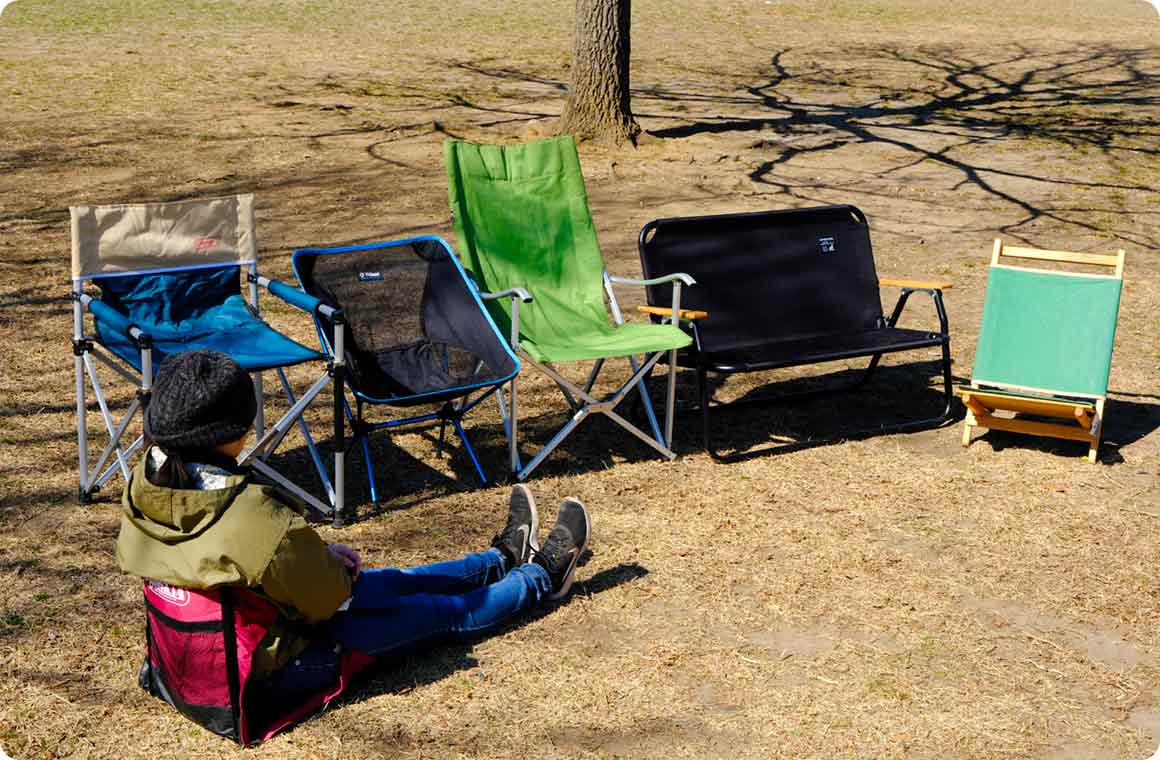
高さ・背もたれ・素材、キャンプ用チェアのスタイル別の特徴|Hondaキャンプ
1日中アウトドアで過ごすキャンプでは座り心地のいいチェアがほしいもの。座面の高さや座面の張りによってくつろぎ度が異なりますし、組み立て・撤収の手間も考慮すべきポイントとなります。スタイル別にチェアの特徴をまとめてみました。
www.honda.co.jpHow Backrest Height and Armrests Shape Comfort
Backrest height heavily influences the feel of a chair. A lower backrest frees up the shoulders, makes it easy to lean forward, and suits eating and task work. Reaching across the table for plating or passing dishes feels natural, which matters more than you'd think during a cook-heavy camp meal. A taller backrest, on the other hand, wraps the upper body in a way that makes fire-watching deeply satisfying. The enveloping feel reduces fatigue over long sits and helps with posture stability.
Recline angle is another piece. A slightly upright angle that keeps your pelvis level suits breakfast, coffee, and light cooking assistance. A deeply reclined angle is perfect for unwinding after dinner — but leaning forward to grab a bowl or check the pot becomes noticeably harder. With low chairs in particular, thinking about which time of day you'll use it most rather than just "it's comfortable when seated" leads to more consistently satisfying setups.
The presence or absence of armrests makes a tangible difference. Armrests give you a push point when standing, and make shifting between postures easier. On a chair around 30 cm, having armrests makes the transition from eating to relaxing feel completely natural. Wooden armrests add a visual warmth that's hard to quantify — the feel of wood under your hands just sits differently, and it helps pull a site's aesthetic together. The trade-off is that armrests add some bulk and weight in storage, which puts them at odds with ultra-light-focused builds.
Dining comfort, fire-session depth, and ease of standing — none of these is determined by seat height alone. Together with backrest height, recline angle, and armrest presence, they form the complete picture. What makes low-style camping genuinely comfortable isn't the low seat itself — it's whether the shape of the chair matches the shape of your day.
Side-by-Side: Top 8 Low Camp Chairs
Numbers alone don't tell the full story with low camp chairs — how the angle feels when you sit down and how the legs connect with the ground shape the experience just as much. On grass you might barely notice a difference in leg geometry, but move to sand and some chairs will have the front legs sinking enough to push your pelvis backward, while wider-footprint models need far fewer adjustments. Below, I use confirmed specs where available and fill in unclear details with practical observations on how each chair tends to feel.
These 8 picks cover clear territory: chairs around 30 cm for comfortable eating, lower seats for deep campfire immersion, adjustable designs for one-chair versatility, and flame-resistant options for serious fire time. The 30 cm threshold for standability is well-established — sorting by fire focus vs. meal focus makes the choice much simpler.
Here's the side-by-side overview of confirmed specs.
| Brand | Model | Seat Height | Weight | Packed Size | Load Capacity | Type | Fire Resistance | Ease of Standing | Best For |
|---|---|---|---|---|---|---|---|---|---|
| Snow Peak | Low Chair 30 | 30 cm | — | — | 100 kg | Fold-flat | Medium–High | Good | Auto camping, meals, campfire balance |
| Coleman | Compact Folding Chair | ~28 cm | ~2.1 kg | ~54×8.5×55.5 cm | ~80 kg | Fold-flat | Medium | Medium | Day trips, solo, family backup seat |
| Helinox | Ground Chair | — | — | — | — | Assembly | High | Lower end | Solo, portability-focused, campfire |
| DOD | Sugoi-su | — | — | — | — | Adjustable | Medium–High | Good | One chair for both meals and fire |
| Onway | Comfort Low Chair Plus | — | — | — | — | Fold-flat | Medium–High | Good | Comfort-focused, aesthetic-driven setups |
| WAQ | Folding Wood Chair | — | — | — | — | Fold-flat | Medium–High | Medium–Good | Wood-arm aesthetic with camping comfort |
| QUICKCAMP | Single Low Chair | — | 2.2 kg | 53×9×56 cm | 80 kg | Fold-flat | Medium | Medium | Price-to-performance balance |
| Flame-resistant types | Campfire Chair | — | — | — | — | Scissor/fold | High | Depends on model | Campfire time above all else |
Even from the models with confirmed specs, the differences are clear. Snow Peak Low Chair 30's 30 cm seat height and 100 kg load capacity give it a strong case for anyone who values standability and security. Coleman Compact Folding Chair at ~2.1 kg wins on grab-and-go ease. QUICKCAMP Single Low Chair at 2.2 kg, 53×9×56 cm packed, 80 kg capacity is the balanced utility pick — solid all around, nothing missing.
Ground conditions matter here too. Fold-flat chairs tend to flex across the whole frame, which works well on grass. But an assembly-style low-seat model on sand will have its leg tips sinking and directly changing how the chair feels — same "low chair" category, noticeably different sense of security. For kids, the lower seat is approachable, but once you factor in eating ease and standability, chairs around 30 cm have the edge.
Snow Peak Low Chair 30
The Snow Peak Low Chair 30 earns its reputation as a low chair benchmark through the immediate reassurance you feel the moment you sit down. Confirmed specs: 30 cm seat height, 100 kg load capacity. It preserves the relaxed feel of a low style while staying clear of the height where standing becomes a project. When you want to eat and watch the fire from the same chair, that 30 cm is genuinely practical — it keeps the friction down throughout the day.
The seat angle leans slightly toward cradling your hips, which makes it well-suited for long fire-watching sessions. On grass it holds steady, and on sand it doesn't inspire the kind of forward-topple anxiety some chairs do. The armrests double as push-off points when standing, making the constant cycle of sitting, serving, and standing during a meal feel smooth even for first-timers. Best for auto campers who want a chair that is the centerpiece of relaxation at the site.
Coleman Compact Folding Chair
At ~2.1 kg, ~28 cm seat height, ~54×8.5×55.5 cm packed, and ~80 kg load capacity, the Coleman Compact Folding Chair hits a balanced sweet spot. It falls just short of 30 cm but doesn't sink low enough to feel like you're falling in — it occupies a useful middle ground for both eating and resting.
What makes this chair enjoyable is the combination of effortlessness and utility. It's fold-flat, so there's no assembly learning curve — pull it from the car and you're seated. The thin profile also makes it easier to slip into gaps in your cargo, so it doesn't break your setup rhythm. It won't match the Low Chair 30 in presence, but for day trips or park outings, the lightness earns its keep.
The sit itself is more front-back agile than wrapping. You can lean forward easily for plating, then lean back to rest — the transitions feel natural. On grass it behaves well; on sand the thin legs will sink a bit, which is expected at this weight class, but the non-extreme seat height keeps recovery easy. Works well as a family backup chair too, with a height that's manageable for kids without feeling scary.
Helinox Ground Chair
Among these 8, the Helinox Ground Chair is the one to watch if you're optimizing purely for low-and-relaxed. The seat sits lower than typical low chairs, and the design weighs in at around 960 g (~2.1 lbs) with a 145 kg load capacity — remarkably light for its strength. Assembly-style build, aimed squarely at those prioritizing portability.
An extra-low chair places your eye line naturally at fire level, and adding wood to the fire grill just feels intuitive. The cocoon-like feel is real, but ease of standing is clearly lower than fold-flat chairs at 30 cm. This chair belongs to campfire sessions, scenic views, and chair-centric outings — not dining or high-activity days.
On grass, the low center of gravity reads as secure. On sand, the narrow legs can shift your posture as they sink. Low-seat assembly chairs tend to ask you to gather your weight forward before rising rather than just pushing straight up, which feels fine at a slow fire-watching pace but adds friction when you're up and down repeatedly for meals. The night-time happiness factor is genuinely high for solo sessions where quiet campfire contemplation is the whole point.
DOD Sugoi-su
The DOD Sugoi-su is an adjustable design built for anyone who doesn't want to choose between campfire and cooking. I wasn't able to confirm exact specs this time around, but the whole premise of this chair — "works for meals, works for fire, same chair" — puts it in a distinctive position in the category.
Adjustable height lets you sit a little higher at a low table, drop down for fire time, and switch back as the evening shifts. The trade-off compared to simple fold-flat or assembly designs is that pure weight and packed size aren't this chair's strong suit. But for someone who cooks, eats, then lingers by the fire at the same site, that's a worthwhile exchange.
The feel leans toward versatile utility rather than deep immersion. Fire resistance is on the higher end conceptually, though I couldn't confirm the specific fabric properties. In terms of cooking flow — standing to check the pot, rotating to plate, then sinking back in — this style of adjustable chair keeps the chain of actions from getting broken.
Onway Comfort Low Chair Plus
The Onway Comfort Low Chair Plus is, as the name implies, a model people choose when comfort is the headline feature. I couldn't confirm official specs this time around, but as a category it lands firmly on "comfort over weight savings" and "visual satisfaction included in the value proposition."
Comfort-focused low chairs like this deliver a quality of sitting that extends beyond specs — the way the backrest receives you, how the armrest feels under your hand. It pairs well with fire-watching evenings and slow mornings with a mug. The aesthetic brings furniture-like warmth to a campsite, which has its own kind of value.
Ground performance leans toward fold-flat stability, which works nicely on grass. On sand, narrower legs may sink a bit, but the sit height means correcting your posture is easier than on an ultra-low model — and once you're settled, staying settled is less of an effort. Standing up is relatively smooth for a "comfort-first" category, making it more day-functional than it might initially seem.
WAQ Folding Wood Chair
The WAQ Folding Wood Chair is for the person who wants both the look and the functional comfort — not one or the other. Seat height is about 37 cm (~14.6 in) and weight is around 2.2 kg, folding into a compact package.
Wooden armrests aren't just visual. They're genuinely easier to grip when pushing yourself up. In low-style camping, having something to push off of changes the physical ease of standing more than you'd expect. Whether you're resetting your posture mid-meal or dropping deeper into the chair for fire time, wooden arms give your body a clear place to go.
The overall feel leans toward site atmosphere and comfort over pure compactness. Stable on grass, pairs well with family car camping setups and a dining arrangement. If you care about how your campsite photographs — the way a chair reads next to a cast iron pan, a wooden tray, and a lantern — this type of chair earns its space.
QUICKCAMP Single Low Chair
The QUICKCAMP Single Low Chair is one of the cleaner benchmark picks thanks to confirmed specs: 2.2 kg weight, 53×9×56 cm packed, 80 kg load capacity. A use size of roughly 54×55×61 cm gives you a picture of a chair that's neither oversized nor cramped — just practically proportioned.
What this class of chair does well is everyday usability. At 2.2 kg, it's below the 2.5 kg (~5.5 lbs) threshold that often marks the line for comfortable carry. It packs thin enough to avoid fighting for cargo space, and the packed dimensions hold up practically. The satisfaction doesn't fade over time.
The sit itself is more middle-of-the-road than lounge-depth — suits both eating and resting without forcing you to choose. Good on grass, modest sinking on sand depending on leg footprint, but not so low that standing is a struggle. Works as a regular solo camping chair or a family addition seat.
Flame-Resistant Campfire Chairs
If campfire time is your priority, looking at fabric character over brand name is the more direct path. "Flame-resistant campfire chair" here refers to models using cotton, poly-cotton, inherently flame-resistant fabric, or flame-retardant-treated synthetics. I couldn't confirm current specs for specific LOGOS or BUNDOK models, so rather than spec comparisons, I'll focus on what to look for when choosing a campfire chair.
Prioritizing resistance to embers gives you peace of mind that standard mesh or polyester can't match — and that matters for cooking quality when you're working near the fire. Night fires in particular tend to send embers over sitting areas, and fabric choice shows its difference in those moments. BE-PAL's coverage of campfire chairs notes the same thing: even with flame-resistant or flame-retardant fabric, you're not invincible — maintaining safe distance is still the foundation.
Feel-wise, campfire chairs tend to be low and rear-tilting, which suits adding wood to the fire grill, watching flames, and stretching your legs. On grass they hold deep and stable; on sand, the legs sinking further can push the rear-tilt even further — which can read as "cozy" or "hard to get out of" depending on the ground. Best for people whose campfire time is its own activity, separate from cooking. If you want one chair to handle the whole evening from dinner to bedtime, a 30 cm model is more versatile.
💡 Tip
Comparing all 8 side by side, the clearest organizing principle isn't "what brand" but seat height paired with chair type. Fold-flat around 30 cm if meals are frequent, lower seat if fire is the focus, assembly if you're minimizing load, adjustable if you want one chair for everything. This framework holds up even as your camping style evolves.
Snow Peak Low Chair 30 — Full Review
The Snow Peak Low Chair 30 is consistently cited as the benchmark for sit comfort and stability in low chair territory. At 30 cm, it sits squarely in the recommended band and has the standup ergonomics to match. Both mybest's low chair rankings and hinata's low chair feature note that 30 cm and above tends to be easier for meals and standing — which is precisely what this model is known for.
In practice, the height stays versatile: you're not locked into fire-only mode, but you can still lean back and watch the flames comfortably. The thing that genuinely sticks in memory isn't the fire-watching — it's how effortless the morning coffee routine feels. Mug down, kettle trip, back in the chair, repeated ten or more times, and the knees stay cooperative. The "heave-ho" moment that lower chairs demand just doesn't happen here. It's one of those chairs where you realize the height is doing real ergonomic work.
The fold-flat design also earns its reputation. No pole-threading, no learning curve — open and sit. During the cooking window when you want the table area set before the chairs, or when you need to quickly put a seat down for a child, this chair doesn't slow the process. It's not just the sit that makes it a popular family main chair; it's that getting it into service takes no thought.
Armrests matter here too. Push-off when standing, yes, but also when you want to slightly reset mid-meal or re-anchor after leaning forward at the fire. In low-style setups, arm placement changes how tiring prolonged sitting feels — and the Low Chair 30 handles this in a way that's obvious once you've used it for a full day. You end up staying seated longer just because the chair keeps up with you.
The honest caveat: this is not a light chair. Against the general 2.5 kg (~5.5 lbs) portability benchmark, this model falls in the heavier category. The packed shape also runs long rather than short-and-thick, which suits a car trunk more than a hiking pack. Worth bringing despite the weight is the honest assessment — for car campers with cargo room, the comfort payoff is real.
On soft sand the legs will sink, which can compromise the feel. If you're planning beach or sandy riverbank use, a thin board under the feet helps considerably.
Who this is for: auto campers who want one chair for both meals and the campfire. From breakfast through afternoon coffee through the fire-watching close to midnight, it transitions smoothly. For families, it works as the adult main chair with solid satisfaction. If comfort when seated matters more than packed efficiency, this model's reputation makes sense the moment you sit in it.
Note: weight and packed dimensions vary by retailer — you may see figures like 3.5 kg vs. 3.6 kg, or 60.5×16×72 cm vs. 16×18×101 cm. Use the official Snow Peak site as your final reference.
Coleman Compact Folding Chair — Full Review
The Coleman Compact Folding Chair is the easiest entry point into low-style camping — a classic precisely because nothing about it is difficult. At ~2.1 kg, it lands in a weight range where portability is genuinely noticeable. The ~28 cm seat height is neither pulling you all the way down to fire-watching territory nor pushing you close to a standard chair — it's a comfortable middle ground where campfire relaxation and meal functionality coexist without a fight. Low chairs generally run 20–35 cm, with 30 cm being where standup ease tends to improve, and 28 cm sits just at the edge of that — low without going full relax-only.
What feels good about this chair, beyond the numbers, is how light it is to deal with. Fold-flat design means it's one motion from car to seated. In particular, loading it behind a rear seat — just slide the flat pack in from the side — is one of the more satisfying small moments of good gear design. No pole assembly means the chair doesn't interrupt your flow during arrival when you want the kettle on first, or during teardown when you're trying to pack rhythmically. A chair that's annoying to deal with slows down a whole campsite; this one doesn't.
The sit is easy-in, easy-out rather than wrapping. Forward lean for plating is natural; leaning back to rest is equally fluid. For camps where kitchen activity runs high — breakfast sandwiches, repeated pot-checks, multi-step plating — the agile fold-flat works better than you'd expect. Against the Snow Peak Low Chair 30 it feels lighter and less imposing, but for solo and duo trips that translates directly to freedom.
Value reads well too. It doesn't project the premium presence of high-end chairs, but the combination of weight, setup speed, and seat height balance is clean. Tana Channel's comparison post captures this well: ~2.1 kg, ~54×8.5×55.5 cm packed, ~28 cm seat — practical numbers that explain why it comes up in recommendations so reliably.
The limits are real though. The ~80 kg (~175 lbs) load capacity leaves less margin for larger builds who want to fully lean in and unwind. The seat width, fine for average frames, can feel a bit narrow for wider builds. The backrest is short enough that full neck-and-head support isn't on offer — anyone who wants to really recline and rest their whole upper body will notice the gap. If deep enveloping comfort is the priority, even within the fold-flat category there are higher-comfort options worth looking at.
Still, for a first low chair that's hard to regret, this is a strong pick. Light, instant setup, non-extreme seat height. Works for solo and duo packs, day trip chair-and-go setups, and as an extra seat in a family camp context. For anyone who wants straightforward usability over maximum luxury, the Coleman Compact Folding Chair still earns its place.
Helinox Ground Chair — Full Review
The Helinox Ground Chair is the clearest expression of prioritizing campfire immersion in this lineup. Where the Coleman Compact Folding Chair balances daytime agility with relaxation, this chair goes significantly closer to the ground and concentrates the experience: sitting by the fire with proper time to settle. The general principle holds — below 20 cm, immersion starts winning over standup ease — and this model is built around exactly that trade.
Its first strong suit is weight and packed efficiency. I wasn't able to confirm precise official specs, but the Ground Chair's name and design philosophy point clearly toward a chair that earns its place on hiking trips, bike tours, and neighborhood chair-outings rather than sitting at the back of an SUV. Assembly design avoids the flat-panel bulk of scissor and fold-flat chairs, which matters when every item needs to contribute to a coherent pack. On days when the fire grill and cooking kit take priority in the load plan, a chair that disappears into the pack genuinely changes how the rest of the gear arranges.
Setup for assembly chairs requires learning the sequence once, but after that the process becomes intuitive. It lacks the "just open it" speed of fold-flat, but there's something appealing about setting up an assembly chair as part of a deliberate solo camp arrangement — taking the time to place each piece while the fire catches.
Seated, the impression is settle down, not sit up. The lower eye line brings the fire grill naturally into view; watching embers pulse becomes a comfortable long-form activity. It's more an after-dinner mug-and-flames chair than a lunchtime cutting-board chair. For people who hike in, camp solo, or treat campfire time as a destination rather than a backdrop, this height genuinely delivers.
The weakness is clear: standing up isn't this chair's strength. Cooking prep, pot checks, and repeated standing belong to a higher chair. This is the deliberate opposite of a utility posture — you sit knowing you'll stay for a while, and that's the point. Personally, when I'm moving between the kitchen and the chair all evening, I want something taller.
Ground sensitivity is worth noting for assembly lightweight chairs generally: narrow legs will sink on sand. On firm grass it's fine; on loose sand or soft riverbanks, you can settle unevenly over time. A thin board or dense foam pad under the feet solves this immediately — the difference in focus-at-the-fire is disproportionate to the effort.
ℹ️ Note
On sand, sliding a thin board or dense pad under the feet to create a wider base improves stability significantly. The lighter the chair, the more this one small adjustment matters.
Cold weather is another consideration. Low chairs pull cold from the ground, and that effect intensifies in winter. Mesh fabrics and thin materials — great for airflow in warm months — become chilly conduits in cold ones. Adding a chair cover or blanket is a small change that makes a real difference. Low-seat campfire chairs are in an interesting thermal position: the front of you is warm from the fire, the underside is exposed to cold air. Using them without any insulation layer in winter means managing that disparity consciously.
Best for: hiking trips, bikepacking, chair-sitting outings, or anyone building an ultra-light setup without sacrificing sit quality. It won't do everything, but for a slow night by the fire, it's one of the more thoughtful chairs available. The kind of chair that improves a campfire evening specifically — that's the honest summary.
DOD Sugoi-su — Full Review
The DOD Sugoi-su targets people who want one chair to handle the whole arc of a camp day. Compared to the Snow Peak Low Chair 30, which has a fixed, well-defined feel, or the Helinox Ground Chair, which is built around a very specific kind of low-and-slow relaxation, the Sugoi-su's value is precisely that it isn't locked into one answer. Using the chair differently for fire time than for eating time is the whole design premise.
The general pattern with low chairs is: lower seats equal more comfortable lounging, higher seats equal easier meal and stand ergonomics. The rough threshold is 20 cm for campfire-leaning and 30 cm for meal-and-work-leaning. The Sugoi-su is built for people who want to cover both ends within a single chair. Precise specs weren't available for this review, but the comparison table framing — "adjustable-style, for the person who wants meals and fire from one chair" — captures it accurately. The value proposition is versatility, not any single dimension of performance.
That adjustability genuinely matters during the natural time shifts in a camping day. Early evening — just after getting the fire going — a lower, more open position makes tending the fire grill and reading the flames easier. Then the food moves from the fire to the table and suddenly a slightly more upright sit is better for handling chopsticks and small dishes. I often find myself wanting to shift from "fire-tending posture" to "eating posture" without getting up and rearranging the site — a chair that supports that transition without switching seats is a meaningful convenience.
Practical for Sharing
The other thing worth noting is how well adjustable designs adapt to different users. Fixed low chairs have a very specific feel that's great when it matches you and more variable when preferences differ. An adjustable chair can lean into "today is relaxed" or "today is meal-focused" based on who's using it and what they're doing — which makes it a genuinely versatile household object at a campsite. The kind of chair where one person uses it upright for dinner and then drops it down to fire-watching mode afterward.
From a cooking flow perspective, not having to think about which chair is for which purpose simplifies the camp layout. When you have separate cooking chairs, fire chairs, and lounge chairs, the logistics of moving them adds friction. A multi-purpose design like the Sugoi-su covers more ground per chair, which matters for both the car loading equation and the site layout.
The Trade-offs of Adjustability
Adjustable designs do come with characteristic costs. More moving parts means less pure lightness than single-use chairs. The 2.5 kg (~5.5 lbs) threshold that often marks portability-friendly territory is harder to hit with adjustability built in. Where someone hiking out reaches for a Helinox-style assembly chair, the Sugoi-su makes more sense as a car camping investment in functional range rather than weight savings.
Price tends to run a bit above simple fixed chairs. The framing isn't "cheapest one-chair solution" but "does one chair covering multiple scenarios justify the cost over buying separate specialized chairs?" For people who'd rather consolidate, the answer tends to be yes.
Moving parts also mean some mechanical feel over time — adjustments can develop slight play or texture that a fixed chair doesn't. For someone who primarily wants to sink into a chair and stay still for hours by the fire, small movements in the structure stand out. For people managing kids, handling meals, and moving around constantly, though, the convenience of repositioning tends to outweigh the mechanical sensibility.
💡 Tip
A chair that lets you sink in for the fire and sit upright for dinner at the same site changes the density of the experience. Shifting modes without swapping chairs is a subtle pleasure unique to adjustable designs.
Who this is for: anyone who wants one chair to handle everything. Not the deepest campfire immersion, not the highest meal ergonomics — but adaptable across the whole day's range. The more your camping varies between slow fire evenings and active cooking sessions, the more the Sugoi-su earns its keep. Think of it as a chair that follows the day rather than defines it.
Onway Comfort Low Chair Plus — Full Review
The Onway Comfort Low Chair Plus is aimed squarely at people who want their low chair to feel like furniture. As noted in the comparison table, its appeal is less about weight savings or packed efficiency and more about the quality of the sit and the aesthetic contribution to a campsite. The clean aluminum frame with wooden armrests shifts the whole feel — less gear, more living space. Next to wooden tables, cast iron, and enamel mugs, the overall scene comes together more easily. It's a chair you sit in and also a piece of the site's visual composition.
The Comfort Is Real: a Sofa-Like Quality Without the Full Sink
What tends to stick in memory with this chair is the gentleness of how it receives your body. Some low chairs have seat tension tight enough to feel fatiguing after a while — pressure builds in the hips and lower back. The Comfort Low Chair Plus earns its name with a sit that absorbs rather than pushes back, which pairs particularly well with long fire evenings or slow mornings with a cup of coffee.
The comfort is especially noticeable when you lean back and let your head rest — the neck and shoulders don't have to work to stay up. In an evening where the conversation is drifting and the fire is doing the entertainment, not having to sustain active posture lets the relaxation go much deeper. That kind of passive physical ease is genuinely part of what makes a great camping evening.
Wooden Armrests Add More Than Looks
Wooden armrests are harder to quantify in a spec table but easy to feel. Wood under the hand has a different texture and temperature than bare metal — neither cold nor industrial. During the constant small transitions of camp cooking — standing to tend the food, sitting back while it cooks — the quality of what your hand touches as you push up and drop back in does register. On camps where you're up and down frequently, it adds a kind of physical satisfaction to the routine.
The aesthetics are also part of the pitch, and they're not superficial. Onway's furniture sensibility means the chair doesn't stick out awkwardly in an otherwise warm, styled site. For people who consider gear selection part of building an atmosphere rather than just solving a functional problem, this chair fits that intention. It photographs well without being designed for photography — the balance with lanterns, dishes, and wooden accessories just naturally coheres.
Honest Caveat on Storage and Weight
This is not a throw-in-the-backpack chair. Fold-flat designs generally trade compactness for stability, and the packed size runs on the larger end compared to assembly-style or ultralight options. Car camping makes this a non-issue; carrying it on foot is another matter. The comparison table positions this chair firmly in the auto camping zone, which is exactly right.
Weight follows the same logic. The 2.5 kg (~5.5 lbs) comfort benchmark doesn't really apply here — this chair is chosen on different terms. The reasoning isn't "I want to carry as little as possible" but rather "I'm willing to bring more weight in exchange for a better sit". Think of it less as something you haul and more as something you transport to its destination. Worth it in the weight category — but only if you're driving.
Price sits above the entry range, which is appropriate given the source of value. The comfort, materials, and aesthetic finish are the product, and that tends to land in the mid-to-upper bracket.
ℹ️ Note
Having a chair that genuinely lets you settle back and rest your head after dinner — with lantern light dialed low — makes the boundary between the meal and the evening feel much more relaxed. That quality of transitional ease is what this type of chair does well.
Who this is for: auto campers who want to deeply relax at the campsite, and anyone who wants their chair choice to contribute to the look of the site. If you want the low campfire feel but with real cushioning, and you want to keep talking long after the food is put away, the Onway Comfort Low Chair Plus is a high-satisfaction choice. It rewards being judged by the feeling after you sit down, not the efficiency before.
WAQ Folding Wood Chair — Full Review
The WAQ Folding Wood Chair is for the camper who wants both the visual and the functional payoff from a single chair. Wooden-frame chairs immediately soften the whole visual register of a campsite — not just the chair itself but the space around it. The concern with purely aesthetic furniture-style chairs is that they can fall short in prolonged use: hard to stay in for a full evening, or requiring constant posture adjustments around meals. The WAQ sits in the category of "doesn't stop at looking good" — which is the most useful way to frame it.
Cushioning That Works Over Time
The first functional win is the quality of contact with the seat and backrest. Low chairs concentrate body weight in ways that can create pressure buildup at the hips and lower back. Meaningful cushioning distributes that load more gently, and the effect accumulates over a longer sit — it's the difference between standing up stiff and standing up ready to keep going. Whether it's a longer morning coffee or a post-dinner fire session, that kind of sustained comfort is genuinely different from a firm seat.
Backrest angle matters here too. A deeply reclined back makes eating harder; a near-vertical back reduces the low-chair character. A backrest that suits both the meal and the leisure moments is the specific sweet spot — and finding it in one chair extends how long and how comfortably you stay in it. Personally, I prefer camps where eating and relaxing flow into each other rather than feel like separate activities, and chairs with this kind of angle balance support that.
The Wood Aesthetic Is a Functional Feature
The WAQ Folding Wood Chair is one where selecting by appearance is fully justified. Metal-frame chairs have a utilitarian lightness to them; visible wood brings the whole site register down in the best way — warmer, more considered. Cast iron pans, wooden plates, enamel mugs, glass lanterns — the wood frame connects to all of it. In low-style camping especially, your eye level drops to where the chairs are, and the material quality reads directly in the atmosphere.
For cooking-adjacent use, wood integrates naturally. The visual link between the chair and cast iron, enamelware, and wooden prep boards is genuinely pleasant, and it translates in photos — not because the chair is "designed to photograph" but because it harmonizes instead of contrasting. If your campsite aesthetic matters to you, this chair contributes rather than detracts.
Wood Care Is Part of the Relationship
Using it happily means paying some attention to the condition of the wood sections. More so than metal-frame chairs, exposure to rain, dew, and morning condensation is part of the story. After a wet night, the smart move before packing is a wipe-down with a dry cloth — seat surface, frame joints, any condensation-prone areas — then letting it air out briefly rather than bagging it immediately. I find that even just repositioning the chair toward the morning sun while finishing coffee before breakdown keeps the wood looking good over time and makes the next setup feel fresh.
Storage follows the fold-flat pattern: expect length over compactness. Fold-flat generally trades packed size for in-use stability, and this model is no exception. Car camping is the natural home for it; on-foot carrying is less suitable. Weight is similarly positioned — not in the ultralight zone, but chosen on different terms. The value isn't in portability; it's in the sitting experience at the site.
💡 Tip
For a wood-frame chair that caught morning dew, a wipe-down with a dry cloth followed by a short stint in a breezy spot (rather than direct sun) keeps the finish looking good and reduces moisture in the joints. The better the wood looks, the more satisfying it is to open the chair the next time.
Who this is for: low-style campers who aren't willing to trade either the look or the comfort. Warm and relaxed near the fire, usable during breakfast, and a genuine contribution to the site's visual feel. If weight and portability take a back seat to the quality of the sit and the look of the setup, the WAQ Folding Wood Chair delivers.
QUICKCAMP Single Low Chair — Full Review
Wide Seat for Relaxed Low-Style Sitting — an Approachable Starting Point
The QUICKCAMP Single Low Chair is a model that shines for easy-out, wide-seated, low-style comfort. As featured on cooking and outdoor lifestyle site Sotorecipe, the QUICKCAMP single low chair comes in at a use size of 54×55×61 cm, packed size of 53×9×56 cm, and a weight of 2.2 kg — handling car camping, park outings, and day trip backup seating comfortably.
The standout feature is a seat with tangible lateral room. Low chairs tend to compress you when the seat is narrow — no escape for the knees, no space to shift. A little extra width changes the feel on contact: less immediately constrained, more naturally settled. Angling slightly sideways for the fire, or resettling after dinner without worrying about the edge of the seat, is the kind of small physical freedom that adds up over an evening. It's not thick-cushion comfort, but an accessible version of that wrapped-in feeling at this price point is a meaningful thing.
Easy to Deploy, Easy to Add as a Family Seat
The fold-flat structure means no pole threading or assembly puzzle — pull it out, open it, sit. That instant-readiness is especially significant for first-time low-style campers. Gear comparisons naturally focus on seated feel, but a chair with fewer steps to being seated simply gets used more.
For family camping, this type of chair earns its place practically. Even if you have a dedicated main chair for meals, there's always a moment when a kid wants to rest, or an adult wants to pull a chair closer to the fire without restructuring the whole site layout. A backup low chair like this smooths those transitions. When I'm choosing a supplemental chair for family use, I look for a low center of gravity that stays stable if a kid sits down quickly, plus easy reach-over assist for helping them stand. This height range is a sweet spot: feet can reach the ground without stretching, but not so low that standing requires real effort.
Honest About the Trade-offs for the Price
The limitations are clear and go with the price point. An 80 kg (~175 lbs) load capacity means it's positioned differently from a 100 kg chair like the Snow Peak Low Chair 30. It's not the "main event" chair you buy to own for years and fully rely on; it's the chair you buy because you want low-style at a reasonable cost and the spec balance is good. That's a completely legitimate reason.
Leg geometry is worth a look. Narrow legs look clean and help the weight, but on soft ground or sand they'll sink some. Grass and firm earth are the natural home; sandy riverbeds require a bit more attention to placement. On its best surface, the chair's fold-flat stability and workable seat height come together well.
The fabric also loosens a bit over extended use — not a flaw exactly, since it often starts to conform to the body in a pleasant way, but if you value a crisp tension throughout the chair's life, this is an area to be aware of.
ℹ️ Note
The wide seat on this type of low chair makes it easy to turn slightly — facing the fire at an angle, adjusting toward a child, or shifting orientation without fully getting up. As a backup or supplemental chair, that casual repositionability is frequently useful.
Who this is for: anyone starting out in low-style camping without wanting to stretch the budget, and family campers who want an additional seat. Not the most luxurious or the most load-capable, but the wide seat, one-motion setup, and manageable weight make for a genuinely practical package. Sometimes a chair that just works, with nothing complicated about it, is exactly what a campsite needs.
Flame-Resistant Campfire Chairs — Full Review
If the fire is what the evening is about, low chair selection comes down to pairing seat height with fabric fire resistance. A chair closer to the ground aligns your line of sight naturally with the flames, making the slow rhythm of tending the fire grill feel right. Add cotton, poly-cotton, or flame-resistant fabric to that low seat, and the anxiety around embers drops considerably — which is the difference between watching the fire and nervously monitoring your gear at the same time. The pattern shows up consistently in BE-PAL and Hapicam coverage of campfire setups.
The crucial framing: fire-resistant means harder to ignite, not immune. Sitting on the downwind side one evening when the wood cracked hard and sent embers further than expected — a regular polyester chair in that spot would have been cause for real concern. With flame-resistant fabric, the anxiety is lower, but maintaining distance, shifting position when the wind shifts, and adding a heat-shield cover near legs and seat are still good practice. Three-layer protection — distance, wind awareness, coverage — is more reliable than relying on fabric alone.
Fire-Appropriate Fabric Does More Than Resist Sparks
The reason cotton, poly-cotton, and flame-resistant fabrics work so well for campfire people goes beyond just spark management. The big practical gain is that you can stop managing the chair's safety and just exist in front of the fire. Standard polyester and mesh create a background hum of caution in serious fire sessions; fire-appropriate fabrics quiet that. For long evenings, that mental ease accumulates.
Cold-weather feel is the other significant factor. Cotton and poly-cotton don't have the immediate chill of mesh — sitting down in cool air feels noticeably different. The difference between settling into a soup cup next to the fire and having to manage a cold seat underneath you is meaningful. Aesthetically, these fabrics also tend to have a canvas-like tone that pairs naturally with wooden tables and fire grills — which matters if the overall look of your campsite is part of what you enjoy.
Weight, Maintenance, and Price Are the Trade-offs
Campfire fabrics aren't for the weight-obsessed. Cotton and heavier textiles pack bigger and weigh more, which is simply the exchange. For hiking or casual chair outings, assembly ultralight designs offer a different set of advantages that these chairs can't match.
Flame-retardant treatments on synthetics come with an additional consideration: treatment efficacy can decrease over time, particularly with repeated washing. For people who regularly wash the campfire smell out of their chairs, this is worth knowing upfront. Price also runs a bit above standard synthetic chairs — the question is whether campfire peace of mind and the associated atmosphere is worth the premium. For anyone who regularly spends long evenings by the fire, the answer is usually yes.
Matching Scene to Chair Type
Breaking it down by use case simplifies the choice. For fire-focused evenings: low seat with cotton, poly-cotton, or flame-resistant fabric is the natural combination. Deep seat position, comfortable fire distance, and long unhurried evenings.
For meal-focused setups: a 30 cm (~12 in) seat height with armrests handles standing, reaching, and posture better. Easier plate-handling, easier standup, better alignment with low table height. The Snow Peak Low Chair 30 is the textbook example, and it bridges fire and meals well.
For hiking or chair outings: assembly-style lightweight is the practical choice. The 2.5 kg (~5.5 lbs) threshold applies here, and keeping the whole pack light is the priority. The Helinox Ground Chair's portability-focused design belongs in a different conversation than campfire specialization.
For families: start with stability. Kids sitting down hard, adults reaching across, repeated standing — a fold-flat chair that doesn't wobble is more important than any other single attribute. If fire resistance is also on the list, it's a secondary filter once stability is confirmed.
LOGOS and BUNDOK Flame-Resistant Chairs Are Worth Watching
Searching for flame-resistant campfire chairs, LOGOS and BUNDOK come up consistently. I wasn't able to confirm current official specs this time, but both brands are associated with chairs designed to be used near fire, and their flame-resistant offerings lean into the campfire atmosphere and safety combination that defines this category.
💡 Tip
Choosing a campfire chair works better as a system decision than a single-item choice. The chair's fabric, your distance from the fire grill, your position relative to the wind, and any knee or seat cover you add all interact. Think in terms of the whole setup rather than just the chair spec.
Who this is for: anyone who stays by the fire for extended sessions, especially in autumn and winter camping. If you're back in the tent shortly after dinner, a lightweight chair covers the need. But for lingering with coffee, slow-cooking something over embers, and genuinely inhabiting the fire space for hours — flame-resistant fabric earns its place. Spark protection, cold-weather comfort, and a campsite that looks cohesive: when those three come together, the fire session quality is in a different category.
Seat Height and Angle — How Comfort, Standability, and Relaxation Diverge
Seat Height Guide by Height and Table Height
The two biggest factors shaping comfort are seat height and backrest recline angle — neither alone gives you the full picture. The core principle is simple: 30 cm and above is easier for standing and suits meals; under 20 cm is better for deep relaxation. The ~30 cm standard for low chairs exists precisely because it maintains standup functionality alongside low-style character. Very low seats are wonderful for fire-watching but ask more of your legs every time you get up. The 20–29 cm band is the in-between: balancing relaxation with practical usability.
The furniture concept of seat-to-table differential is useful here. For a 170 cm (~5'7") person, the ideal differential is about 31 cm. That's a furniture generalization, but in camp it translates well: how the chair height relates to your low table matters more than chair height in isolation.
With a low table in the 38–45 cm range, rough fit guidelines look like this:
| Low Table Height | Comfortable Seat Height | Feel |
|---|---|---|
| 38 cm (~15 in) | ~20 cm (~8 in) | Fire and light meals. Deep sit, some forward lean for eating |
| 40 cm (~16 in) | 20–28 cm (~8–11 in) | Low relaxed feel with workable casual meal height |
| 42 cm (~17 in) | 28–30 cm (~11–12 in) | Good balance for meals, coffee, and light cooking assist |
| 45 cm (~18 in) | 30 cm+ (~12 in+) | Easier plate and utensil handling, easier to stand |
Height adds another layer. Shorter campers can hit lower seats without foot-contact issues, and lower tables pair naturally with them. Taller campers in a low chair tend to have higher knee positions, which creates a forward-fold feeling when eating. At taller heights with a low table intended for real meals, 28 cm and up is the more workable range — for morning hot sandwiches or active plating, those extra centimeters matter more than expected.
Among the reviewed models, the Coleman Compact Folding Chair at ~28 cm sits right in the middle range — low enough to feel like a low chair, high enough to stay functional at a table. The Snow Peak Low Chair 30 at 30 cm occupies the place where "eating" and "standing" don't require compromise.
Let Your Standing Frequency Guide the Height
Seat height decisions made purely on static comfort tend to miss the mark. How many times you stand determines the right answer for camping. Morning prep, coffee, condiments, kids' plates — the standing count during a meal window is higher than most people realize. For all of that, 30 cm and above is clearly easier, supported consistently across outdoor media. Not having to fully unlock your hips before standing — where each movement requires real effort — changes the feeling of a whole meal.
For evening fire time or quiet movie sessions where you're planted for an extended stretch, low-seat advantages emerge. Under 20 cm is disadvantaged for standup ease but strong for immersion. The legs-out position comes naturally, the fire distance feels intuitive, and the post-dinner slow-down fits the format. The Coleman, Snow Peak, and other 28–33 cm models can all serve evening fire sessions, but they don't fully commit to the lying-back-toward-the-ground posture.
Personally, cycling between 28, 30, and 33 cm at the same table makes the differences concrete. At 28 cm the shoulders relax but the forward lean during eating increases. At 30 cm the plate distance feels right and shoulder tension eases. At 33 cm, plating and serving are noticeably easier, though a dedicated fire session can feel slightly too task-oriented. The numbers are small; the postural shift between them feels like a step change rather than a gradual slope.
Time-of-day framing helps: higher for morning and late-afternoon cooking windows, lower for night fires. One chair throughout means the middle band, weighting toward 30 cm for meal focus and sub-20 cm for pure relaxation. For cooking-centered camps, seat height functions less as a "comfort setting" and more as part of the kitchen workflow.
ℹ️ Note
When choosing a low chair, asking "how many times will I stand during this session" gives a more direct answer than "how long will I be sitting."
Backrest Angle and Whether Your Pelvis Can Stay Upright
Standability also depends heavily on whether the backrest angle allows your pelvis to stay reasonably upright. For meal-heavy chairs, confirm both seat height and backrest together.
Chairs with a more upright backrest let you reach the table naturally, keep the pelvis from rocking backward, and make standing a continuation of good posture rather than a fight against it. The Snow Peak Low Chair 30 is often cited as a model that manages this balance — relaxed enough to feel like a low chair, upright enough to support eating. The flip side is deeply reclined designs: the sense of release when you sit is strong, but getting back out or reaching forward requires more muscular input.
Backrest angle connects directly to back fatigue. A chair angled too far back during table work pulls your head and neck forward without support, leading to shoulder tension. In a low-seat configuration, this compounds — more of your lower back ends up doing postural work, and the fatigue accumulates by the end of the evening. A slightly higher, more upright configuration trades the plunge-in feeling for easier posture maintenance and less cumulative wear.
The practical takeaway: "easier to stand" doesn't simply mean "higher seat". A 30 cm chair with a deeply reclined back leans toward rest, while a 25 cm chair with a moderate angle and minimal seat sink can still handle meals passably. Cooking-heavy campers benefit from looking at whether the pelvis stays level and whether reaching forward is natural, not just at the seat height number. The campfire immersion and the morning standup ease are genuinely in tension within the same chair — seat height and backrest angle together determine where the balance falls.
Campfire, Meals, or Chair Outings — the Best Chair Changes with the Scenario
Fire Sessions: Seat and Fabric Choice
For fire-first evenings, the answer is direct: low seat, flame-resistant or cotton fabric. Sitting lower aligns your eye line with the fire grill naturally, makes the legs-stretched-out position comfortable, and deepens the post-dinner slow-burn session. As discussed, the very-low range gives up standup ease but gains immersion — for fire time, that trade is usually the right one.
Fabric matters too. Standard mesh and polyester are light and breathable but require constant vigilance near embers. Cotton, poly-cotton, and flame-resistant fabrics let you relax into the chair without monitoring it. The cold-weather factor also plays here — fire-adjacent fabrics don't carry the chill that mesh does, which keeps the evening comfortable longer.
Among the 8 reviewed, the Helinox Ground Chair's low-seat assembly style is the natural campfire candidate from the portability end. Light, easy to position close to the fire grill, and the low seat fits the fire-watching posture. For more emphasis on spark resistance, the flame-resistant campfire chair category covered earlier is a direct match. If the night's plan is specifically slow fire time with no meal work, either direction works.
Meals and Task Work: Posture and Ergonomics
Meal-focused setups call for a different calculation. The benchmark is 30 cm (~12 in) seat height with armrests. That combination covers standability and gives you a push-off point that keeps posture stable during repeated micro-adjustments — grabbing a dish, passing food, placing utensils. For a four-person family dinner, the difference between a chair with armrests and one without shows clearly: with armrests, the axis of your upper body stays more stable through all those small movements, and the meal flows better.
For this use case, the Snow Peak Low Chair 30's 30 cm seat height is the obvious match — versatile enough for meals, capable of fire sessions, one chair for the evening. The Onway Comfort Low Chair Plus brings armrests and a clear "relaxation forward" comfort angle, which extends its usefulness into the post-dinner wind-down. Both handle the transition from eating to lingering well, with different emphases on aesthetics and cushion feel.
Hiking and Chair Outings: Minimum Viable Setup
For chair-centric outings at the park or riverside, or any hike-in situation, weight and packability take over from comfort as the primary filter. Assembly-style, lightweight, and ideally fitting in or on a pack is the spec set. The 2.5 kg (~5.5 lbs) threshold applies strongly here; above it, the before-departure calculus starts to work against the chair.
Fold-flat designs are fast and stable but pack large, which is a real problem on foot. Assembly designs pack into smaller geometries at the cost of some setup time and a different feel. For chair outings where a coffee and a book is the agenda, the pack-compactness wins. If there's a campfire element, adding a cover or a small flame-resistant pad is a cleaner solution than carrying a heavy campfire-specific chair.
Among the 8, the Helinox Ground Chair most clearly fits this scenario. Low-seat relaxation with portability is its whole design intent. The Coleman Compact Folding Chair at ~2.1 kg is genuinely light, but its fold-flat packed size places it more in the car-camping light category than true hiking-light. For minimizing load, Helinox; for short outings and day trips, Coleman.
💡 Tip
For hiking-appropriate low chairs, "light enough" matters less than "does the packed shape fit with everything else in the bag." Volume and form factor often create more friction than weight does.
Family Camping: Stability and Easy Maintenance
In family camping, stability comes before almost everything else. A child sitting down hard, a body twisting mid-meal, repeated sit-stand cycles — lighter chairs with clever structures don't handle the chaos as cleanly as heavier, more solidly built fold-flat designs. A wide seat and meaningful load capacity — roughly 100 kg (~220 lbs) as a comfortable minimum — add a layer of confidence that light chairs don't offer.
Cleanup is part of family camp comfort. Ketchup, soup, mud — the seat takes more abuse than in adult-only setups. A fabric that wipes clean after a messy dinner removes one more stress point from an already busy end-of-day wind-down.
For family-appropriate picks in this lineup, the Coleman Compact Folding Chair and QUICKCAMP Single Low Chair fit well — fold-flat for fast setup and inherent stability. QUICKCAMP's 2.2 kg / 53×9×56 cm / 80 kg combo is a practical family supplemental chair. For a chair that also handles the full adult weight-and-comfort requirement, the Snow Peak Low Chair 30's 100 kg rating provides the margin. For families who want one chair to serve the whole day's range — meals, fire, kid time — the DOD Sugoi-su's adjustable concept is the natural pivot.
Scenario summary: fire sessions → Helinox low-seat or flame-resistant models; meals → Low Chair 30 or Onway; hiking and chair outings → Helinox assembly-style; family use → Coleman or QUICKCAMP. If you can't commit to one scenario, fire-and-meal versatility points toward the Sugoi-su as a reasonable middle answer. Chairs chosen by scenario rather than by brand tend to produce more consistently satisfying camping experiences.
Ground Conditions Change Everything — Grass, Sand, and Mud
Stability on Grass and Soil
Low camp chairs have a natural advantage on grass and firm soil — the lower center of gravity means less wobble overall when you lean forward for the pot or twist sideways for plating. The reduced leverage of a low seat versus a tall chair makes unexpected movement less dramatic.
That said, leg geometry makes a real difference even among low chairs. As mybest notes, wider base contact is better on soft ground; narrow four-point contact suits hard surfaces. A site with firm, compact turf rarely causes problems, but when the soil is soft under a dry surface crust, narrow legs will gradually sink, and you'll feel the tilt most clearly when standing rather than sitting.
On a mixed-grass-and-soil site, I've had a chair that looked level sink on one side enough to make me cradle a bowl on my knee. In that situation, whether the feet create a point contact or a surface contact was the whole difference. Fold-flat chairs with a broader support stance tend to feel more reliable in those conditions, not just from frame stiffness but from how the footprint meets the ground.
Sand and Gravel — Managing the Sink
On sand, the low chair's low-center advantage holds, but narrow legs sinking is an explicit weakness. When the seat is already low, any leg penetration tilts the pelvis, and what should have been a relaxed fire session turns into a fidgeting exercise. One leg sinking unevenly while the other holds position subtly throws off your distance and angle to the fire.
The fix is about expanding the contact surface, not changing the chair. Foot pads are the purpose-built answer; in their absence, a small board or plate under the legs does the same job. On beach or sandy riverbank, lifting the chair to move it also becomes easier when the legs haven't dug in — the whole retrieval interaction is cleaner.
Rocky riverbeds are a different problem: legs catching between stones versus rocking on top of them. Four-point narrow contact is fine on hard flat ground but unpredictable on varied rock sizes — one point can be slightly elevated, creating a subtle rocking. Feet with a small surface area have less lateral give when touching rock, which actually helps them stay planted rather than slip. Small repeated movements — coffee prep, utensil handling — read clearly in this kind of subtle instability.
ℹ️ Note
On sand or gravel, rather than checking stability the moment you sit down, lean forward and shift your weight to simulate a standing movement. Sinking and rocking behaviors tend to show up in that weight-shift rather than in static seated position.
Muddy Post-Rain Cleanup
After rain, the experience of a campsite is largely about how easy it is to pack up, not how comfortable the sitting was. Muddy ground sucks at chair legs when you lift them, wraps mud around frames, and sends it into seams and fabric undersides. Low chairs sit closer to the splash zone than tall ones.
Fabric wipeability is the key variable. A surface that can be cleaned with a cloth in under a minute versus fabric that holds mud in its texture affects how the whole teardown feels. Mud dries and gets easier to brush off — the risk is loading the chair into the car while it's still wet, where it settles into frame joints and stitching.
In practice: knock the worst mud off the legs first, wipe the frame, then attend to the fabric underside. This sequence avoids dragging mud across the seat surface. Narrow legs that penetrated the mud will be harder to pull cleanly — which again is where foot pads pay off. Pre-empting the sink in setup means a cleaner retrieval in teardown.
Post-rain mornings with a coffee before a quick pack-up make easy-clean fabric feel as valuable as comfort. It's easy to get caught up in the seated feel during purchase; the ground-situation realities show up every trip.
Winter Camping and Fire Safety — What to Actually Check
Cold Defense in Winter
The cold problem with low camp chairs in winter isn't your back — it's the chill that rises through the seat. Mesh chairs that are perfect in July become cold conduits when temperatures drop. The campfire heats your front while the back of your thighs and hips pull cold from below — particularly pronounced if you're not actively moving.
I've noticed this clearly at temperatures around 0–5°C (~32–41°F): the first few minutes in a mesh chair feel fine, then a slow chill builds in the lower back that isn't covered by the fire's warmth. A mug of soup or coffee in hand while sitting still makes the underside sensation more noticeable. A chair cover or folded blanket on the seat makes a surprising difference — not a dramatic insulation fix, but enough to take the edge off and let the fire do its job.
Practical cold-weather pairings by use case: campfire-focused → low seat with a wrapped, enveloping feel, cotton or flame-resistant fabric (better warmth than mesh); meal-focused → ~30 cm seat with armrests, denser woven fabric to reduce cold pickup; hiking and outings → assembly lightweight, but bring a small insulated mat or cover for the seat specifically in winter; family → stable fold-flat, children lose body heat faster and benefit from a fabric that doesn't actively cool them.
The standard general note: "flame-resistant" typically describes an inherent material property, while "flame-retardant" describes an applied treatment. For chair selection, fire-time people gravitate toward low seat + flame-resistant or cotton fabric. For a chair that covers meals and fire: ~30 cm + armrests stays most useful. For visual and atmosphere importance alongside camping: cotton and poly-cotton fabrics have a texture and aesthetic that often earns its way beyond just the fire safety function. For ultralight situations: an assembly lightweight with a flame-resistant cover as an add-on can be a cleaner solution than a specialty campfire chair.
Fire Distance and Operating Rules
Campfire chair safety comes more from how you sit and how you manage the fire than from the chair material alone. Low camp chairs bring your body closer to the fire, which is part of the appeal — but it also means embers have a shorter distance to travel and getting up requires more deliberate movement. Low-seat fire chairs and fire grill management belong together in your thinking.
Operationally: a low seat that doesn't sink too deep works best for fire time; armrests at mid-to-higher height reduce fatigue for meal work. Frequent cooks — those constantly getting up for food — benefit more from ease of movement than from closeness to the fire. An evening where cooking is the main activity is actually better served by a stable chair at some distance from the fire rather than a fire-specialist model.
Family campfire setups add a kid-specific concern: children sitting near fire on chairs that rock or tip laterally is a problem that a solid fold-flat design avoids effectively. On hiking and outing trips where weight is limiting, a lightweight assembly chair with a cover for the lap and seat handles fire proximity better than an unprotected ultralight model would.
⚠️ Warning
Separating "fire-watching seat" from "cooking seat" makes campfire evenings both safer and more comfortable. Low seat for the watching period; 30 cm with armrests for the eating period. This simple split handles the tradeoff cleanly.
The campfire chair decision ultimately comes down to which time block is longest at your campsite. Long fire-watching: low seat, flame-resistant or cotton fabric. Meal comfort priority: ~30 cm with armrests. Frequent movement: assembly lightweight. Family evening: stability-first. This framework produces an answer that's simultaneously safer and more comfortable than trying to optimize for everything at once.
Conclusion — Which Low Chair Fits Your Camping Style
First Chair: Minimize the Risk of Regret
For a first low chair, the safest bets are the Coleman Compact Folding Chair or the QUICKCAMP Single Low Chair — fold-flat designs where the friction of daily use is low. Both are easy to deploy, non-extreme on seat height, and capable of covering both campfire time and meals. The Coleman at ~2.1 kg and ~28 cm sits at the edge of fire-friendly and meal-capable. The QUICKCAMP at 2.2 kg and 53×9×56 cm packed is a straightforwardly useful chair — the kind where nothing is missing for ordinary use.
My consistent experience with low chair selection is that starting with a chair that gets you in and out without effort and doesn't pitch you too far forward during meals produces more durable satisfaction than picking a specialist from the start. Families who are the last to start packing because someone is always still sitting? It's always one of these stable fold-flat types.
The decision path is simple from here. Low table? Lean lower. Standard low table as the dining surface? Middle height band. Standup frequency is a priority? 30 cm territory. Then car camping narrows on packed size, hiking narrows on weight, and you're down to 3 candidates naturally.
Maximum Campfire Relaxation
For fire-first camping, the most satisfying answer is a two-chair approach: one low-seat model like the Helinox Ground Chair, and one flame-resistant campfire chair. The former gives you low-eye-level fire immersion; the latter covers spark resistance. Together they separate the functions cleanly.
The Helinox Ground Chair — without confirmed specs in hand, but based on what the design represents — is the reference low-seat assembly chair for solo and portable use. Adding wood to the fire grill, nursing embers, waiting on the pot — these slow activities suit it completely. Meanwhile, for evenings where the fire is actively managed and cooking is part of the session, owning a separate flame-resistant chair is practically justified. Less anxiety about the fabric means more room to relax. Two defined seats also naturally organize the fire-side layout.
Hiking and Chair Outings: Keep It Simple
For ultralight load-outs, the Helinox Ground Chair is the center-of-gravity pick. The whole premise of chair outings — coffee at the river, a book on the grass, a few hours at the park — depends on the chair not being the heaviest thing in your bag. Assembly-style light chairs deliver on packability in a way fold-flat can't fully match. Under 2.5 kg (~5.5 lbs) is the operative filter here.
The Coleman Compact Folding Chair at ~2.1 kg handles day trips and short outings cleanly, but its fold-flat packed geometry still fits the car-camping end of the portability spectrum. For genuinely minimizing total load, the assembly advantage is meaningful. For any fire element in the outing, a cover or resistant seat pad integrated with a lightweight chair is the tidy solution.
If sorting this out at the table-height level, cross-referencing with camp-living-chair-table will clarify how chair height and table height interact before finalizing.
Eliminating Standup Friction
For camping with frequent standup cycles, Snow Peak Low Chair 30 is the reference point. The 30 cm seat height is clean and clear, and the armrests make the standup motion a controlled action rather than an effort. Across meals, plating, serving, and kid management, that combination is doing consistent ergonomic work throughout the day.
It's not a lightweight chair — honest framing is that it's heavy, but worth bringing. The "heave-ho" quality of ultra-low chairs doesn't appear here: you stand, you sit, you stand again, and the motion stays smooth. For the person who's cooking all evening, it holds posture better for active table work than low-specialist chairs. A high-performance balance of fire enjoyment and meal comfort.
If table height is the undecided variable, start with the table and work backward to seat height. That grounds the decision and makes the trade-off between the Low Chair 30 and a lighter middle-range option immediately clear.
Family Camping: A Seat for Everyone
For family use, the priority shifts from peak performance to wide seat and solid stability. The chairs that fit this naturally are Onway and QUICKCAMP style fold-flat designs — relaxed-fit seats, stable enough for active kids, and appropriate for mixed adult-child use. Enough chair for the cook waiting on the food, the person stepping away mid-cleanup, and the early morning tea while everyone else is still getting organized.
In family camps, a chair that's still available at the very end of pack-up is a quiet luxury. After the table is folded and the gear is staged for loading, someone is always still seated — waiting for shoes, completing the last bit of loading. Fold-flat chairs that open and close instantly fill that role better than assembly types. For aesthetics combined with comfort, Onway; for one-chair-does-everything range, the DOD Sugoi-su concept fits well here too.
Side reading: combining chair selection with tent sizing and winter tent choice helps ensure the living area itself isn't the bottleneck, making the chair decision part of a coherent campsite layout plan.
Pre-Purchase Checklist and Next Steps
Narrowing down with a deliberate sequence beats going by first impressions. Low chairs have strong visual and tactile initial appeal, but real-world satisfaction splits cleanly on table height, stand frequency, transportation mode, and fire distance. I tend to start from cooking ergonomics — not the seated feel per se, but whether I'm pitching too far forward during meals and whether standing up for the pot is an interruption or a flow.
Standard framing puts ~30 cm as the low chair baseline, and mybest's comparison structure reflects this. The standability advantage of 30 cm and above is consistent across hinata, mybest, and similar sources. The flip side — very low seats for deep fire immersion — has its own clear advocates in campfire-focused coverage like CAMP HACK: that height band genuinely deepens fire-watching time.
The 5-Step Sequence That Eliminates Guessing
- Start with your low table height. This single reference point organizes the candidates more effectively than any spec comparison. If meals are a significant part of camp time, check whether reaching for plates or a skillet from the seat keeps your shoulders level. The 31 cm (~12 in) differential ideal for a 170 cm (~5'7") person is a starting reference, not a strict rule — but ignoring table height entirely leads to chairs that feel good in isolation and awkward in use.
- Decide between standup priority and fire priority first. Morning prep, kid management, full meal service — if that's the day, Snow Peak Low Chair 30 territory (~30 cm) makes mechanical sense. If the evening is fire-watching, embers, and slow evenings, Helinox Ground Chair's low-seat direction is the honest answer.
- Set a weight ceiling based on transportation mode. Under 2.5 kg (~5.5 lbs) for hiking and outings; above that is fine for car camping where comfort and armrests take priority. Mybest's weight comparisons use this same axis. Car transport frees you to prioritize the seated experience; foot travel makes packability the dominant filter.
- Narrow to 3 candidates and lay the specs side by side. For this review group: seat height, load capacity, packed size. Three numbers, three chairs — posture from seat height, security from load capacity, real-world loading from packed size.
- Only then, address fabric and cover needs. Cotton, poly-cotton, and flame-resistant synthetics hold up better near the fire. Flame-resistant and flame-retardant don't mean fireproof — that remains the ground truth. Covering just the fire-facing chair with a heat shield, or keeping a separate fire-dedicated seat, are both practical solutions.

マイベスト - おすすめ商品比較サービス
マイベストは「おすすめ商品比較サービス」です。実際に商品を購入して自社の施設で比較検証したり、専門家を中心としたクリエイターが自らの愛用品やおすすめ商品を紹介して、あなたの「選ぶ」をお手伝いします。
my-best.comComparing 3 Finalists
When you've narrowed to three, keep the comparison tight. From this review, taking Snow Peak Low Chair 30, Coleman Compact Folding Chair, and QUICKCAMP Single Low Chair as a representative spread makes the differences visible clearly.
| Model | Seat Height | Load Capacity | Packed Size |
|---|---|---|---|
| Snow Peak Low Chair 30 | 30 cm (~12 in) | 100 kg (~220 lbs) | 60.5×16×72 cm |
| Coleman Compact Folding Chair | ~28 cm (~11 in) | ~80 kg (~175 lbs) | ~54×8.5×55.5 cm |
| QUICKCAMP Single Low Chair | — | 80 kg (~175 lbs) | 53×9×56 cm |
Note: Snow Peak Low Chair 30 dimensions vary by retailer — some list 3.5 kg, others 3.6 kg; packed sizes range from 60.5×16×72 cm to 16×18×101 cm. Use the official Snow Peak spec page as the final reference.
Field Note: Those Last 2 cm Matter More Than They Should
This is the thing that sounds trivial and turns out to be real. Set up a low table with a cutting board, plates, and a skillet in reach: 2 cm of additional seat height can meaningfully reduce forward lean during active prep. Flip it around to the campfire: 2 cm lower and the fire comes into your eye line differently — more settled, more immersive. The numbers are small. The postural feel is noticeably different. Thinking through the specific actions — pouring coffee, stirring the pot, adding wood to the fire grill — makes the meaning of seat height concrete rather than abstract.
What to Look for When Assessing Quality
For a genuinely useful product comparison, working through at least 3 clear strengths and 3 clear weaknesses per product is the exercise that prevents lazy conclusions. For the Snow Peak Low Chair 30: strengths include standability, armrest stability, and meal posture support; weaknesses include weight, packed length, and price. For the Coleman Compact Folding Chair: strengths include lightness, grab-and-go ease, and versatile sizing; weaknesses include load capacity margin, depth of relaxation, and fire-session confidence. Mapping both sides with equal effort avoids "cheap wins" and "expensive is safe" as the default logic.
Price framing that holds up: what does that price actually buy you in this specific use case? Heavy and hard to carry but genuinely easier for a full cooking evening — that's a real exchange, and the price can make sense. Short day trips and park outings, where a large expensive chair would be overkill: the price/use ratio shifts. Value is determined by how often the chair is in use, not by its peak performance specification.
Minimum Information for a Sound Comparison
When reviewing or comparing chairs, having at least the following in scope keeps the analysis grounded:
- Model name
- Model number
- Retail price (tax included)
- Active or discontinued status
- Weight
- Packed dimensions
- Load capacity
- Seat height
- Fabric type/material

【BE-PAL】キャンプ、アウトドア、自然派生活の情報源ビーパル
No.1アウトドア情報誌「ビーパル」が運営する公式情報メディア。おすすめのキャンプ場、キャンプ道具から、キャンピングカー、焚き火のコツ、野外料理、登山、自転車、サステイナブルな生活、DIY、防災の心得、フェス情報まで、自然と人生を楽しむため
www.bepal.netSources and Notes
This article uses cross-referenced information from multiple outdoor media sources as the baseline for general low chair guidelines, with individual product specs prioritized from official sources wherever possible. Core dimensions like seat height and weight are useful entry-level filters, but actual satisfaction depends on whether fire-watching or cooking posture is the primary use case. Personally, I find that thinking about chairs together with table height, ground conditions, and seasonal temperature — rather than chair specs in isolation — eliminates most of the common regret patterns. Picking based on aesthetics or popularity without anchoring to the specific way you spend time at camp is the mistake most worth avoiding. The most reliable shortcut is starting from the moment you want to be most comfortable in, and working backward from there.
Related Articles
High Style vs Low Style Camp Setup: 7 Factors That Actually Matter
The right camp setup height has less to do with looks and more to do with how you spend your time outdoors. We break down posture, standing frequency, fire proximity, cooking, vehicle loading, child safety, and winter cold across seven axes to help you decide between high, low, or mixed-height configurations.
Lightweight Chairs Under 1kg: 6 Top Picks for Hiking and Motorcycle Tours | Comparison Guide
A lightweight chair under 1kg isn't just about being light—it's a tool where weight alone doesn't guarantee the right choice. On a mountain summit, even a few minutes of sipping coffee becomes noticeably more restorative with a backrest, and on a motorcycle tour, a compact stored length means your saddlebags and rack space fit together so much more easily.
How to Choose a Camp Table | Compare by Height and Material
Camp tables come in many varieties, but comparing by height × material × size × storage shape makes the choice surprisingly simple. The key is deciding on your chair seat height and whether you'll use it mainly for dining, cooking, or campfire cooking.
How to Choose an Outdoor Chair in Japan and Compare Sitting Comfort
Choosing a camping chair in Japan might seem overwhelming due to the variety available, but the process becomes much simpler once you decide what takes priority: dining, campfire time, relaxation, or portability on foot. For seat height, aim for 40–50cm for high-style chairs and 20–35cm for low-style chairs. When you combine this with storage methods—folding, collapsing, or assembly types—and match them to your use case, the right chair becomes clear.