
Solo Campfire Stoves Under 500g: 8 Top Picks Compared
Solo Campfire Stoves Under 500g: 8 Top Picks Compared
Once you start solo camping on foot, by bike, or motorcycle in Japan, you quickly learn that lighter isn't always better for a campfire stove. That said, there's genuine appeal in the lightness gained by fitting a thin stove into your backpack's back panel on days when you're hiking from the station to camp. But real usability varies significantly based on storage shape, how easily wood fits, and wind resistance.
Once you start solo camping on foot, by bike, or motorcycle, you quickly learn that lighter isn't always better for a campfire stove. That said, there's genuine appeal in the lightness gained by fitting a thin stove into your backpack's back panel on days when you're hiking from the station to camp. Real usability, however, varies significantly based on storage shape, how easily wood fits, and wind resistance.
This article compares eight models side-by-side: PICOGRILL 398, NINJA FIRESTAND Solo, Sho's B-6kun, IRORI-101, UKIBI Ukabihi, huanbush models, SOTO Mini Campfire Stove Tetra ST-941, and Solo Stove Lite.
On a breezy autumn highland, I noticed that open designs struggle to keep flames steady, while box types and stoves with sides burn much more stably. Choosing sub-500g stoves without regret means weighing not just lightness, but storage shape, wood-size constraints, wind resistance, cooking load capacity, and combustion method. By the end of this article, you'll see whether you want a stove for fire-gazing, cooking, or pure UL minimalism—and you'll have narrowed your choices to two finalists.
Benefits and Caveats of Choosing Under 500g Solo Campfire Stoves
Benefits
Under-500g solo stoves shine in camping with strict mobility constraints. On foot, via transit, motorcycle, or bike, actual dimensions matter more than raw weight. A flat profile around 2cm thick is invaluable for fitting into backpack rear panels or slim computer sleeves—it keeps your gear outline compact and doesn't steal space from food or cookware. The PICOGRILL 398 (33.5 × 23.5 × 1cm) and Sho's B-6kun (~18.1 × 12.2 × 1.8cm) are textbook examples of "flat cargo" that tuck easily without competing for space. You genuinely feel the weight savings when transitioning through landscape.
From personal experience, this difference is striking with motorcycle saddlebags. A flat stove slides neatly alongside the bag edge, with rain gear or food stacking easily on top, whereas rod-shaped or roll-like storage bumps awkwardly against other gear—you need creative packing. The PAAGO WORKS NINJA FIRESTAND Solo weighs just 275g, which is tempting, but its 400 × 100 × 20mm rectangular storage occupies space differently than a flat panel, creating that familiar UL gear puzzle: light but picky about placement.
Just as important: even at the same weight class, fire character differs dramatically. Open-frame designs like PICOGRILL 398 and NINJA FIRESTAND Solo display flames beautifully, offering the joy of building fire by rearranging wood. For people who treasure fire-gazing time, this openness is enormously valuable. In contrast, box types like Sho's B-6kun and SOTO Tetra ST-941 have walls that enable chimney effects and more stable combustion—short wood starts easier. When you factor in cooking ease, the same 500g may suit very different purposes.
Conversely, sub-500g stoves come with clear trade-offs. Lighter stoves catch wind more easily, often demand shorter kindling, and typically support lower load capacities. The NINJA FIRESTAND Solo's current ~4kg rating is an improvement, but it's not meant for heavy cast iron sitting permanently on top. If fire-gazing is your priority, these constraints barely register. Goal-setting—fire contemplation first, or cooking first?—dramatically reshapes what "500g right choice" means.
A definition worth settling: This article's "500g or under" is primarily by body weight. Include cases, grates, and fire pokers, and perception shifts for many models. Comparison tables separate body weight from loaded weight to avoid confusion. PICOGRILL 398 (body 448g), NINJA FIRESTAND Solo (body 275g), and Solo Stove Lite (~255g) are all light, but storage shape and cooking aptitude create vastly different real satisfaction.
💡 Tip
True happiness at 500g often comes not from "being light" but from "how neatly it stows matching your transport". On station-to-camp hikes or tight motorcycle loads, this fit matters more than the gram count suggests.
Looking at 500g comparisons, CAMP HACK's three-model side-by-side makes PICOGRILL 398, NINJA FIRESTAND, and B-6kun differences instantly graspable. You see storage form and purpose gap clearly. For a broader lightweight survey, HYAKKEI's sub-500g roundup is solid for brainstorming options. Combustion-shape differences are explained well in LANTERN's form-based analysis—open designs show flame easily but catch wind, while boxes use updraft for stability.
Viewing gear holistically, tent fit matters too. If everything else is bulky, even the lightest stove loses appeal. Balancing solo gear, especially checking out solo tent recommendations, makes the overall picture clearer.
{{cluster:takibi-dai-erabikata}}
Sub-500g stoves are easy to regret if chosen for weight alone—"harder to cook than expected" or "wind kills the fire" are common complaints. Shape, combustion type, and storage method together determine fit. If you're uncertain about selection criteria, reviewing broader stove-choice principles first prevents frustration.
Five Keys to Avoiding Regret: Weight · Storage Shape · Combustion Method · Cook Load · Wind Resistance
Before browsing rankings, clarify whether you want portability ease, cooking reliability, or fire-gazing pleasure. All sub-500g seem light, but real differences show in storage approach, flame behavior, cookware stability, and wind handling. Let's work through five decision axes before looking at specific products.
Weight and the "Body vs. Bundled" Distinction
The phrase "500g or under" tempts, but a crucial detail: is that body weight or bundle weight with case and grate? Accessory weight matters more than you'd expect in this category.
Take PICOGRILL 398 at 448g body, PAAGO WORKS NINJA FIRESTAND Solo at 275g body, and Solo Stove Lite at roughly 255g body. All sufficiently light, but carrying experience shifts with storage bag, spit, and tongs-as-grate presence. NINJA FIRESTAND Solo carries a ¥11,000 JPY (~$75 USD) official price, and its weight philosophy is clear: it's the ultralight path, not a all-encompassing cooking setup.
Material deeply affects weight feel and durability. Titanium is extremely light and resists corrosion and heat, but costs more. Hikers who shave every gram find it compelling. Stainless steel balances light weight, strength, and price—the sub-500g mainstream. PICOGRILL 398, B-6kun, NINJA FIRESTAND Solo, and Solo Stove Lite sit here. Iron weighs more but provides rigidity and heat retention; cooking feels solid but rarely leads the sub-500g category. Understanding this spectrum clarifies the trade-off between lightness and cooking confidence.
In practice, after 100g of difference, "how much extras fatten your pack" feels heavier. A stove scoring as ultralight on paper, but requiring separate grate management, spreads gear around and dulls the agility sensation.
Storage Form: Flat (A4–A5 / Under 2cm) or Rod-Shaped (φ4.5×38cm Class)?
Equally important as weight: where does it stow? Flat and rod-shaped storage create vastly different ease-of-use.
Flat-storage champions include PICOGRILL 398 at 33.5 × 23.5 × 1cm and Sho's B-6kun at ~18.1 × 12.2 × 1.8cm—ultra-thin. These slip into backpack rear panels, motorcycle saddlebag floors, or document sleeves. A4–A5 proportions nestle naturally, and gear silhouette stays intact. Hikes from train stations feel considerably easier.
NINJA FIRESTAND Solo measures 400 × 100 × 20mm—a thin rod or roll-like package. It's wonderfully compact lengthwise, but that length competes with cookware, poles, and chair legs during packing. It occupies a "gap" rather than a plane, so it drifts in the pack more easily. This is the classic UL gear paradox: feather-light but location-specific.
The difference persists after arrival. Flat designs unfold with clear assembly intent; unloading feels smooth. Rod shapes deploy nimbly but vanish in your bag during setup, occasionally buried under smaller gear. For foot/bike/bike trips, the ability to "carry one flat piece" often feels lighter than the actual gram count, trumping rod-shaped alternatives. Choosing between thin and narrow requires matching your bag's architecture.
💡 Tip
On foot, bicycle, or motorcycle, even at 500g, a "thin-flat-sheet" model often feels lighter than rod-shaped cousins. The sensation is real.
Combustion Type: Open / Box / Double-Wall—Smoke, Efficiency, Flame Beauty
Combustion method defines personality. Under 500g, roughly open, box, and secondary-combustion categories clarify thinking.
Open type—PICOGRILL 398, NINJA FIRESTAND Solo, UKIBI Ukabihi—sits with minimal framing. Wood catches easily, flame shows clearly, building fire feels rewarding. Wind hits directly; heat disperses. Cooking works but emphasizes roasting/warming over searing; heat spreads rather than concentrates. PICOGRILL 398 handles longer wood nicely; fire-tending feels great, though cook-surface distance is generous—better for slow cooking than quick searing.
Box type—Sho's B-6kun, SOTO Tetra ST-941—has walls. Wind resistance improves, air flow concentrates, and chimney effect boosts burn efficiency. B-6kun, despite its size, keeps fire organized and short wood productive. Kindling effort increases marginally, but fire consolidates easily. Open types sacrifice this bundled-heat advantage.
Secondary-combustion type—Solo Stove Lite—heats air in a double-wall cavity, reinjects it upward, burning unburned gases. Smoke reduces, ash shrinks. The forest article on secondary combustion explains mechanics beautifully. Solo Stove Lite, at roughly 255g, is impressively light for dual-wall construction and available around ¥10,890 JPY (~$75 USD) at UPI Online Store. Its 950ml rapid boil is compelling but demands frequent small-stick feeding—more tool than campfire.
Burn feel shapes mood: fire-gazing wants openness; efficient heating prefers box shapes; minimal smoke favors secondary combustion. Match your intent first.
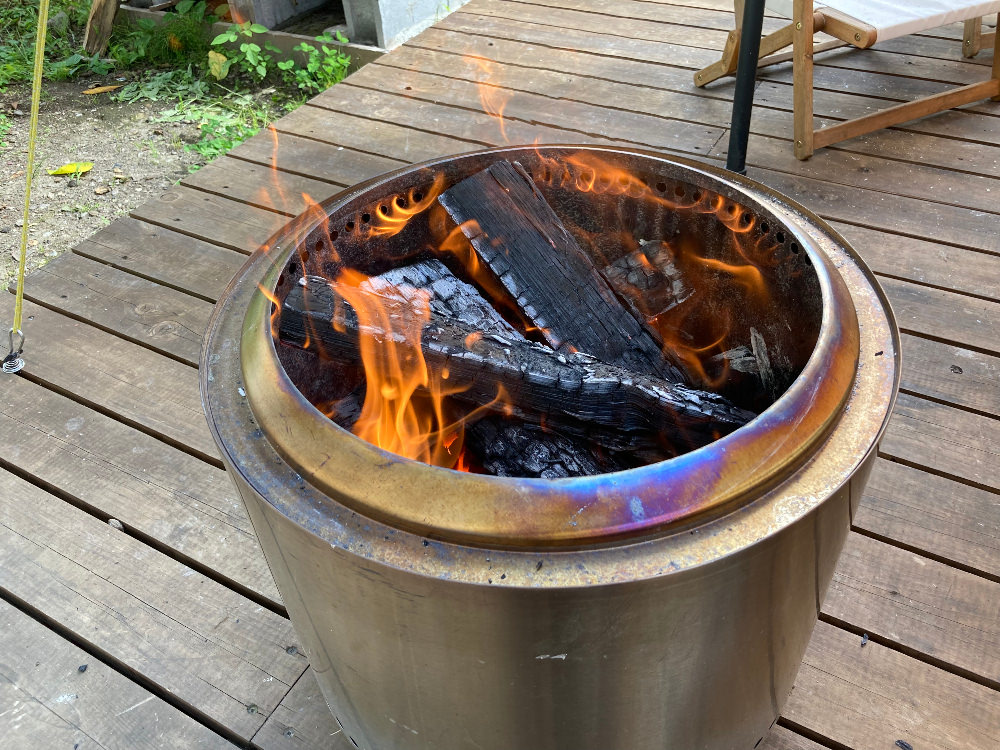
Nine Secondary-Combustion Campfire Stoves Recommended. Structure, Merits, and Drawbacks Explained | "Mori no Naka"—Know and Feel the Forest | Saito Timber Industries
To enjoy secondary combustion in a campfire, a dedicated stove is essential. Among campfire fans seeking secondary-combustion models, this article introduces nine recommended stoves, covering structure, merits, drawbacks, and more.
mori-naka.jpCooking Load Capacity and Grate Design
The lightness world's easiest oversight: load capacity and grate construction. Sub-500g stoves shift usability dramatically as cookware weight grows.
A quick mental map: 2kg class suits kettles and small pots; 10kg class embraces cast iron practically. Two kg—filled cooker or full kettle—hits "caution-needed" territory. Wire or mesh fire beds show slight deflection under loaded cookware; this flex registers psychologically beyond the numbers. NINJA FIRESTAND Solo's current ~4kg beats the old 2kg baseline, making solo skillet work viable—but heavy cast-iron simmering isn't its world. UKIBI Ukabihi Mサイズ quotes ~3.5kg, healthy for a lightweight mesh but light-cookware centric.
Conversely, proper grates transform cooking confidence. ASOBU IRORI-101 weighs ~250g in A5 storage—appealing—but official load specs remain elusive despite "10kg class" mentions in some retailers. Buying directly benefits from spec verification with the maker. Grate presence alone differs: bare wire feels light but bottoms wobble; multi-point or face-contact grates steady heavy pots, freeing mental bandwidth for actual cooking.
Stove "cooking-friendly" status hinges not on raw heat but on whether your hand stops worrying mid-recipe.
Wind Strength: Windbreak Design and Site Wind-Speed Judgment
Lightweight stoves surrender to wind easily. Open designs especially: minor breeze tilts flames, flares scatter, cooking repeatability crashes. Autumn highlands and river valleys where wind runs freely show this gap vividly.
Wind resilience starts with walls. Box types like B-6kun or SOTO Tetra ST-941 steady combustion; boiling resists wobble. ASOBU IRORI-101 embeds wind-break logic into the fire-bed angle itself—intelligent for ultralight. PICOGRILL 398 or UKIBI Ukabihi—open designs—excel at flame beauty but lose composure in crosswind.
Wind judgment pairs with gear selection: your SELECT's wind-speed baseline suggests wind above 5m/s favors skipping fires. Sub-500g models match this closely; ~4m/s already roughens open designs. Fine evening air makes open types magical; windy days call for box types.
A robust stove steadies flame direction predictably, concentrating pot heat—not a stove that merely resists extinction. Cooking priority? Walls and shape help. Flame-time priority? Calm evenings unlock open types' beauty. Both sensibilities matter for happiness.
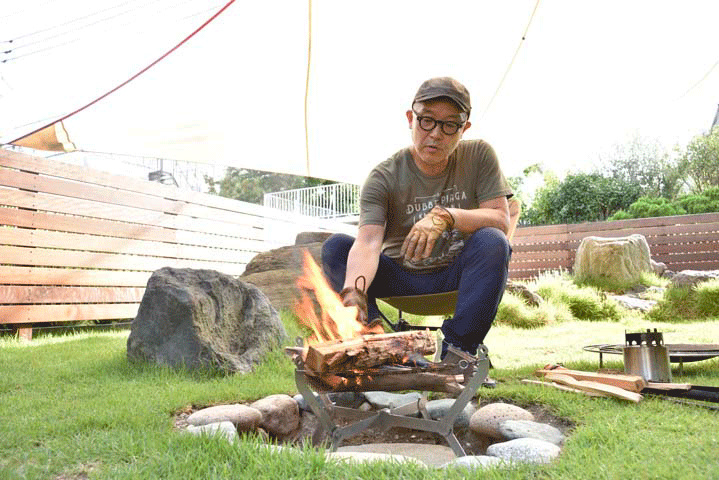
13 Recommended Campfire Stoves Compared! 40-Year Outdoor Pro Explains Maker Differences and Selection Tips
Campfire stoves are essential for fire-gazing and camp cooking. This guide shares pro advice on stove selection, kinds, care methods, and 13 top models.
cuebic.co.jpEight Recommended Solo Campfire Stoves Under 500g
With selection axes clear, let's meet candidates individually. Wanting to adore flames versus rapid meal prep creates vastly different happiness at 500g. The intuitive split from CAMP HACK's three-model comparison shows open-for-beauty, box-for-cooking, and UL-for-extreme-light as distinct characters.
PICOGRILL 398
Body weight is 448g, under 500g. Storage size is 33.5 × 23.5 × 1cm, a flat panel suited to backpack rear or motorcycle cargo. Thin and light yet opens into substantial fire space—this balance defines PICOGRILL 398.
Best fits solo camping where fire-gazing matters. Open framing displays flames beautifully—side and overhead views shine. Sipping while rearranging wood to stoke fire is quintessential. This type alone captures that joy.
Cooking works but excels at roasting-spit and small-pot heating rather than searing. Fire-to-cookware distance is generous; heat clusters loosely, favoring slow warmth over flash-frying. Sausage roasting or simmering soups suit; rapid sear-pan work feels subdued.
Caution: Prioritizing cooking requires workarounds. Fire-stove aesthetics are supreme, but asking "where's the cooking heat?" reveals another form handles it better. Trade-off between stove beauty and thermal clustering governs satisfaction.
{{product:PICOGRILL-398}}
PAAGO WORKS NINJA FIRESTAND Solo
Body weight is 275g, under 500g. Storage is 400 × 100 × 20mm—more compact rod than flat panel. Ultralight impact is striking; days when every gram counts showcase its appeal.
Fits hiking-and-ultralight solo styles. Mesh open-frame suits branch kindling and quick heat-taking. Current Solo's ~4kg load lands small cookers and solo skillets within reach.
Flame visibly delights—open-mesh shows embers easily. Fire-gazing is sprightly but contemplative. It's gear philosophy: lightness without abandoning flame joy. Boiling and casual grilling harmonize; post-meal flame play slots naturally.
Caution: Heavy-pot devotees need elsewhere. Current ~4kg capacity works for solo scales, not cast-iron persistence. Rod storage occupies space unlike flat panels—if flat-pack appeal drew you, expect different packing experience.
{{product:PAAGO-NINJA-FIRESTAND}}
Sho's B-6kun
Body weight is ~500g (border-case; "approximately 500g" wording lets units vary). Storage is ~18.1 × 12.2 × 1.8cm—tiny and remarkably flat; usage size is ~21.5 × 12.2 × 16.5cm, looking quite compact in action.
Best for solo kitchens trading some flame-gazing for cooking ease. Box shape enables chimney effect; short kindling grows fires readily. Boiling-to-pan-sear flows smoothly. Solo meals—boil, then fry bacon or small portions—hit a sweet spot.
Flame appeal differs: you're using fire more than admiring it. Payoff: heat concentrates readily. Small-pot and frying-pan work feel assured. Wind-catching is minimal. Boiling stability impresses this category.
Caution: Short-wood preference. Compactness requires kindling prep; scavenged or store-bought logs demand cutting. Fire contemplation feels constrained, but cooking comfort emerges from that "gather-tight" character.
{{product:SHOS-B6KUN}}
ASOBU IRORI-101
Body weight ~250g, under 500g. (Official load capacity for the supplied grate remains unconfirmed; some retailers claim 10kg, but maker specs lack clarity. Verify before buying.) A5 storage, slim profile.
Fits seekers balancing lightness with cooking hand-feel. Fire-bed angle embeds wind-break logic—not fully open, not fully enclosed. Canned heat, fuel-tablet warming, small-pot soups suit solo meals well.
Flame sight is direct; you peer into it like a hearth. Cooking meets flame-gazing halfway: contemplative yet practical. Lightness couples with food-table presence.
Caution: Official load specs remain iffy. Build suggests heavy-pot friendliness, yet unconfirmed numbers mean conservative forecasting. Article prioritizes verified specs; true aptitude leans solo-friendly adaptability rather than assertion.
{{product:ASOBU-IRORI101}}
UKIBI Ukabihi
Body weight ~95g, under 500g. Storage is flat, roughly 40 × 28cm. Fire appears floating—genuinely ultralight.
Suits seekers marrying gram-shaving with flame beauty. Mesh openness excels; floating embers glow evening-magic. UL doesn't kill campfire soul.
Cooking centers on lightweight cookers, boiling, simple reheating. Mサイズ reports ~3.5kg load capacity, but think small-cooker agility, not heavy-pot authority. Flame joy plus minimal feeding suits balanced days.
Caution: Wind vulnerability and grate design dependency. Cooking stability leans gear quality. Flame appearance impresses; practical cooking asks more care.
{{product:UKIBI-UKABIHI}}
huanbush-Type Ultralight Models
Sub-500g claims vary by SKU; verify official weight per model. "~107g" appears in some sources but lacks unified maker confirmation. Direction: ultralight-first, efficiency-next, mesh/box variants.
Suits pure UL thinkers prioritizing carry weight. Small-branch heat-taking, spare-fuel cooking match minimalism. Think tool more than campfire.
Heat efficiency fronts design; slow flame-gazing retreats. Multi-model variance means always verify specs individually before purchase. Brand-name stoves offer higher confidence.
{{product:HUANBUSH-ULTRALIGHT}}
SOTO Mini Campfire Stove Tetra ST-941
Body weight 122g, under 500g. Storage is 88 × 80 × 4mm—impossibly flat, pocket-small. More emergency heat-source than stove.
Suits small fire contemplation plus shiro cup or tiny-pot boiling. Compact box shape steadies flames; small-fire charm delights. Table-top magic feels precious.
Cooking strictly limits: heat-taking beats ambitious meals. Tinder roasting, can-warming, cup-prep work. Knapsack-gap filling—that's the happy role.
Caution: Scope limits by design. Sub-lead-stove suitability; backup-only wisdom serves best.
{{product:SOTO-TETRA}}
Solo Stove Lite
Body weight ~255g, under 500g. Storage is height ~10cm × diameter ~10.8cm, cylindrical. Secondary-combustion technology, unusually light.
Suits efficiency-over-contemplation solo styles. Boil reliability impresses; small-branch burn speeds, smoke lightens. 950ml rapid boil is signature.
Flame clusters upward—not sprawling-sideways beauty. Stove-mindset beats fire-mindset; cooker boil, soup warm, freeze-dry prep excel. Tool-tone prevails.
Caution: Kindling feeding stays frequent. Efficiency burns fast, requiring small-stick continuity—contemplative large-fire tending doesn't fit. Pack contents unclear bundled; official sites and UPI Online Store quote ~¥10,890 JPY (~$75 USD).
{{product:SOLO-STOVE-LITE}}
Spec Comparison Table
Comparison Dimensions
Eight models show storage shape and cooking ease matter as much as weight. Thickness millimeters—1cm, 1.8cm, 4mm—dictate backpack-back or saddlebag-bottom fit. Rod shapes eat space differently, affecting pack efficiency.
| Model | Weight (Body/Bundled) | Storage Size & Form | Material | Load Capacity or Cooking Aptness | Combustion | Price Range | Under 500g |
|---|---|---|---|---|---|---|---|
| PICOGRILL 398 | Body 448g / Bundled not published | 33.5×23.5×1cm·flat panel | Stainless | Load not stated; spit-use fire-cooking oriented | Open | Price info pending | ✓ |
| NINJA FIRESTAND Solo | Body 275g / Bundled not published | 400×100×20mm·rod-like carry form | Stainless | Current Solo ~4kg; small-cooker suited | Open | ¥11,000 JPY official | ✓ |
| Sho's B-6kun | Body ~500g (boundary; seller variation possible) / Bundled not published | ~18.1×12.2×1.8cm·flat panel | Stainless | Load not stated; boil & small-pan adept | Box | Price info pending | ✓ |
| ASOBU IRORI-101 | Body ~250g / Bundled not published | A5 storage·panel form | Stainless-noted | Load spec unconfirmed (10kg claims unverified); small–mid cooker apt | Open with wind-block fire-bed | Price info pending | ✓ |
| UKIBI Ukabihi Msize | Body ~95g / Bundled not published | Flat storage·case-packed | Stainless mesh & spokes | ~3.5kg noted; light-cooker priority | Open | Price info pending | ✓ |
| huanbush Ultralight Series | Body weight varies by SKU / Bundled not published | Storage specs per-model unclear | Stainless-noted | Load varies by model; twig-cooking oriented | Box or wood-stove type | Price info pending | ✓ (ultralight-range) |
| SOTO Mini Tetra ST-941 | Body 122g / Bundled not published | 88×80×4mm thickness·ultra-flat panel | Stainless | Load not stated; shiro-cup & mini-pot apt | Box | Price info pending | ✓ |
| Solo Stove Lite | Body ~255g / Bundled varies by seller | ~10cm height × ~10.8cm diameter·cylindrical | Stainless | Load not stated; boil & light-simmer apt | Secondary combustion | ~¥10,890 JPY UPI Online Store | ✓ |
PICOGRILL 398 and B-6kun both flatten—radically differently. PICOGRILL's 1cm hugs rear panels; area matters, "flat board" sensibility. B-6kun fits 1.8cm, smaller footprint, fits beside cookers or pack-gear flanks. Storage numbers differ subtly; packing experience transforms.
Load specs show NINJA FIRESTAND Solo current ~4kg unlocks small-skillet cooking beyond old-model 2kg. Solo Stove Lite (~255g) stays light but character leans stove—not campfire. Cylindrical storage doesn't compress flat; bag compromise is real.
UKIBI Ukabihi (~95g) and SOTO Tetra (122g) show weight extremes. Tetra's 4mm thickness fits paper-thin pockets. Both shrink "fire availability" into gram-counts: ultra-portable, scope-limited trade-off.
💡 Tip
Body weight and bundled weight blur easily. This article prioritizes confirmed body weights; missing unified bundled specs appear as "not published" to avoid confusion.
Further reading clarifies landscape. CAMP HACK's three-model side-by-side (PICOGRILL 398, NINJA FIRESTAND, B-6kun) makes positioning snap into focus. Actual use reveals character gaps invisible in spreadsheets.
Broader lightweight survey: HYAKKEI's sub-500g ultralight roundup and campballoon's ten under-500g models expand horizon. Titanium-lean ultralight thinking versus stainless-cooking-inclusive thinking diverge, same sub-500g weight.
A5 storage (flat) versus rod-shape: imagery clarifies instantly. A5 types nestle backpack rear or computer-sleeve space, stacking gear layers. Rod shapes use vertical/frame-side pockets, length tolerance critical. "Plane-fit" versus "line-fit" mental frames help.
Note: Parallel-import and vintage-listing weight/load variation runs high. NINJA FIRESTAND mixes old 2kg with current Solo ~4kg; PICOGRILL 398 shows seller variance. Unified-basis comparison stays vital.
→ Related guides
- Solo Tent Recommendation and Selection
- Tent Selection Complete Guide
Retail entry-points distilled:
| Model | Official/Direct | Amazon | Rakuten |
|---|---|---|---|
| PICOGRILL 398 | Picogrill official | Amazon listing present | Rakuten retailer present |
| NINJA FIRESTAND Solo | PAAGO WORKS Official Store | Amazon retailer present | Rakuten retailer present |
| Sho's B-6kun | Sho's Online Shop | Amazon listing present | Rakuten retailer present |
| ASOBU IRORI-101 | ASOBU product page | Amazon distributor status varies | Rakuten distributor status varies |
| UKIBI Ukabihi Msize | Official domain unclear; Makuake launch primary | Amazon listing present | Rakuten retailer present |
| huanbush Ultralight | Official domain unclear | Amazon listing present | Rakuten retailer present |
| SOTO Tetra ST-941 | SOTO official | Amazon listing present | Rakuten retailer present |
| Solo Stove Lite | Solo Stove Japan / UPI Online Store | Amazon listing present | Rakuten retailer present |
Weight order simplifies quickly; real utility reverses easily. Whether "flat-back fit" or "cylindrical heat" matters flips priorities. Comparison table serves as a quick-sort geography, not gospel.
Don't Choose by Weight Alone: Fire-Gazing, Cooking, or UL Extremes?
Split by intent: flame-watching priority favors open-design joy; cooking priority wants cookware security; ultralight priority accepts tradeoffs. Five axes—flame visibility, wood-ease, cooker-stability, wind-catch, cleanup-flow—reveal same 500g splits into incompatible desires. Autumn-night fine-kindling imagining shows the gap clearly.
Fine-kindling autumn nights show gaps vividly. B-6kun builds fire intuitively, short-wood reliable, where PICOGRILL 398 displays flame ecstatically, watching-joy supreme. Specs alone won't settle this; use-mode alignment does.
Broader comparisons help. Compact-stove roundups add breadth; selection-criteria refresh clears confusion.
Fire-Gazing Priority: PICOGRILL 398 / B-6kun
Want campfire time treasured? PICOGRILL 398 leads, simply: flame visibility excels. Open-frame minimal walls expose fire-growing joy. Lateral and overhead views shine. Arranging lengthwise wood, feeding flame-by-flame, building embers—the pleasure is unmatched. Fire as "scene" over "heat" scores highest here.
Wood-feeding ag
Tips for Safely Using Sub-500g Models
Fire pits under 500g are easy to carry, but that lightness comes with trade-offs: smaller fireboxes, open structures, and greater exposure of the ground beneath to heat and sparks. The key to safe use isn't "light means casual" but rather light means one extra layer of preparation. Open-frame models like the Picogrill 398 and mesh-style units like the NINJA FIRESTAND Solo or UKIBI Ukibi are especially sensitive to placement and wind awareness.
The non-negotiable first step is always pairing a high-heat-rated fire mat underneath. Lightweight models often have shallow ash trays or sit close to the ground, and grass sites are prone to heat discoloration and scorch marks. Don't assume "slightly elevated means safe" on turf -- lay down a fire mat, and while you're at it, line up your tongs, fire extinguisher bucket or fireproof bag, and water within arm's reach before you light anything. Having that cleanup path set beforehand keeps you from scrambling mid-session. Personally, this single prep step changes the entire enjoyment level of the fire.
Wind judgment is also something to take more seriously with lightweight fire pits. The general guideline from your SELECT puts 5 m/s (~11 mph) as the threshold for avoiding open fires. Sub-500g pits are light-bodied with compact fireboxes, so when wind enters the picture, flames redirect easily and sparks travel further. Even at highland campsites where the breeze feels gentle, occasional gusts through an exposed position can make open-mesh models tough to manage. In those situations, using low shrubs, your vehicle, or a terrain rise to deflect wind helps, and adding a windscreen on the upwind side steadies the flame and evens out cooking heat. On days when the wind is truly unpredictable, calling it off is the cleaner play.
Stick to thin splits as your primary fuel. As covered in Honda Camp's firewood basics, dry wood ignites and burns more predictably, and with lightweight fire pits that difference translates directly into usability. Even box-style models like the B-6kun, which contain combustion well, perform better with thin splits fed gradually than with thick logs jammed in -- fire control improves and the gear stops feeling like it's running you. High-moisture wood produces more smoke and leaves behind soot and half-burned chunks, so avoid it. Double-wall combustion designs like the Solo Stove Lite do reduce smoke effectively, but they won't magically clean-burn wet fuel. Even the most efficient combustion design turns rough with poor-quality fuel -- keep that in mind for safety.
💡 Tip
On grass sites, don't just place the fire pit on a fire mat -- keep tongs within reach so you can grab any stray embers or ash that fall outside. The smaller the fire pit, the more speed matters when a rogue ember escapes.
How you end the fire also matters more with lightweight models. Since thin splits burn down small, there's a deceptive "looks dead" stage where embers still hide in the ash. Before packing up, stop feeding fuel early, spread the remains with tongs to release heat, and confirm everything is truly out before collecting ash. Don't leave ash on the site -- use an ash bucket or fireproof bag and pack it out. On grass sites this care doubles as etiquette, and on dewy or post-rain ground, ash mixes with mud and becomes much harder to deal with. Just like planning rain drainage around your tent, thinking about cleanup-ready placement from the start makes teardown far smoother.
Wrap-Up
Lightness really is an advantage. But the buying approach that leads to fewest regrets is deciding first whether you want to watch flames, cook over fire, or shave pack weight to the bone -- then matching packed shape, cookware compatibility, and burn behavior to that answer. Beginners will find the B-6kun the most forgiving; UL hikers should look at the PICOGRILL 398 or UKIBI Ukibi for maximum weight savings; cooking enthusiasts will gravitate toward the ASOBU IRORI101 as a first pick.
When in doubt, narrow it down in this order:
- Decide your transport method
- Decide whether fire-watching or cooking is your priority
- Use the comparison table to shortlist two models by packed shape
Then check total carry weight including fire mat, tongs, and ash container. For walk-in-from-the-station setups, the number that matters most isn't grams on a scale -- it's "light enough to still enjoy yourself once you arrive."
Related Articles
6 Best Camping Fire Pit Mats Compared by Continuous Use Temperature
When choosing a fire pit mat in Japan, you'll have better results by prioritizing continuous use temperature rather than just picking something that 'looks heat-resistant.' If you want to properly protect grass sites or wooden decks, aim for 700°C or above. With low-profile fire pits, layer a high-heat-resistant mat with reflective insulation, or ensure adequate clearance from the ground.
Campfire Cooking Methods Compared — Direct Flame, Fire Grill, and Dutch Oven
If you're new to campfire cooking, your first win is easiest to build over a fire grill on a glowing ember bed. The heat stays steady, you control intensity by distance, and mushrooms, meat, and bread can all move along at the same time without drama.
How to Choose a Fire Grill | Compared by Camping Style
Rather than picking a popular model on instinct, choosing a fire grill gets a lot easier when you nail down five things first — group size, how you travel, what you want to do, firewood length, and setup effort. This guide breaks down five types — scenic, cooking-focused, ultralight, secondary combustion, and family — comparing weight, packability, load capacity, price range, and setup method side by side.
How to Choose a Fire Grill for Cooking in Japan | 5 Key Criteria
Want both the joy of watching a fire and the confidence that your food will cook properly? This guide breaks down fire grills by three conditions—group size, cooking style, and transportation method—so you can choose with confidence. We'll cover when you need a 40cm+ size, why 15kg+ load capacity matters, and specific models ranging from lightweight 794g options to the practical sweet spot of 2.8kg with 3cm storage depth.