
How to Choose a Fire Grill | Compared by Camping Style
How to Choose a Fire Grill | Compared by Camping Style
Rather than picking a popular model on instinct, choosing a fire grill gets a lot easier when you nail down five things first — group size, how you travel, what you want to do, firewood length, and setup effort. This guide breaks down five types — scenic, cooking-focused, ultralight, secondary combustion, and family — comparing weight, packability, load capacity, price range, and setup method side by side.
Rather than defaulting to whatever model is trending, your fire grill choice becomes much clearer when you settle five things upfront: group size, how you're getting there, what you want to do, firewood length, and how much setup effort you're willing to put in. This guide organizes five types — scenic enjoyment, cooking-focused, ultralight packable, secondary combustion, and family — comparing weight, packability, load capacity, price range, and setup method in one place.
A windy evening at a highland campsite with the whole family, a solo outing where you've stripped the pack down to essentials — the right fire grill is a completely different piece of gear in each scenario. I'll help you pinpoint your type in about three minutes, while also covering fire grill mats, windscreens, when to call it quits above 4 m/s wind speeds, and why you shouldn't douse the fire bed with water directly. Safety fundamentals worth knowing before your first use.
The 5 Decisions That Actually Matter When Choosing a Fire Grill
Buy a fire grill based on looks or popularity alone and you'll often hit the same wall: "smaller than I imagined," "my pot wobbles on it," "carrying this thing is miserable." The five things to nail down first are who's using it, how it's being transported, what you're doing with it, whether standard firewood fits, and how much time you can spare for setup and cleanup. Once those are clear, it becomes obvious whether you should go ultralight solo, secondary combustion, or a high-load-capacity model for car camping.
Group Size, Fire Bed Dimensions, and Load Capacity
Group size is the first filter that matters most. Solo use tends to center on "can I enjoy the fire and do some basic cooking?" Add a second person and consistent fire quality and refueling frequency start to matter more. Four or more — especially families — and the size of the fire bed and load capacity become the decisive factors.
For solo use, slim lightweight models have real appeal. A general benchmark is 1–1.5 kg or under for the lightweight solo category — a manageable weight if you're trimming down your kit. That said, lighter models tend to have a smaller fire bed, and how well they handle a pot or pan varies quite a bit between products. If cooking is a priority, you'll want to look beyond weight to load capacity. Even within solo models, load capacity can range from around 10 kg to 25 kg, so if you're planning to put a large pot on it, factor that into your decision.
For two people, a fire bed that's too small means constant refueling and less time just enjoying the fire. From personal experience, going from one to two people alone makes "a little bigger" feel just right. What seemed ample for one gets cramped the moment you're boiling coffee while grilling something at the same time. For families, this effect is even more pronounced — the more people around the fire, the more value shifts toward surface area that holds firewood steady and a structure capable of supporting cookware. If you're thinking pots, pans, and grilling racks, a heavier car-camping model becomes a serious contender.
Weight and Packability by Transport Method
"Solo camping" can mean driving, riding a motorcycle, or hiking in on foot — and the right fire grill is different for each. Get vague here and you'll end up with something that works great at the site but wears you out getting there.
For hiking and motorcycles, 500 g–1.5 kg is a useful range to focus on. If you're really paring things down, a sub-500 g, ~2 cm thick flat-pack model has genuine appeal. The difference in how it sits on your shoulders and back is significant — once you go over 500 g on an ultralight day, you start to feel it. Models in the 1 kg range sit in a "light, but not ultralight" position. A model with packed dimensions of roughly 21 × 40 × 2.5 cm, for example, packs almost like a board — easy to tuck along your pack's back panel. Weight-wise, it's close to carrying a 1-liter water bottle, which is perfectly realistic for shorter approaches.
Car camping removes these constraints entirely. 2 kg or 3 kg is fine if it means a bigger fire bed, a more stable platform for pots, and a steadier flame. Personally, on cooking-focused trips I often reach for the heavier high-load model — being able to set a Dutch oven down without worry makes dinner prep considerably more relaxed.
Browsing through roundups of solo fire grills, the pattern is clear: lightweight models trend toward flat, A4-footprint designs, while models focused on smoke reduction or high load capacity tend to bulk up. The thinking around managing your overall kit follows similar logic to tent sizing.
![【2026年】ソロ用焚き火台おすすめ34選|軽量コンパクトなモデルなど! | CAMP HACK[キャンプハック]](https://images.camphack.jp/wp-content/uploads/2024/01/pixta_2677957_M-1.jpg)
【2026年】ソロ用焚き火台おすすめ34選|軽量コンパクトなモデルなど! | CAMP HACK[キャンプハック]
ソロ用焚き火台の選び方と、おすすめ最新モデルを紹介します。キャンプには欠かせないアイテムの焚き火台。ソロキャンプにも持って行きたいですよね。この記事では、おすすめモデルや選び方に加え、上手に火をつける方法や、焚き火台のお手入れ方法も解説して
camphack.nap-camp.comRanking Your Priorities: Scenic Enjoyment, Cooking, or Smoke Reduction
What you plan to do around the fire changes everything about how you evaluate a fire grill. Leave this fuzzy and you end up with a mismatch — beautiful flames but awkward cooking, or a great cooking platform that feels nothing like a campfire.
If scenic enjoyment is the priority, how the flame rises and how easy it is to arrange firewood take center stage. An open design with a visible fire bed offers a satisfying view and photographs well. Watching wood stacked log-cabin style through the open structure, the fire itself becomes the main event of the evening.
For cooking-focused use, the priorities shift sharply. Load capacity, grate stability, and distance from the flame are what matter. For grilling, a structure that concentrates heat upward works well enough. But for simmering or boiling, whether your pot sits solidly and level determines whether the whole experience feels comfortable or anxious. The more you cook, the more you realize that "will this pot tip?" matters more than fire bed dimensions.
If smoke reduction is the goal, secondary combustion models enter the picture. These systems channel hot air into unburned gases for a second burn cycle, significantly cutting smoke and soot. As outlined in explanations of secondary combustion fire grill mechanics, the design logic holds up well. The trade-off is weight — secondary combustion units tend to be heavier, with cylindrical or box-shaped packed forms that take up space. The clean flame and low smoke are genuinely attractive, but bringing one on foot isn't always practical.
💡 Tip
When you're stuck, think about which happens more often: evenings where you just want to watch the fire, or evenings where cooking is the main point. I've found myself prioritizing pot stability over flame aesthetics more and more often, simply because I grill and cook over the fire more nights than not.
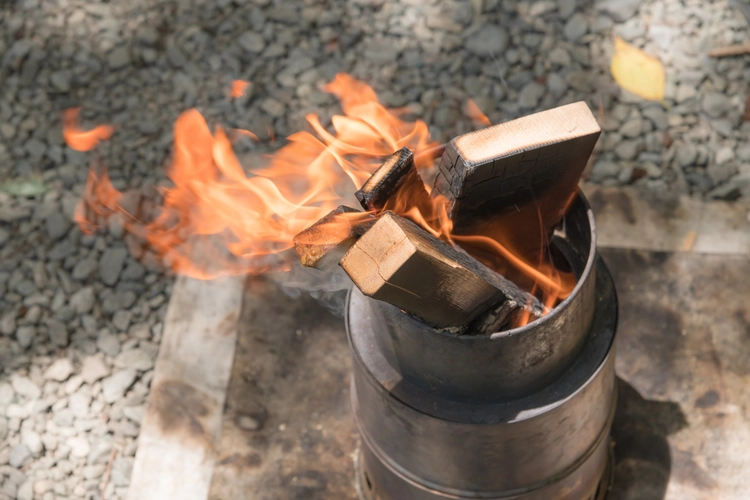
二次燃焼を利用したおすすめ焚き火台&ストーブ13選!燃焼の仕組みも解説 | キャンプ・アウトドア情報メディアhinata
二次燃焼を利用した焚き火台とストーブに注目。仕組みやメリット・デメリットを解説しつつ、二次燃焼を楽しめるおすすめのアイテムを紹介します。
hinata.meDoes It Handle 30–40 cm Firewood Without Modification?
One of the easiest things to overlook when sizing up a fire grill is how it works with commercially available firewood. Standard firewood is typically 30–40 cm long, and a fire bed that's too small means you can't load it directly — you'll be splitting, sawing, or chopping before you can even get the fire started.
This plays out in real conditions. Lightweight solo models are appealing, but their compact fire beds often can't accommodate standard-length wood without modification. That means time spent with a saw or knife adjusting lengths, or splitting pieces down further before loading. For some people that's part of the ritual. But on evenings when you've just finished pitching camp and want to get a fire going quickly, that extra step adds up.
The effect is sharpest when you're cooking at the same time. Being able to drop full-length logs in means your flow stays uninterrupted — tending the fire while prepping ingredients and bringing water to a boil without pausing. Compact models have their place, but the day-to-day comfort of not having to process your firewood accumulates over time.
Setup Speed and Ease of Cleanup
Setup style looks like a footnote in the specs but matters enormously in the field. The broad division: fold-out models set up fast; assembly models pack flatter.
The appeal of fold-out designs is pure speed. Arriving at the site in the late afternoon, pitching the tent, wanting fire before dark — a design that opens and goes is genuinely valuable in those moments. A fire grill is supposed to be enjoyable, and spending too long setting up means losing the best part of the evening. The simpler the open-and-done setup, the more you appreciate it when daylight is running short.
Assembly models, on the other hand, often pack down to an almost board-like profile — exceptional in terms of storage efficiency. They slide into the back panel of a pack or fit neatly into motorcycle luggage with a "slip it in the gap" satisfying feeling. If flat storage is the priority, these lead. But as part count increases, so does the attention needed for assembly sequence and keeping the joints clean.
On the cleanup side, differences show up in ash removal ease, whether the fire bed corners and mesh catch residue, and whether heat-warped components can still be reassembled cleanly. Simple structures are easier to clean but may sacrifice packability. Flat-folding models carry well but are more susceptible to warping that affects how panels mate. This isn't about one being better — it's a genuine speed vs. thinness trade-off worth naming clearly.
Fire Grill Types Compared | Fold-Out, Assembly, Secondary Combustion, Mesh
Fold-Out: Strengths and Limitations
Fold-out fire grills earn their reputation on setup speed above everything else. Unfold the legs, open the fire bed — that's often all there is to it. When you're racing the sunset, that smooth-start character keeps your evening on track. I do a lot of campfire cooking and being able to start the fire almost as a reflex, without puzzle-solving, makes a real difference.
The integrated structure also creates a natural rigidity that's hard to replicate with assembled panels. Wobble when you add firewood is minimal, and placing a pot or kettle on it feels secure. As Snow Peak's durability materials on their Takibi-Dai line note, fire grills are designed to operate in extreme thermal conditions as a baseline — and fold-out models tend to project a "built to be used hard" confidence.
The trade-off is packed thickness. With parts that stay connected, fold-out models don't get as slim as assembled ones. Tucking one into the back panel gap of a backpack isn't really the use case. And cleaning the joints takes a bit more attention — hinges and overlapping edges accumulate ash and soot, and the fire bed isn't always removable for a direct rinse.
Flame aesthetics lean toward openness, particularly with shallower or disc-like fire beds. The fire is visible from all sides, firewood arrangement reads clearly, and the whole setup pairs well with people who prioritize the experience of sitting around a real fire. For cooking, the wide-open structure works for multiple small pans or a grill grate — it's a show-the-flame-while-you-cook kind of setup rather than a focused single-burner feel.
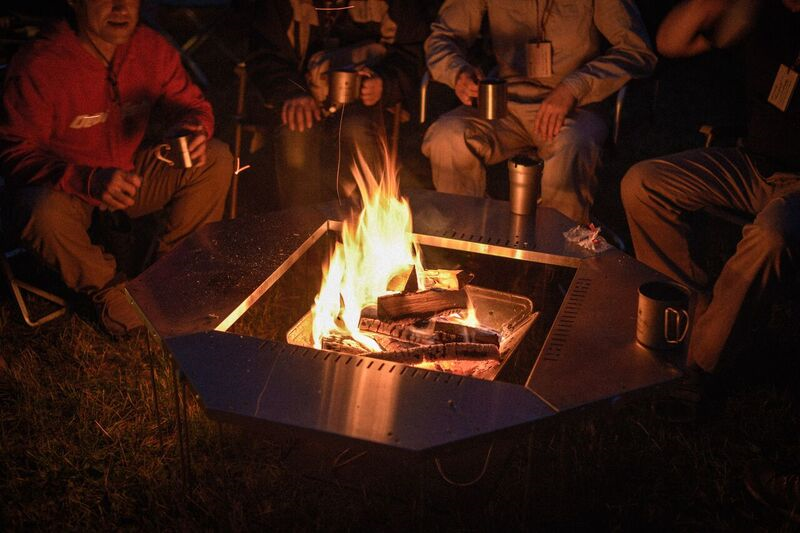
焚火台の強靭な耐久性 | THE SNOW PEAK WAY
普段の生活の中では見ることのない自然の炎の揺らぎをただ眺めながら、その日一日の余韻に浸る。キャンプの中で一番好きな時間かもしれません。そんな焚火に欠かせないのは、もちろん焚火をする台。発売以来、基本的な構造は変わらず、20年以上も毎年販売数
www.snowpeak.co.jpAssembly Models: Strengths and Limitations
The defining appeal of assembly-style fire grills is flat storage. Panels and legs break down and stack, creating a board-like form that pays dividends on foot or on a bike. A flat fire grill runs cleanly along the back of a pack and doesn't disrupt the shape of your load. A model with packed dimensions of roughly 21 × 40 × 2.5 cm packs much more intuitively than those numbers suggest — it behaves like a flat object, which simplifies the whole loading process.
Weight tends to be in their favor too. Assembly models frequently land in the lightweight-solo sweet spot. Around 1,120 g feels similar to carrying a single 1-liter water bottle — realistic even for shorter hikes. And in packable gear, "doesn't add bulk" can matter as much as the number on the scale.
The persistent issue with assembly models is distortion that makes reassembly harder over time. Fire grills live in extreme heat, and even slight warping of panel edges or locking tabs can make fitting pieces together stiff or frustrating. Experienced campers handle this easily, but on a cold morning or a rushed pack-out, that extra friction adds low-grade stress. Assembly models earn their packability — in exchange, they ask a bit more of you in the field.
A narrow or V-shaped fire bed encourages standing firewood arrangements that promote efficient combustion and direct heat toward cookware well. The trade-off is that the flame view is more contained than the open spread of a fold-out model — great if cooking is the point, occasionally feeling a bit utilitarian on evenings where you just want to stare into the fire.
Secondary Combustion: How It Works and What You Actually Feel
Secondary combustion fire grills have a clearly defined mechanism. As covered in secondary combustion explainers like hinata's breakdown, the system channels hot air into the unburned gases from the primary combustion stage, igniting them a second time — which cuts smoke and soot substantially. The external air intake path and the re-combustion zone at the top of the unit work together, producing a flame that behaves noticeably differently from a conventional fire grill.
The most tangible benefit? On windy nights, the reduction in smoke is worth a lot. Poor-quality firewood won't make it entirely smokeless, but the experience of constantly getting smoke in the face every time the wind shifts is largely eliminated. The smell that lingers in clothing and hair is also reduced — for anyone who loves campfires but finds the smoke a friction point, this design delivers. Secondary combustion models consistently earn strong endorsements in smoke-reduction contexts across gear coverage like CAMP HACK's comparisons.
The counter is that secondary combustion units weigh more and cost more. The double-wall or cylindrical structure required by the design can't be compressed into the slim form of a lightweight assembly model. Storage is cylindrical or box-like with real bulk — a better fit for car camping than a hiking pack. This isn't a weight-efficient tool; it's a tool that buys you a more comfortable fire experience. Honestly, it's on the heavier side to carry. But watching a fire without being distracted by smoke is a genuine luxury.
The flame character is distinctive too. Secondary combustion models concentrate fire upward inside the cylinder, so the experience is more about the clean column of flame above than watching logs shift and collapse sideways. For cooking, the focused upward heat works well for boiling and grilling, though fine-tuned fire control while moving logs around is less intuitive. Open shallow fire bed for flame watching, secondary combustion for low-smoke comfort — treating those as distinct categories makes the choice cleaner.
ℹ️ Note
A secondary combustion fire grill isn't really about making the fire look more dramatic — it's about removing the moments where smoke keeps pulling your attention away. The more you want to just sit, eat, and talk around the fire, the more that value becomes apparent.
Mesh Fire Beds: Packability and Wear Considerations
Mesh fire beds appear often in lightweight models. The metal mesh cradles the fuel without adding much mass, keeping the unit light and the packed form compact. When you're cutting weight on a solo trip, this design is genuinely attractive. The open mesh structure also means excellent airflow from below — fire catches and builds quickly, which is satisfying when you're getting started with limited kindling.
Cleanup speed is another mesh-specific advantage. Ash tends to fall through rather than pile up, so breakdown at the end of the night is fast. There's less to deal with inside the fire bed, which keeps the rhythm going on a morning when you're moving quickly. The "easy ending" quality of a mesh fire bed has saved me time on more than a few short-notice pack-outs.
The trade-off is that mesh is better treated as a consumable part. Repeated high-heat cycles stretch the mesh, soften the tension, and gradually wear the edges. Long-term use means planning for eventual replacement — the design is optimizing for lightness and combustion efficiency, not the near-permanent durability of a solid plate fire bed. That's not a flaw; it's just a different design philosophy.
Worth noting: ash fallthrough needs to be managed. The fact that ash drops readily below the fire bed means paying attention to what's underneath. On sandy ground especially, ash and sand mix and become harder to deal with — fast cleanup above the fire bed, but more care required at ground level. Mesh fire beds trade durability and some ash management effort in exchange for packability and strong combustion performance.
Visually, flames through a mesh fire bed look open and airy — firewood appears almost suspended. For cooking, it pairs better with solo cookware and smaller kettles than with heavy pots set flat. On days where carrying less matters more, or when you want the evening to end efficiently, the low-maintenance character of mesh is exactly right.
How Material Changes the Experience | Stainless Steel, Titanium, and Iron
Stainless Steel: The Balanced Default
When you're unsure about material, stainless steel is the most reliable starting point. The reason is straightforward: it resists rust, handles rough use without fuss, and balances looks with durability. As Snow Peak's Takibi-Dai durability coverage notes, fire grills are designed from the ground up to handle extreme heat environments. Within that context, stainless steel keeps the day-to-day maintenance bar low — accessible as a first fire grill for most people.
Realistically, ash and soot will accumulate regardless of material. Within that reality, stainless steel cleans up relatively easily — wipe down the residue, let it dry, move on. When I'm cooking over the fire and something boils over or spatters, stainless steel lets me deal with it without mentally spiraling. For people who cook regularly over a fire grill, that "I don't have to be precious about this" quality adds up.
It also pairs well with the thicker construction and reinforcement approaches that extend lifespan. More products exist in stainless steel than any other material — from lightweight solo to full family sizes — which means you can match your use case more precisely. That breadth comes from the material's versatility.
Titanium: Weight vs. Cost
Titanium's draw is the sheer weight advantage. When you're trimming a hiking or motorcycle kit, this difference matters. In the sub-500 g world that defines serious lightweight fire grills, the material's lightness translates directly into packability. There's a notable ease to lifting it with one hand, and breaking down camp doesn't involve wrestling a heavy plate into a bag. On walking trips, that lightness shifts the whole experience.
The trade-off is price. For people who genuinely prize the weight savings, it's a rational spend. For primarily car-camping use, the cost premium buys less. There's also the question of thermal distortion — thin titanium construction, while achievable, doesn't automatically mean shape stability under heat. A fire grill operates in extreme heat, and "lighter material" and "better at holding shape" aren't the same claim. Titanium is a material for ultralight-leaning builds — understanding it as prioritizing packability over robustness keeps expectations calibrated.
From a cooking standpoint, titanium's main virtue is "light enough to actually bring." The reassuring mass that holds heat steadily for cooking belongs more to stainless steel and iron. Titanium fire grills are ideal on days when moving fast matters most, but they ask for a bit more mental attention if you're setting a heavy pot down for a long simmer.
Iron: Rigidity and Cooking Performance
Iron (steel) fire grills announce themselves the moment you pick them up — solid, weighty, and immediately projecting a working tool character. They're not light. But that weight converts directly into confidence: the stability when it's set up, the lack of flex when you add a log, the security of placing a cast iron pot on the grate. For car campers who want to cook seriously around the fire, iron is an excellent match.
For cooking specifically, iron leads. The fire bed and frame are typically substantial enough that heavy cookware doesn't cause concern. Beyond that, iron retains heat and maintains embers consistently, which makes controlled cooking over coals — grilling, slow-cooking — genuinely enjoyable. Adjusting grill marks on sausages and vegetables over iron embers, the fire behaves predictably and gives you time to respond. A steady, glowing coal bed that connects naturally to cooking is one of iron's best qualities.
The downsides are weight and rust management — both real. But the hands-on character of an iron fire grill, the way it develops patina with use, and the visual weight of the whole setup appeal to people who enjoy the full atmosphere of campfire cooking. Heavy enough to justify bringing, but worth it — that's the feeling iron tends to produce.
💡 Tip
If cooking is a significant part of your campfire time, fire bed stability and pot confidence matter more than material weight. For serious camp cooks, iron or high-rigidity stainless steel tends to produce more satisfying results than an optimized-for-weight design.
Why Aluminum Doesn't Belong in the Fire Bed
Aluminum is light and easy to work with, but it's fundamentally the wrong material for a fire grill fire bed. The issue is compatibility with the sustained heat that a fire grill's core is designed to handle. A fire bed simultaneously absorbs the weight of firewood and the heat of burning — asking a material that isn't built for high-temperature stability to handle that combination leads to deformation and durability problems.
The fire bed specifically catches the full combination of mechanical load and thermal stress. A material lacking adequate heat resistance in that position will lose its shape, making stable long-term use structurally difficult. Weight reduction alone doesn't justify the choice. In a fire grill, maintaining form under heat comes first.
Aluminum can be useful for peripheral components or carry bags, but as the core heat-handling material, it's the wrong tool. The reason the mainstream remains stainless steel, titanium, and iron is that these materials actually answer the thermal demands. For most buyers: stainless steel if you're not sure, titanium if minimum weight is the overriding priority, iron if cooking quality and campfire atmosphere are what you're after.
Spec Comparison Table | Weight, Packed Size, Load Capacity, Price Range, and Recommended Style
How to Read the Comparison Metrics
Comparing fire grills on "light" or "big" alone leads to wrong turns. The useful comparison runs weight, packed dimensions, setup style, load capacity, price range, recommended use, and 30–40 cm firewood compatibility side by side. Firewood compatibility especially — since commercial firewood is centered on 30–40 cm lengths, whether a fire grill handles that without modification dramatically changes the day-to-day experience.
Packed dimensions involve shape as much as numbers. The TOKYO CRAFTS Macrite 2, for instance, packs to approximately 21 × 40 × 2.5 cm — its board-like form is the real advantage. A 2.5 cm profile slides into the back panel of a pack or between items in a bag without fighting for space. At approximately 1,120 g, the weight is close to carrying a 1-liter water bottle — realistic for hiking. A disc-type model opens easily but doesn't flatten the same way — manageable in a car's cargo space but occupying surface area rather than slip-fitting.
Setup style affects even the mood of cleanup. Unfold-and-place designs are beginner-friendly and stay manageable in the dark or cold. Assembly models require a few more steps but win on packed thickness. For cooking specifically, inadequate load capacity means a pot causes visible flex — if you want to cook seriously, a model with frame-level strength, not just fire bed specs, will feel noticeably more composed.
Here's a reference comparison across key models. Figures are based on verified information available for this task; unconfirmed items are marked —.
| Model | Weight | Packed Size | Setup Style | Load Capacity | Price Range (est.) | Recommended For | 30–40 cm Firewood |
|---|---|---|---|---|---|---|---|
| TOKYO CRAFTS Macrite 2 | ~1,120 g | ~21 × 40 × 2.5 cm | Assembly | — | Mid-range (est.) | Solo, hiking, motorcycle, flat-storage priority | Handles well |
| Coleman FireDisc | — | — | Fold-out | Multiple sources cite 25–30 kg | Mid-range (est.) | Car camping, family, easy setup priority | Handles well |
| Coleman FireDisc Solo | — | — | Fold-out | Multiple sources cite 25–30 kg | Low–Mid-range (est.) | Solo, duo, simplified setup | Depends on model size; some adaptation useful |
| ZEN Camps NT FIRE STAND | — | — | Assembly | 15 kg | Mid-range (est.) | Solo, lightweight-leaning, also wants to cook | Depends on firewood placement |
| Uniflame Maki Grill Solo | ~1.1 kg | — | Assembly | Distributed ~10 kg | Mid-range (est.) | Solo cooking, grilling-focused, stability priority | Handles well |
| Snow Peak Takibi-Dai M | — | — | Fold-out | — | High-range (est.) | Car camping, classic preference, durability priority | Handles well |
| Secondary combustion cylinder models (category) | Typically 2 kg+ | Cylindrical/box — bulky | Unfold/integrated | — | Mid–High-range (est.) | Low smoke, clean flame aesthetics | Most models handle well |
Price ranges here are kept broad. In practice: hiking or motorcycle use is most comfortable up to around 1–1.5 kg, while car camping benefits from prioritizing load capacity and setup convenience over weight. For people who cook regularly, optimizing for "does the pot feel secure?" over visual elegance tends to produce more consistently satisfying evenings.
ℹ️ Note
When reading a comparison table, the clearest sequence is packed size → weight → load capacity. Will it fit? Can you carry it? Will it hold your cookware? When all three align, the small frustrations across a season of camping start to disappear.
Individual product pages are findable through TOKYO CRAFTS' official fire grill collection, and Coleman, ZEN Camps, Uniflame, and Snow Peak each publish official product pages that are the most reliable source for current specs. For purchasing, most mainstream models are widely available on Amazon and through other retailers, making price comparison relatively straightforward.

焚き火台
キャンプ用の焚き火台、焚き火で用いるキャンプギアのTOKYO CRAFTS公式通販ページです。ソロでもファミリーでも使える軽量コンパクト焚き火台マクライト、無骨な焚き火台KUBERU、暖かさに優れる焚き火陣幕、ヒートリフレクターなどの取り扱
tokyocrafts.jpThe "Too Small" Fire Grill Problem and Standard-Length Firewood
Chasing compact doesn't come without a cost that's easy to underestimate: how the fire bed works with actual firewood. Commercial firewood centers on 30–40 cm. Too small a fire bed means you can't load it directly. The result: you're splitting, sawing, or snapping wood before you can get the fire going. A lightweight fire grill that's otherwise comfortable can quietly push you toward bringing more tools — saw, knife — which eats into the weight savings you were after.
This is felt most on hiking trips. A sub-500 g fire grill is genuinely appealing and significantly lighter in the pack. But once you account for the time spent processing wood, the weight of the unit alone doesn't determine how good the evening feels. Speaking from cooking-focused campfire experience: constantly loading short split pieces to maintain heat leans more toward fire management labor than relaxed campfire time. Fine for boiling water, but slower for grilling and simmering through a long evening.
This is where models like the Macrite 2 and the Uniflame Maki Grill Solo earn their place — solo-oriented designs that still accommodate 30 cm-range firewood comfortably. A fire bed with adequate horizontal space lets you angle longer pieces in, spread embers for heat control, and build more flexible cooking setups. Ultra-compact models have their uses for minimal fire enjoyment — but they're misaligned with buying commercial firewood and using it as-is.
When evaluating compact models, adding "do I need to cut firewood, or can I use it straight?" to your checklist changes how you read the comparison table. Smaller looks like better value in this category — but with fire grills, fire bed working area translates directly to ease of use.
Size Context for Secondary Combustion, Disc, and Mesh Models
"Compact" means different things across secondary combustion, disc, and mesh designs. Breaking these apart makes spec sheets much easier to navigate.
Secondary combustion units, as explained in sources like hinata's breakdown, re-burn unburned gases using hot air — which requires wall structure and air channels. The result is that they tend toward cylindrical or box shapes with real volume. Low smoke and beautiful flame are compelling, but on packed size alone, they don't compete with flat assembly models. Car camping absorbs this easily; hiking feels the bulk more than the weight number suggests.
Disc types — the Coleman FireDisc family is the archetype — are genuinely excellent on setup speed. Open it and it's ready, almost immediately. Firewood goes in easily, and the wide open design is great for groups. The storage form, though, is "flat but still takes up significant floor space" rather than "board-like and slideable" — easier to stack in a vehicle than to slot between other items. That's a meaningful difference compared to flat-pack models like the Macrite 2.
Mesh types lead on combustion efficiency and lightness. Air flows in readily, the transition to embers is smooth, and fire builds quickly. Trade-offs appear in fire bed stability and load capacity variability between models — heavy pots are a different use case. From a cooking perspective, mesh fire grills feel great for actually enjoying the fire; for serious simmering with a large pot, a structurally rigid frame model feels more secure.
Broadly by type: prioritize thinness → assembly, prioritize ease → disc, prioritize low smoke → secondary combustion. The real-world feel of loading, the ease of starting, and the pack-out experience are shaped more by this shape difference than by weight numbers alone. Fire grills are unusual in how completely the ideal type shifts depending on whether the priority is cooking, atmosphere, or a fast morning pack-out.
Recommendations by Style | Solo, UL, Duo, Family, Cooking-Focused, Low-Smoke
Solo and UL
For solo use, the key move is thinking past "lightweight" to whether the fire grill actually works with standard firewood. A rough benchmark is the 1–1.5 kg flat-profile range. The TOKYO CRAFTS Macrite 2 at roughly 1,120 g and a 21 × 40 × 2.5 cm packed form is a good representative — it loads into a pack almost like a flat object. The carried weight is a small step above a 1-liter water bottle, which is genuinely manageable hiking in. Not ultralight-class, but a solid balance between firewood compatibility and packability.
For days when the goal is maximum weight reduction on foot or by motorcycle, sub-500 g models in mesh or titanium deliver. The reduction in walking load is real, and when the whole kit needs to come in light, this class helps. The trade-off is that these designs often assume you'll be splitting firewood — and if you're cooking, the stability of the grate and the balance point of your cookware start to matter. Pure ultralight days make it easy to focus on body weight; the question is whether the pot wobbles or the flame stays centered under real use.
Even for solo camping, if eating well is a priority over simply watching the fire, a lightweight model with some fire bed width beats an ultra-minimal one. From my cooking-focused experience: dropping a 30 cm log calmly onto the grate and building a proper coal bed is a better flow than repeatedly loading short splits to keep heat up. The deep dive on lightweight solo models belongs in a focused piece, but the broad distinction between sub-500 g UL-specific designs and ~1 kg practical lightweight designs is real — the first optimizes for packability, the second for balancing campfire and cooking.
Duo and Family
Moving from two to a full family shifts the evaluation criteria significantly. What drives value here is standard 30–40 cm firewood compatibility and a fire bed wide enough that a group doesn't feel crowded. The Coleman FireDisc series is the clearest example of this category — firewood loads easily, setup is intuitive, and the large disc fire bed reads as immediately obvious to anyone who approaches it. In family camping, that "no explanation required" quality is especially valuable.
For family use, load capacity matters too. You'll be cooking, not just watching the fire. The FireDisc is cited across multiple sources with a 30 kg load capacity; the FireDisc Solo with around 25 kg. That margin means setting a heavy pot down without second-guessing it — the gear is working as both fire gathering point and cooking platform. With children around, a design that's visible from all sides and easy to approach safely from any angle also helps; that's something disc-type models handle naturally.
When car camping is the baseline, a slightly heavier large-diameter, high-load model consistently produces better satisfaction than chasing a lighter number. A wide fire bed makes log-cabin arrangements stable, keeps embers spread for parallel cooking, and gives you the space to grill and simmer at the same time. If meal time is the center of the camping experience, the fire grill's site relationship with your shelter setup matters too.
Cooking-Focused, Secondary Combustion, and Beginner-Easy Setup
If cooking is the main event, grate stability and load capacity are where to focus. A medium pot filled with water gets heavy fast — 15 kg or above is a useful minimum benchmark for comfortable use. ZEN Camps NT FIRE STAND is rated at 15 kg; the Uniflame Maki Grill Solo at roughly 1.1 kg with a distributed load capacity of ~10 kg. The Maki Grill Solo's cooking workflow for solo use is excellent — great for grilling and small-pot cooking. For heavier pots as the centerpiece, disc-type high-load-capacity models have more headroom. "It holds the pot" and "I can stir it without anxiety" are not the same spec — if you're a serious cook, that's the line worth caring about.
For smoke reduction, secondary combustion is the clear recommendation. Re-burning unburned gases keeps smoke and soot down and the flame appearance clean. Post-fire cleanup feels lighter, and smell transfer to clothes and gear is reduced — good pairing for anyone who wants a campfire experience without the next-day smoky evidence. The weight cost is real at 2 kg or more, and flat-pack minimalism isn't on the table. But for people who frame campfire time as fully inhabiting the experience rather than using it as a heat source, this type consistently delivers.
For beginners where setup simplicity is the top priority, fold-out designs and minimal-parts disc types are the right call. The FireDisc family in particular has almost no decision points between taking it out of the bag and starting the fire. The first campfire experience lives or dies on not getting mentally drained by setup — when that's smooth, the fire itself becomes the experience.
ℹ️ Note
Stuck between styles? Solo lightweight → "can I carry it?" Family → "does firewood go in easily, and what's the load capacity?" Cooking-focused → "is the grate stable?" Low-smoke → secondary combustion. Beginner → "does it go from bag to usable in one move?" Narrowing to those single questions tends to produce a clear answer.
Solo lightweight deep dives and cooking-oriented selection belong in focused articles — but the consistent insight is that fire grill recommendations split cleanly on "who's using it and what they're doing." When that's clear, the same popular model can be obviously right for one person and completely wrong for another.
Safety Gear and Setup Principles That Often Get Overlooked
Using a Fire Grill Mat and Windscreen Correctly
A fire grill mat is baseline equipment — not optional. It's tempting to assume the raised fire grill protects the ground, but radiant heat and falling ash damage grass and soil regardless. The fire grill's underside runs hot, and heat radiates downward even when nothing is actively burning onto the surface. A campsite rule of "fire grill required" is a starting point; the mat underneath is what actually protects the ground.
A windscreen also belongs in the "essential, not optional" category — though the key is understanding it as a tool that stabilizes the flame, not one that seals in the fire. The TokyoCamp Windscreen at roughly 40 × 144 cm and approximately 1,640 g is a useful size reference for solo-to-duo setups. A 40 cm height covers the back of lower-profile fire grills effectively and gives the wind somewhere to redirect without channeling it directly across the fire.
Placement approach: cover the windward back face first, then extend to the side if needed. Wrapping the full perimeter cuts off air supply, which doesn't just slow combustion — it concentrates heat in ways that stress the fire grill and grate. On days when I've carelessly set the windscreen on the wrong side, the fire is restless and hot on my face rather than centered and steady. Getting the windward side covered properly changes the whole feel of the fire. A windscreen is a flame-organizing tool that works within safe oxygen levels — not a containment solution.

ウインドスクリーン | TokyoCamp powered by BASE
専用 ウインドスクリーン風を遮り、燃焼効率をさらに向上スチール製の折りたたみ式で持ち運びも簡単視覚的にも"無骨で美しい"世界観をプラス■ 商品スペック【ウインドスクリーン】・サイズ(組立時):約40×144cm・収納サイズ:約30× 22c
shop.tokyocamp.oooReading Wind and Positioning Your Setup
The piece of fire grill setup most often underestimated isn't the unit itself — it's where you place it. Wind above 4 m/s is a practical threshold for reconsidering whether to light a fire at all. What feels like a mild breeze can put the flame sideways in a way that's genuinely dangerous. I've had a wind shift push flame directly toward a pot handle and completely rearrange where I wanted to be standing — the windscreen being set correctly beforehand made all the difference.
Positioning relative to your tent or tarp is equally important. Keeping embers from traveling toward the shelter wall keeps mealtimes calm. The mental habit of surveying the full setup — where things are relative to each other — is the same kind of thinking that applies in other camping setup decisions.
Clothing is a quieter safety layer but a meaningful one. Flame-resistant fabrics for your outer layer, pants, and gloves change the experience when a spark lands on you. Synthetic fabrics in particular melt under heat, which is worse than a hole — they can bond to skin. Even gear that looks outdoor-appropriate may not be rated for fire proximity. Heat-resistant gloves follow the same logic — adjusting firewood position or moving a windscreen without bare-hand instinct is a habit worth building.
Extinguishing the Fire and Cleaning Up Properly
The quality of a campfire experience is often set by how well you've planned the end of it. Before lighting, having a fire extinguisher tin, heat-resistant gloves, and water or sand within reach removes the anxiety from winding down. Coleman's campfire guidance reinforces the importance of having everything prepped in advance — practically, knowing exactly how you'll close out the fire lets you relax into the time before that point.
The most important rule: don't pour water directly onto a burning or recently-burning fire grill. Rapid cooling warps the metal. Steam spikes upward and creates a burn risk. Hot metal that looks calmed down is still holding substantial heat — forcing the end with water is hard on both the equipment and the person managing it. The right sequence is to stop adding fuel, let the fire come down to embers, then address the ash from there.
⚠️ Warning
When evaluating fire grill safety beyond the unit itself, consider: does it sit stably with a fire grill mat underneath, can the windscreen cover the back and sides, and is there a clear path for placing extinguishing tools nearby? People who cook over fire especially find that safety usability is as much about the surrounding setup as the fire grill itself.
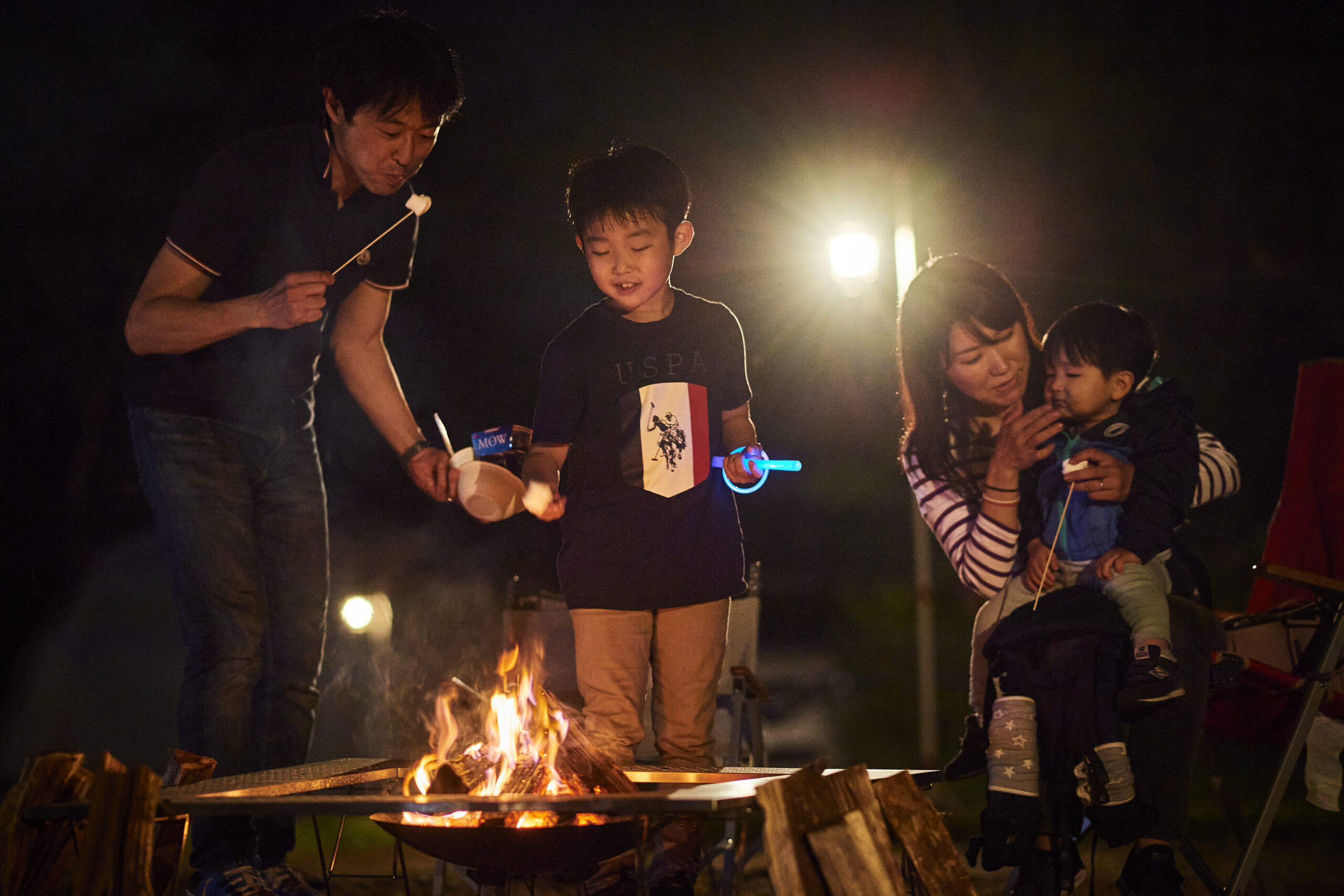
キャンプでの焚き火のやり方やオススメアイテム、注意点を解説! | コールマン|Coleman
本記事では、キャンプ初心者の人へ向けて、キャンプでの焚き火のやり方やオススメのアイテム、消火方法、注意点を紹介します。安心・安全に焚き火を楽しむためにも、ぜひ参考にしてください。
www.coleman.co.jpLong-Term Maintenance and Knowing When to Replace
Ash Removal and Pack-Out After Use
How you handle the fire grill immediately after use has an outsized effect on its lifespan. Ash in particular holds internal heat long after it looks settled, so the baseline practice is to let everything cool fully before dealing with it. As covered in the previous section, forcing the end with water is hard on the equipment — letting embers wind down and then handling ash as ash is better for both the unit and the process.
The real differentiator in ash management is treating it as a pack-out material, not something to deal with on-site. Lightweight models without ash catchers, and mesh fire beds especially, let fine ash fall through and disperse — dumping the fire bed carelessly at breakdown leaves residue around your site. After campfire cooking, I also end up with fat splatter and small food remnants mixed into the ash, so I use tongs to separate unburned pieces and collect only the cooled ash for pack-out. That small extra step keeps the stuff bag from becoming an ash cloud on the next trip.
One autumn trip, rushing through a rainy pack-out, I stashed the fire grill without fully wiping the legs. Back home when I opened it, the moisture that had pooled at the leg bases had started producing light rust spots. The lesson: a fire grill's lifespan is determined less by field conditions than by fully drying it after you're home. Packing away with trapped moisture and uncleaned residue lets the combination work on the metal between trips. Cleanup isn't finished at the campsite — it's finished when the unit is open, aired out, and dry at home.
Drying, Rust Prevention, and Material-Specific Care
As a tool that lives in high heat, a fire grill responds poorly to residual moisture. Snow Peak's materials on Takibi-Dai durability describe the extreme thermal environment as a design starting point — and heat-stressed metal with rain, condensation, or post-rinse water left on it deteriorates faster at its weakest points.
Material-by-material: stainless steel is relatively forgiving; iron is highly sensitive to moisture and rust prevention is directly tied to how long it lasts. Stainless handles wipe-down and air-dry without demanding much, though the heat discoloration and surface burns are permanent over time — that's just the use record accumulating. Iron is heavier and more confidence-inspiring when cooking, but water sitting in the leg joints or fold points invites rust to start there. Titanium's light weight is its virtue, but warping and surface change under heat have their own character — letting it cool naturally rather than quenching it tends to preserve shape better.
The practical sequence is straightforward: knock out ash → wipe soot and moisture → spread open to dry. The most common mistake is going straight back into a wet stuff sack. At home, checking that legs, the underside of the fire bed, and the valleys of weld joints are actually dry before closing everything up makes a meaningful difference. BE-PAL's fire grill maintenance coverage aligns on the same point: the fundamentals are removing residue and eliminating moisture, not specialized cleaning products.
Thermal distortion is worth monitoring too. Fire beds and side panels that absorb heat continuously warp more easily when the plate is thinner. Models designed for durability differentiate themselves through plate thickness, internal reinforcement ribbing, and the quality of leg and fire bed welds. Two units can look nearly identical and diverge significantly over two seasons of use. For someone regularly placing heavy cookware on their fire grill, that construction quality translates directly to how confident cooking feels over time.
💡 Tip
Even when the unit looks clean before stowing, leg bases and fire bed edges often hold traces of moisture. A quick wipe and a flat open air-dry at home — before folding everything closed — makes the next time you pull it out feel substantially better.
Wear Parts and Longevity Strategies
Even a durable fire grill has parts that wear first. The mesh fire bed is the clearest example — lightweight, excellent combustion, visually appealing flame, but also the component that takes the most heat and mechanical load. Load it with firewood over enough seasons and it will stretch, sag, and begin to fail at the edges. Treating it as permanent equipment sets up disappointment.
This makes replacement part availability a meaningful selection criterion for long-term users. Mesh fire beds, grates, leg end caps, and locking pins are the parts that typically give out first. When the main frame is still sound but only the fire bed has degraded, having to replace the whole unit is genuinely wasteful. Models that offer parts replacement allow you to treat the consumable components as consumable — extending the life of a fire grill you've come to rely on and fine-tune your cooking around.
Usage habits also extend service life. Concentrating all the fuel in one area and hitting it with sustained high heat accelerates localized warping. Distributing the firewood load across the fire bed keeps thermal stress more even. If you're placing cookware, a grate that spreads the load rather than concentrating it on a single point matters — small distortions under sustained heat and weight accumulate into visible leg wobble over time.
Signs it's time to consider replacement:
- The fire bed is warped severely enough that firewood won't sit stably
- Leg wobble that makes leveling the unit after setup difficult
- Rivet or joint looseness that reduces structural rigidity when assembled
- Mesh fire bed with breaks or significant fraying
When these show up, the unit may still hold fire but the cooking experience and safe handling decline noticeably. For cooks especially, secure pot placement is directly tied to how enjoyable the evening is. A fire grill's useful life is better measured by whether it still performs reliably than by whether it still technically burns fuel. The longest-lasting setups pair a robust main frame with replaceable wear components.
Making the Final Call | 3-Minute Decision Flow and Next Actions
A Decision Flow That Finds Your Type in 3 Minutes
When you're stuck choosing a fire grill, working through group size → transport method → purpose → firewood compatibility → setup effort in that order narrows the field fast. Starting with "which design looks great" almost always leads to realizing later that it's too small for the group, or too heavy for the hike. Personally, before any cooking-focused trip, I settle the first two — who's coming and how we're getting there — before looking at any products. Leave those vague and you end up with a fire grill that doesn't match the situation.
Start with group size. Solo → lightweight solo designs, 2 people → solo-to-duo models, 3 or more → family-oriented. Once cooking gear comes out, the size of the fire bed and cooking surface matter more as headcount increases. For solo use, the Uniflame Maki Grill Solo and TOKYO CRAFTS Macrite 2 are natural starting points. For family use, the Coleman FireDisc's fast setup and familiar feel tends to suit a group better.
Transport next. Hiking or motorcycle → weight and thinness first; car → stability and easy setup. For walking or riding, whether the fire grill adds bulk to the load is felt physically. The Macrite 2 at roughly 1,120 g is about a 1-liter water bottle equivalent — realistic for shorter approaches. For even more aggressive weight reduction on foot, sub-500 g designs enter the picture. Car camping removes this constraint — the heavier, wider, simpler-to-set-up model usually produces more satisfaction on arrival.
Purpose splits cleanly on cooking vs. flame aesthetics. Planning to grill or use pots? Check grate stability and load capacity. Focused on flame appearance and low smoke? Secondary combustion types enter the picture — with the caveat that they add weight, which creates friction for hiking plans. The more seriously you cook, the more "does the pot feel secure?" outweighs "does the flame look beautiful?"
Firewood length often gets missed. Standard commercial firewood is 30–40 cm — if you want to use it unmodified, a fire bed with room to spare is the comfortable choice. Compact and ultralight designs often assume you'll be splitting or shortening the wood, which adds a prep step. Wanting to go directly from market firewood to fire is a legitimate priority, and recognizing it upfront simplifies the comparison significantly.
For setup effort, the choice is fold-out for immediate use, assembly for flat storage. Arriving by car and wanting fire quickly → fold-out. Hiking or motorcycling and optimizing pack layout → thin assembly type. The FireDisc's fold-out setup speed is its signature appeal; the Macrite 2's flat-pack satisfaction is different in kind. Rather than comparing specs, imagining the setup and breakdown sequence before committing tends to produce the clearest answer.
Narrowing to two types opens up anticipating where the friction will be before it happens — processing firewood, carrying the unit, pot placement. When you can name the specific trade-off in advance, "this isn't what I expected" becomes much rarer. People prioritizing flat storage will benefit from comparing compact fold-out and assembly options together to further sharpen their picture.
Pre-Purchase Checklist
Right before buying, checking four specific points is more useful than expanding the candidate list. A fire grill doesn't work alone, so getting the surrounding gear sorted at the same time significantly improves the first-use experience. Getting those details settled in advance means arriving at the site without the "what did I forget?" feeling.
Work through these in order:
- Write down your group size and transport method in one line.
"Solo, hiking" or "family, car" — just that single line makes clear whether lightweight solo, secondary combustion, or family-oriented is the right direction.
- Decide whether you'll use firewood as-is or split it down.
If you want standard commercial firewood to go in without modification, prioritize fire bed width. If you're fine with splitting, compact and ultralight options open up.
- Choose cooking or aesthetics as your primary goal.
Grilling, pots, and boiling water → stability and load capacity first. Drawn to flame appearance and low smoke → secondary combustion delivers higher satisfaction.
- Source the supporting gear at the same time.
Fire grill mat, heat-resistant gloves, windscreen, and extinguishing tools are best purchased with the fire grill, not after. The mat in particular is easy to forget until you're on-site and need it.
ℹ️ Note
Too many options? Decide just three things first: group size, transport method, and whether you want to skip splitting the firewood. Locking those in usually cuts the viable options down substantially on its own.
For people still undecided on a fire grill mat, comparing heat resistance ratings and dimensions alongside the fire grill itself prevents on-site surprises. For people who want to look more carefully at packed size and storage efficiency, reviewing compact fire grill comparison criteria before returning to this decision sharpens the instinct for cutting candidates. The more you simplify the choosing process itself, the more enjoyable the whole preparation becomes.
A camp cooking researcher and food coordinator. Drawing on 10 years in the food industry, she reviews campfire cooking and cookware from the perspectives of both taste and convenience.
Related Articles
6 Best Camping Fire Pit Mats Compared by Continuous Use Temperature
When choosing a fire pit mat in Japan, you'll have better results by prioritizing continuous use temperature rather than just picking something that 'looks heat-resistant.' If you want to properly protect grass sites or wooden decks, aim for 700°C or above. With low-profile fire pits, layer a high-heat-resistant mat with reflective insulation, or ensure adequate clearance from the ground.
Campfire Cooking Methods Compared — Direct Flame, Fire Grill, and Dutch Oven
If you're new to campfire cooking, your first win is easiest to build over a fire grill on a glowing ember bed. The heat stays steady, you control intensity by distance, and mushrooms, meat, and bread can all move along at the same time without drama.
Solo Campfire Stoves Under 500g: 8 Top Picks Compared
Once you start solo camping on foot, by bike, or motorcycle in Japan, you quickly learn that lighter isn't always better for a campfire stove. That said, there's genuine appeal in the lightness gained by fitting a thin stove into your backpack's back panel on days when you're hiking from the station to camp. But real usability varies significantly based on storage shape, how easily wood fits, and wind resistance.
How to Choose a Fire Grill for Cooking in Japan | 5 Key Criteria
Want both the joy of watching a fire and the confidence that your food will cook properly? This guide breaks down fire grills by three conditions—group size, cooking style, and transportation method—so you can choose with confidence. We'll cover when you need a 40cm+ size, why 15kg+ load capacity matters, and specific models ranging from lightweight 794g options to the practical sweet spot of 2.8kg with 3cm storage depth.