
Envelope vs. Mummy Sleeping Bags: How to Pick the Right Shape
Envelope vs. Mummy Sleeping Bags: How to Pick the Right Shape
Choosing between an envelope and a mummy sleeping bag comes down to more than just shape. Roomy envelope bags shine for summer family camping and car-based trips, while body-hugging mummy bags excel in cold highland nights and weight-conscious backpacking or motorcycle touring. The real key to avoiding a bad purchase? Understanding temperature ratings.
Choosing between an envelope and a mummy sleeping bag trips up a lot of campers. Envelope bags are wide, flat, and feel more like a regular blanket — ideal for summer family camping or car-based trips where pack size doesn't matter. When temperatures drop at higher elevations or you need to keep your gear minimal for hiking or motorcycle touring, the body-conforming design of a mummy bag starts pulling its weight. Shape alone isn't what causes bad purchases, though. Some nights you'll appreciate an envelope bag's 90 x 200 cm footprint because you can unzip the bottom to vent heat. Other mornings, you'll want a mummy bag rated to a comfort temp of about 2 degrees C (limit around -4 degrees C) with a hood cinched tight to block cold air at your shoulders. What separates a good choice from a regrettable one is how well you read temperature ratings. This article breaks down the differences between comfort, lower-limit, and extreme temperature ratings, then maps each shape to specific seasons, travel styles, and sleeping preferences. If you're genuinely torn, consider a hybrid or stretch design that bridges warmth and freedom of movement — it's the safest bet.
The Bottom Line on Envelope vs. Mummy
When an Envelope Bag Makes Sense
If sleeping comfort and space are your top priorities and you have room in the car, go envelope. These rectangular bags — Captain Stag offers models around 90 cm wide by 200 cm long — feel closer to sleeping under a proper comforter. You can bend your knees, roll onto your side, and shift around without that suffocating wrapped-up sensation. For anyone who's ever felt claustrophobic in a sleeping bag, the envelope shape is far easier to settle into.
Temperature ratings tell the same story. Summer-focused envelope bags typically target the 5-10 degrees C range, and you'll find models rated down to 5 degrees C for general use. Some claim -5 degrees C for colder conditions, but the rectangular design naturally leaves gaps around your body, so an envelope bag will feel colder than a mummy bag carrying the same rating. In my experience, an envelope bag is blissfully comfortable at lowland auto-camping sites through spring to early fall, but once you're at a highland site where mornings get crisp, you start reaching for extra blankets and liners.
Pack size and weight are the envelope bag's weak spots. No precise cross-category statistics exist, but the trend is unmistakable: for equivalent warmth, envelope bags run heavier and bulkier than mummy bags. That's a non-issue when you're loading a car trunk, but on foot or on a motorcycle the difference becomes very real. For family camping with car access, though, the blanket-like comfort is a genuine advantage — kids fall asleep easier, and you can unzip the whole thing into a flat quilt on warm nights for instant temperature control.
Price-wise, the entry-level bracket (a few thousand yen / roughly $20-70 USD) skews heavily toward envelope bags, making them an accessible starting point (prices as of publication).
When a Mummy Bag Makes Sense
If warmth and packability top your list — especially for cold-weather camping or weight-restricted travel — a mummy bag is the answer. The tapered shape hugs your body from shoulders to feet, cutting down on dead air space. Less air to warm means faster heat-up and less cold-air intrusion. Honda's sleeping bag comparison guide makes this structural difference crystal clear.
Temperature specs highlight the mummy bag's strengths. Captain Stag's lineup includes models with a comfort rating around 2 degrees C and a lower-limit rating around -4 degrees C — the kind of numbers that matter when you're camped at elevation in spring or fall. You do sacrifice the freedom to sprawl, but the hood and snug shoulder area keep heat from leaking at dawn when temperatures bottom out.
Sizing runs slim, but length options are generous. Models accommodating up to 188 cm tall users exist, so height alone isn't limiting. Shoulder-width fit and personal tolerance for snugness are worth checking beyond just the stated length. Recent designs have started loosening the foot box or adding stretch panels, steadily chipping away at the old "warm but restrictive" reputation.
Packability is one of the mummy bag's strongest cards. The size difference that feels trivial when loading a car becomes immediately tangible on a trail or strapped to a motorcycle. A few liters less in compressed volume can mean the difference between fitting your rain gear and cook set or leaving something behind. On touring trips, that compact form factor is comfort in its own right. When I'm packing tight, the mummy bag gets chosen before I even think about sleeping comfort.
Prices span from entry-level models around a few thousand yen (~$20-40 USD) through the mainstream band of 10,000 to 30,000 yen (~$65-200 USD), and on up past 50,000 yen (~$330+ USD) for high-performance down bags (prices as of publication; sources include SAiKYO / Kakaku.com). Within the mummy category, price tends to scale with warmth-to-weight ratio and materials.
寝袋の選び方|マミー型・封筒型、おすすめはどっち?|Hondaキャンプ
キャンプ道具の選び方「寝袋(シュラフ)」編。あなたにオススメの寝袋がわかる!選ぶ際のポイントや、マミー型や封筒型、寝袋の各タイプの特徴をご紹介します。
www.honda.co.jpThree Factors That Actually Decide It
When you're stuck, stop thinking about shape preference and break the decision into three concrete conditions.
- Season and Expected Low Temperatures
Summer camping at sites where nighttime temperatures stay mild? The envelope bag's comfort wins out. Spring and fall at highland sites with big temperature swings? A mummy bag with the same temperature rating performs better in practice. If you want an envelope bag to cover cold seasons too, plan around supplements from the start — blankets, a liner, warm base layers, a hot water bottle. That's working with the shape's structure rather than against it.
- How You're Getting There
Car camping means envelope-bag bulk barely matters, and over time the spacious comfort holds up well. You're actually more likely to enjoy the extra room precisely because trunk space isn't a constraint. Switch to hiking, motorcycle touring, or bicycle camping, and the equation flips. A single sleeping bag's volume difference can reshape your entire packing plan. Mummy bags have the edge in packability and weight. Whether it rides in a pannier or shares a pack with the rest of your kit, shape choice follows transport method.
- Build and Sleep Style
Restless sleepers, people who spread their legs out, anyone who hates feeling confined — envelope bags tend to deliver more stable sleep. On the flip side, if you'll tolerate a snugger fit for better warmth, mummy is the way to go. On the build side, shoulder width and internal room matter as much as length. Putting a child in an adult bag creates excess internal space that actually makes it harder to stay warm, so a properly sized bag is structurally smarter.
💡 Tip
If your hesitation sounds like "I want warmth but can't stand mummy-bag tightness," a hybrid shape deserves a look. Some models advertise up to 125% stretch, aiming to balance warmth with freedom of movement (reference: BE-PAL). Real-world comfort varies significantly by model, so checking multiple reviews before buying is the reliable move.
For a quick rule of thumb: summer family camping by car = envelope; fall/winter or touring = mummy. Layer your sleep habits and build on top of that, and the right shape becomes obvious.
Five Ways Sleeping Bag Shape Changes Your Night
The shape difference isn't cosmetic — it directly affects how heat escapes while you sleep and how freely your body can move. The key comparison axes are warmth retention, ease of rolling over, foot-box pressure, packed size, temperature adjustability, and head insulation.
Start with warmth. Mummy bags taper from shoulder to toe, minimizing the air volume your body has to heat. Less dead space means less heat loss — straightforward physics. Envelope bags leave room at the shoulders and feet, so even with identical fill, cold spots develop more easily. On a fall highland night when temperatures slide after midnight, that gap shows up fast. At an October highland camp, just cinching a mummy bag's hood slightly was enough to seal out that chilly draft at my shoulders and make it noticeably easier to fall back asleep.
Freedom of movement, though, goes to the envelope bag. The rectangular interior lets you bend your knees, roll sideways, and generally move the way you would under a home comforter. Foot-box pressure is minimal. Mummy bags restrict the area from toes to knees for thermal reasons, which trades cold resistance for potential discomfort if you're a restless sleeper. Hybrids and stretch designs sit in the middle — models touting "up to 125% stretch" (as covered by BE-PAL) are engineered to stay close without locking you in. How much that stretch actually contributes to warmth and comfort varies model by model, though.
Packed size and weight also track with shape. While no comprehensive cross-category study exists, the general rule holds: for equivalent warmth targets, a mummy bag's more efficient material use lets it compress smaller. In practice, the difference feels larger than the numbers suggest. A few liters of compression volume determines whether your sleeping bag leaves room in the bottom of your pack for rain gear and a cook set. For car camping, an envelope bag's bulk is easy to absorb and its nighttime comfort pays dividends. On foot or on a bike, the mummy bag's packability takes over.
Temperature adjustability is the envelope bag's specialty. Unzip it wide and it becomes a quilt. Crack just the foot end on a warm night for targeted ventilation. When early-summer temps are hard to predict or family members run at different temperatures, that flexibility simplifies everything. Mummy bags trade ventilation for containment — hoods and draft tubes lock heat in, and when cold air pushes in at 4 a.m., a mummy bag holds its ground better. Head and neck insulation is where the gap is most pronounced; if that zone gets cold, the whole bag's warmth rating feels academic.
On head insulation specifically, the mummy bag's advantage is clear-cut. The hood wraps your head, and a draft tube along the neck seals the gap where warm air tends to escape. Envelope bags leave your head exposed — comfortable in mild weather, but on cold nights you'll find yourself adding a neck gaiter or draping a blanket over your shoulders. Shape differences aren't just about fill weight; they're about where heat can and can't escape.
Temperature Ratings Explained (Comfort / Lower Limit / Extreme)
One detail that trips people up when comparing shapes is what the temperature numbers on a sleeping bag actually mean. Confuse these, and you can't compare an envelope bag to a mummy bag fairly.
Under EN 13537 and ISO 23537, the core ratings work like this: COMFORT is the temperature at which a standard adult woman can sleep relaxed. LIMIT is the lower bound for a standard adult man sleeping curled up. EXTREME is a survival-oriented figure where hypothermia risk enters the picture. The same "5 degrees C" printed on two bags can mean completely different things depending on which rating it refers to.
Shape amplifies the gap. An envelope bag's inherent air gaps mean it tends to feel colder in practice than a mummy bag with identical temperature specs. A mummy bag's hood and neck baffles retain heat more effectively, so the warmth advantage holds even as morning temperatures drop. Don't line up catalog numbers side by side without checking which rating you're reading and what shape it's attached to. That double check sharpens every buying decision.
Mini Glossary
Draft tube — A padded strip running along the zipper to block cold air from seeping through. Most common on mummy bags, effective at the neck and chest.
Hood — A shaped panel that wraps around your head, creating an insulating air pocket. Different from simply wearing a beanie — the sleeping bag itself maintains the warm-air layer.
Envelope (rectangular) bag — A straight-sided sleeping bag that opens flat like a blanket. Prioritizes room and comfort over thermal efficiency.
Mummy bag — A body-shaped bag that tapers from shoulders to feet, reducing internal volume for better heat retention.
Hybrid shape — A design that splits the difference: mummy-like taper with envelope-like room at key points. Examples include widened foot boxes and stretch-panel torsos. Worth considering when you want both roll-over room and solid warmth.
Who Should Pick an Envelope Bag — And When
Three Envelope-Bag Advantages
The envelope bag hits its stride in a specific lane: summer-focused camping, family trips, car-based travel. The rectangular interior keeps pressure off your body, and tossing and turning barely registers. I'm someone who values sleep quality over gear minimalism, and to me an envelope bag feels less like "climbing into a sleeping bag" and more like "wrapping up in a slightly thicker comforter." First-timers adapt quickly. On an August lowland trip, I left the foot end unzipped to let air flow, then pulled it shut around dawn when temperatures dipped — that quilt-style versatility made the night effortless.
The first clear advantage is ventilation and temperature control. Open the zipper wide on a hot night, close it up when things cool down. Models with dual-zip connectors let two bags join side by side, a distinctly envelope-bag perk for couples or parent-child setups. At family auto-camping (drive-in campsite) outings, this adaptability handles kids who kick off covers without anyone losing sleep over it.
CAMP HACK (https://camphack.nap-camp.com/6673) lays out similar guidelines as a reference point. Treat these as one set of benchmarks among several.
Generous dimensions are another reason to go envelope. Captain Stag's 90 x 200 cm class models give you room to twist, prop up your knees, and generally shift around. If you struggle to find a comfortable position on a camp mat, toss in your sleep, or need space to settle a child before tucking yourself in, that extra width translates directly into better rest.
Envelope-Bag Caveats and Workarounds
The main thing to watch: winter demands extra effort. As noted earlier, an envelope bag feels colder than a mummy bag at the same rated temperature. The rectangular shape leaves air pockets at the shoulders and feet, and in late fall through winter those gaps become cold-air reservoirs.
For a down-filled envelope bag targeting colder conditions, some guides (e.g., CAMP HACK) cite around 760 FP as a rough benchmark. Fill power is only one factor, though — down volume, baffle construction, and overall fit all shape real-world warmth. Treat the number as a starting reference, not a guarantee.
The pragmatic move is to own the envelope bag's limitations. Plan it for summer camping, spring/fall car-based trips at lower elevations, and heated-cabin winter stays supplemented with blankets. Under those conditions the downsides stay manageable. If you need a single bag that handles highland winter nights, an envelope shape is fighting its own structure — a mummy or hybrid will serve you better.
For family use, easy washing and handling often matter more than raw warmth ratings. With kids in the mix, the realistic priority is a bag you can clean without stress. Envelope bags score well here. The more your checklist reads "comfortable sleep, blanket-like feel, car with decent cargo space," the stronger the envelope-bag case gets. Just plan winter separately. That one mental boundary is the simplest way to keep an envelope bag purchase from turning into a regret.
Who Should Pick a Mummy Bag — And When
Three Mummy-Bag Advantages
The mummy bag clicks when your conditions look like this: fall/winter camping, high-elevation sites, solo trips, touring, or any scenario where gear volume matters. By hugging your body and cutting internal dead space, a mummy bag retains heat more efficiently and packs down smaller than an equivalently warm envelope bag. On motorcycle tours where pannier space is precious, that "warm yet compact" balance is something I appreciate every single trip.
Advantage number one: insulation that extends to your neck and head. The hood and shoulder taper work together, and models with a draft tube add another seal against cold air along the zipper and neckline. Captain Stag's mummy-bag page highlights this construction as the thermal linchpin. On a site at around 1,000 m elevation in October, a mummy bag rated to the same temperature band as an envelope bag kept me noticeably warmer through the pre-dawn hours. Eliminating shoulder gaps alone makes a dramatic difference in how cold air reaches your core.
Advantage number two: temperature ratings designed for real cold. Mummy bags with a comfort rating around 2 degrees C and a lower limit around -4 degrees C are common. That range covers spring and late-fall highland sites where morning temps nosedive. Beyond the catalog numbers, the tight fit around shoulders and neck produces a real-world warmth surplus that the specs don't fully capture.
Advantage number three: packability. The tapered cut means less fabric and less fill, yielding a lighter and more compressible package at equivalent warmth levels. The payoff is invisible when you're loading a car, but it's immediate on a trail or motorcycle. Shaving a few liters off your sleeping bag's packed size frees room for spare layers or a cook kit in the same pack. On a bike, it can change whether gear fits a pannier or not.
On sizing, mummy bags reward precision. mybest lists models accommodating users up to 188 cm tall, but longer isn't automatically better. Excess internal length undermines the close-fitting design that makes mummy bags warm in the first place. Match shoulder width and bag length to your frame for the best thermal performance and movement.
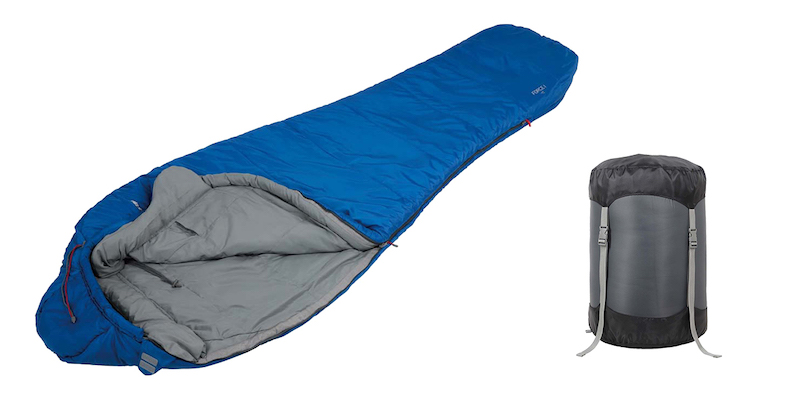
マミー型(人形型)寝袋(シュラフ)を選ぶ | アウトドアお役立ち情報
マミー型(人形型)の寝袋(シュラフ)は軽くてコンパクトに畳めるためソロキャンプやツーリングなどにおすすめです。キャプテンスタッグのおすすめマミー型(人形型)寝袋(シュラフ)をご紹介します。
www.captainstag.netMummy-Bag Caveats (Tightness and Moisture) and Solutions
The most common gripe with mummy bags is feeling constricted. Sleepers who bend their knees, favor their side, or are used to blanket-style freedom tend to notice the tapered knee-to-toe zone most. This isn't a defect — it's the design doing its job — but if the fit clashes with your sleep habits, your rest suffers directly.
The fix: don't default to the slimmest cut available. Plenty of current mummy bags widen the knee area or foot box, and stretch-panel models let the torso flex. Designs advertising up to 125% stretch aim to keep body contact while allowing movement — a hybrid-leaning approach that works well in practice. Even people who've written off traditional mummy bags often find a wider-foot or stretch model perfectly tolerable.
The second issue is moisture buildup. A close-fitting bag warms fast, but zipping it up to the neck can trap humidity, especially on calm fall nights or right after you climb in while your body temp is still elevated. The solution is simple: don't treat a mummy bag as an all-or-nothing seal. Leave the hood loose, crack the zipper an inch or two, and create a small vent path. Adjust the closure as temperatures drop overnight. Thinking of a mummy bag as a tool you regulate rather than a cocoon you seal makes it far more livable.
ℹ️ Note
If you're unsure whether a mummy bag will work for you, focus less on warmth specs and more on where exactly it feels tight. Shoulders? Knees? The answer points to different solutions. If you want shoulder-area insulation without sacrificing mobility, a wider-foot or stretch-panel model is likely your match.
A mummy bag chosen purely on warmth specs can disappoint. Chosen for the right scenario — cold-weather camping, solo travel, compact packing — it's unbeatable. At high-elevation sites and on touring trips, the structural advantage of a hood and draft tube translates directly into better sleep. If tightness is your only reservation, look beyond traditional slim cuts toward models that match your frame and give your joints room. That's how you get the mummy bag's strengths without fighting its shape.
Comparison Table: Envelope, Mummy, and Hybrid
Here's a side-by-side across temperature range, dimensions, packability, weight trend, price range, and best-fit scenarios. The short version: the more your conditions stack toward fall/winter, high elevation, solo or touring, and packability, the more a mummy bag makes sense. Summer car camping still favors the envelope bag's comfort. Hybrids sit in between, trading a bit of each extreme for a balanced middle ground.
| Category | Envelope | Mummy | Hybrid |
|---|---|---|---|
| Temperature range | Summer-focused; thicker cold-weather models exist | Fall/winter-oriented; strong cold-weather performance | Spring/fall core; balances warmth and mobility |
| Dimensions | Wide, rectangular; blanket-like feel | Body-conforming, tapered to the feet | Extra room at shoulders/knees |
| Packability | Bulky | Compresses small | In between |
| Weight trend | Tends heavier | Tends lighter | In between |
| Price trend | Heavy on entry-level | Strong mid-to-upper range | Mid-to-upper range |
| Best scenarios | Summer, family, car-based | Fall/winter, high elevation, solo, touring | When you want both comfort and warmth |
Packability and weight here reflect general trends when comparing equivalent warmth levels and similar materials. Real-world packing experience adds nuance: whether the stuff sack is long and narrow or short and wide affects how it fits your bag, and compression-strap effectiveness changes the feel dramatically. On a motorcycle, a two-centimeter difference in diameter can decide whether a bag fits a pannier. That margin matters more than any spec sheet suggests.
Numerical Benchmarks
CAMP HACK and similar guides cite a comfort-use temperature of roughly 5-10 degrees C as one benchmark for envelope bags. For synthetic-fill models, around 1,200 g of insulation is sometimes referenced as a loft guideline (source: CAMP HACK). These are reference points — actual performance varies with construction and conditions.
Concrete examples: Captain Stag's envelope line includes models in the 90 x 200 cm size class, with temperature ratings starting at 5 degrees C and cold-weather variants rated to -5 degrees C. The spaciousness is appealing, but in genuinely cold conditions that extra interior volume becomes dead air that's hard to heat, giving mummy bags the efficiency edge.
On the mummy side, Captain Stag lists models at comfort ~2 degrees C / lower limit ~-4 degrees C — numbers that clearly signal cold-weather intent. Add a hood and draft tube, and heat loss at the shoulders and zipper line drops further. At high-altitude sites or basin campgrounds where "sudden 4 a.m. temperature crash" is a regular occurrence, that structural design directly stabilizes your sleep. mybest lists models accommodating heights up to 188 cm, though a proper length match matters more than excess room — the mummy bag's insulation design works best when it fits closely.
Hybrid and stretch models are easiest to evaluate with numbers in hand. As covered by BE-PAL, some advertise around 125% maximum stretch. The engineering intent is body-following flex that preserves close contact without locking joints in place. Real results differ by model, so checking hands-on reviews before purchase is the reliable approach.
Quick-Reference: Best Shape by Scenario
Combining the numbers and structural differences, here's how shape preferences map to real camping situations.
| Scenario | Recommended Shape | Why |
|---|---|---|
| Midsummer lowland camping, family trips, car access | Envelope | Maximum ventilation, quilt-style versatility |
| Spring/fall auto-camping with comfort priority | Hybrid | Balances roll-over room with warmth |
| Fall/winter camping, sites with sharp morning cold | Mummy | Hood and draft tube lock in heat |
| High-elevation sites, basin cold snaps | Mummy | Shoulder and neck seal reduce cold-air infiltration |
| Solo camping with minimal gear | Mummy | Packability and weight advantage |
| Motorcycle touring, hiking, bicycle camping | Mummy | Packed size directly affects cargo capacity |
| Mummy-averse but need cold-weather protection | Hybrid | Stretch panels and wider foot boxes reduce constriction |
Even within this table, when fall/winter + high elevation + solo + touring + packability all line up, the answer is straightforwardly a mummy bag. Envelope bags do offer cold-rated models, but once you factor in structural cold-air blocking — hoods, draft tubes, shoulder baffles — a mummy bag is the more rational choice. Conversely, if tightness genuinely disrupts your sleep, forcing yourself into a slim mummy is counterproductive. A hybrid or stretch design will deliver better actual rest. Shape selection isn't just about warmth — it shifts with where you're going and how much gear weight you can tolerate.
Making an Envelope Bag Work in Cold Weather
Immediate Fixes With Gear You Already Own
If you're taking an envelope bag into cold conditions, the most effective first move is adding air-trapping layers inside and outside the bag before replacing the bag itself. That generous rectangular interior is great for rolling over but also lets pockets of cold air settle in. The quickest fix: drape a blanket or throw over the top to cut heat escape paths. This single addition hits hard for car camping and vehicle-based overnights. One winter car-camping trip, I layered a blanket and liner inside the envelope bag, tucked a fleece around my neck, and the pre-dawn chill went from "woke me up twice" to "barely noticed."
Clothing strategy matters too. Rather than simply piling on thick layers, focus on maintaining an unbroken insulating layer. A fleece mid-layer or thin synthetic jacket worn specifically for sleeping traps body-warmed air more effectively than stacked sweatshirts, and you'll feel the difference by morning. Since envelope bags leave space around the shoulders, covering your neck — not just your torso — makes the system more efficient.
An inner liner (sleeping bag liner) pairs especially well with envelope bags. Adding a thin layer inside calms the air movement within the bag and provides a noticeable warmth boost. Because envelope bags have more internal volume to begin with, the effect of inserting a liner is more pronounced than in a mummy bag. Think of it as building a second, thinner wall closer to your body so warm air stays put.
For active heat sources, a hot water bottle or adhesive warmer placed at your feet or lower back is the classic approach. Cold feet make your whole body feel cold, so warming just the foot zone measurably improves how quickly you fall asleep. Placed near the lower back, a heat source also softens core-area chill. To avoid low-temperature burns, always use a towel or clothing layer as a buffer — never direct skin contact.
An often-overlooked detail: sealing the gaps at your neck and feet. These are the primary entry and exit points for cold air in an envelope bag, and they can undermine even high-quality fill. A scarf, neck gaiter, or thin fleece tucked around the neck blocks the drafty feeling at the shoulders. At the foot end, stuffing a small blanket into the unused space collapses the cold-air pocket. The envelope bag's roominess is simultaneously its comfort advantage and its thermal weakness — the trick is plugging gaps selectively rather than trying to make the whole bag warmer.
💡 Tip
Work from the extremities inward: feet first, then neck, then an outer blanket layer. This sequence gets the most warmth from the least additional gear. With envelope bags, targeting the specific spots where cold air enters and exits produces a bigger comfort improvement than adding bulk uniformly.
Reassessing Temperature Ratings and Knowing When to Upgrade
Supplemental gear buys time, but for cold-weather envelope-bag use, don't take the printed temperature rating at face value. As discussed, an envelope bag tends to feel colder than a mummy bag at the same stated rating. The reason is structural: shoulder and foot-end gaps prevent your body from maintaining a close layer of warm air. When catalog specs say winter-capable, reality often runs a tier colder.
The real question when reassessing is how much supplemental gear you're willing to layer in. If blankets, warm sleepwear, a liner, and a hot water bottle together produce a comfortable night, the envelope bag is still earning its keep. But if cold spots at the neck and feet persist trip after trip despite the full supplement stack, the bag's structure has hit its ceiling. Waking repeatedly from cold in the pre-dawn hours is an unambiguous signal.
When evaluating an upgrade within the envelope category, guidelines sometimes cite "around 1,200 g of synthetic fill" or "high fill-power down" as reference points. These are useful starting indicators, not guarantees — actual warmth depends on down volume, baffle design, and overall fit.
Meanwhile, if every cold-weather trip requires blankets, a liner, dedicated sleep clothes, and a hot water bottle just to get through the night, shifting to a shape that structurally retains heat is the more rational path. You can winterize an envelope bag, but the gear count and setup time climb steadily. Car camping absorbs that overhead; solo trips and multi-night outings don't. When it's time to choose: prioritize sleep comfort and open feel? Heavy-duty envelope bag. Prioritize thermal efficiency? Mummy bag. Want warmth without claustrophobia? Hybrid. That three-way split is the most stable framework for the decision.

偏差値とは何?偏差値の意味と求め方・計算方法をわかりやすく解説!|栄光ゼミナールの受験情報
高校受験や大学受験の際に「偏差値」を基準にすることが多いですが、偏差値はどんな数値なのか説明できますか?偏差値とは何か・求め方・注意点を解説していきます。志望校の偏差値を見る際に参考にしてください。
www.eikoh.co.jpA No-Regrets Buying Checklist
The sleeping bags that don't disappoint are chosen by locking in your camping environment and sleep style first, not by starting with shape. Before your trip, check the expected overnight low temperature at your destination. Don't rely on lowland forecasts alone — highland sites at elevation drop sharply before dawn. When I started booking more fall trips where temps approached 0 degrees C at alpine sites, I reconsidered the envelope bag I'd been using for its comfort. The biggest change wasn't "I was cold" — it was waking up fewer times from overnight chill. A sleeping bag is comfort gear, sure, but it's also sleep-protection equipment.
An easy detail to miss: your transport method changes the right answer. Car camping lets you lean into comfort and temperature flexibility — bulkier envelope bags and thick models stay on the table. Hiking or motorcycle touring flips the priority to packability, where a few liters of volume difference restructures your entire load. Underestimating portability is one of the most common sleeping-bag regrets.
Build and sleep habits deserve equal weight. Factor in shoulder width, side-sleeping tendency, and how often you roll over — not just height. Larger-framed people, knee-benders, and restless sleepers can find a slim mummy bag stressful regardless of its warmth rating. In that case, an envelope bag or a stretch-enabled hybrid should lead your shortlist. If you're heading to colder sites more often and can accept a closer fit, leaning toward a thermally efficient shape will pay off in the field.
Whether kids will use it is another branching point. An adult bag on a child creates excess interior space that's harder to heat, working against the bag's insulation. If child-sized options exist, matching the bag to the user's height is structurally smarter. Family camping tempts you to share adult bags, but from a warmth standpoint, dedicated sizing makes more sense.
On the maintenance side, check washability before you buy. Can it be machine-washed? Does it dry quickly? Is hang-drying a hassle? These factors determine whether a bag stays in rotation or collects dust. Down bags especially need post-wash care planning. For family and kid use where stains are inevitable, "easy to clean" should outrank "slightly warmer" — a bag you actually use repeatedly beats one you baby.
Finally, if you plan to rely on liners or hot water bottles, select a temperature rating with a margin of safety. Building comfort around supplemental gear is a valid strategy, but starting at the very edge of a bag's rating means one missing piece makes for a rough night.
Your action steps are simple:
- Pin down the season and your destination's expected low temperature and elevation
- Clarify whether you're traveling by car or by foot / motorcycle
- Honestly assess your build, shoulder width, and restlessness
- Factor in kid use and how easy the bag is to wash
- If supplements are part of the plan, bump the temperature rating up one tier
Complete tent buying guide
When shape alone doesn't settle the decision, step back to the bigger picture of sleeping-bag selection. Revisiting temperature-rating literacy, fill types, and use-case mapping makes the envelope-vs-mummy call more stable.
Solo tent recommendations and comparison guide
Even the right sleeping bag underperforms if ground cold seeps through. Especially when you're shopping by temperature threshold and elevation, nailing your sleeping pad choice at the same time prevents the most common comfort gap.
Winter camping tent selection guide
Car campers who prioritize sleeping comfort should also check cot compatibility — height, ease of entry, and how cold air behaves underneath. Deciding your sleep system as a unit (bag + pad or cot) cuts down on do-over purchases.
Related Articles
Down vs Synthetic Sleeping Bags: How to Read Temperature Ratings and Pick the Right One
Down or synthetic? The answer is never one-size-fits-all. Factor in your transport method, the season, condensation risk, budget, and long-term care, and the right choice becomes surprisingly clear.
Winter Camping Cold Prevention | 3 Core Principles and Layering Order
Sleepless nights on winter camping trips in Japan often stem not from insufficient sleeping bags, but from how the bed foundation is constructed. Ground-transmitted cold, radiative cooling, and inadequate air layers in mats compound when nighttime temperatures drop to near freezing on highland sites—draining body heat from your back.
Best Winter Sleeping Bags 2026: 8 Top-Rated Options for Comfort Down to -5°C
Choosing a winter sleeping bag that won't fail you starts with a simple rule: prioritize comfort temperature ratings of -5°C or lower. This guide compares 8 winter sleeping bags across price, weight, packed size, temperature range, and fill material—then walks you through temperature rating interpretation and down vs. synthetic selection to help you narrow down your options with confidence.
How to Choose a Sleeping Bag | Minimum Temperature, Comfort Range, Materials, and Shapes
The key to avoiding mistakes when choosing a sleeping bag is working backward from the expected minimum temperature of your destination. Rather than focusing on the Extreme rating, start with the EN/ISO Comfort temperature, then narrow down between down and synthetic materials, and mummy, envelope, or egg shapes based on your load capacity and how prone you are to condensation.