
Family Tent for 4-5 People: How to Choose the Right One
Family Tent for 4-5 People: How to Choose the Right One
Choosing a tent for a family of four is trickier than it looks — grab a "4-person" tent and you'll likely end up with just enough room to sleep, nothing more. In practice, going one size up to a 5- or 6-person equivalent gives you real breathing room, especially with kids in tow. Ease of setup, space to change clothes without contorting, and staying comfortable through rain are the factors that make or break a family camping trip.
When it comes to tents for a family of four, picking a "4-person" model at face value is a reliable way to end up cramped. The better move is to look at 5- to 6-person equivalents — that's where your family actually fits. With kids in the picture, three things end up mattering most: how quickly you can get the tent up, whether there's enough headroom to change clothes comfortably, and whether you can hold it together mentally when the rain rolls in.
This article breaks down dome, two-room, tunnel, instant, and air tent styles across three axes — ease of setup, livability, and weather resistance — while using widely referenced benchmarks as comparison points: roughly 180×55 cm of sleeping space per person, 170 cm minimum interior height, and 1,500–2,000 mm water resistance. Along the way I'll pull in real-world moments: the Friday-night arrival where quick setup saved the day, or the wet pack-up where a heavy tent became a serious problem. By the end, you should be able to see clearly whether your family prioritizes setup speed, living space, or budget — and get your shortlist down to two or three candidates.
Don't Let the Capacity Label on a Family Tent Fool You
The Gap Between Rated Capacity and Real-World Comfort
The "4-person" or "5-person" label on a family tent doesn't mean four or five people will be comfortable — it's closer to a maximum sleeping count, jammed in tightly. Even camping gear sites that explain capacity ratings tend to frame the number as a tight-fit benchmark rather than a comfortable occupancy.
The practical consensus across multiple sources: if you have a family of four, look at 5- or 6-person capacity tents. I fully agree with that. Squeeze four people and their gear into a "4-person" dome and yes, everyone fits for sleeping — but changing clothes, managing a kid who thrashes around at night, and getting in and out at 2 a.m. all become miserable. Particularly with small children, floor space disappears fast: sleeping pads push gear toward the edges, a bag of tomorrow's clothes ends up at your feet, and the cooler migrates to the entrance — the tent feels far smaller than the floor plan suggests.
A good example of where the numbers mislead is the dome-style Ogawa Pista 5. Its floor footprint is a reasonable-looking 270×270×180 cm. But "5-person tent" doesn't mean five people plus gear will live comfortably inside. Realistically, two adults plus two kids with their gear is about right — anything more and you're eating into the space you need for nighttime movement and morning routines.
The two-room designs work differently. The Snow Peak Entry 2 Room Elefield is rated for four people, and with four people it actually functions well — because the living area handles gear so the sleeping area stays clear. The raw capacity number is the same as a dome, but the livability feels completely different.
💡 Tip
Think of rated capacity as "sleeping headcount." Actual comfort means accounting for sleeping bodies, gear, and the space to move around at night. Add those up, and size selection becomes a lot more accurate.
Converting the 180×55 cm Per-Person Benchmark to Real Family Use
The 180×55 cm per-person sleeping estimate gets cited a lot in tent comparisons, and for good reason — it's a useful minimum. But for family camping, you need to layer on top of it.
Running the math for four people:
- 180×55 cm = 9,900 sq cm per person
- ×4 = 39,600 sq cm
- That's 3.96 sq m of minimum sleeping floor space for four
Most 4-person tents clear that threshold on paper. The problem is what comes next. On a camping trip, you can't dedicate the entire floor to sleeping. Extra clothes, towels, a stuffed animal, an LED lantern, water bottles, a jacket for tomorrow morning — all of that ends up in the sleeping area. And someone needs room to step around people to get to the entrance at night.
Once you factor in gear and movement space, 3.96 sq m for four people isn't enough. A tent that's "exactly right" on paper becomes a floor-to-ceiling puzzle the moment your family's bags are inside. For four people, the practical solution is either going up to a 5- or 6-person floor area, or choosing a design that offloads gear into a vestibule or living room.
The Ogawa Pista 5 has a 270×270 cm floor — that's 7.29 sq m — comfortably above the minimum 3.96 sq m. But add gear and walking space, and you end up right at "fine for four, starts getting tight at five." Classic case of rated capacity diverging from real-world comfort.
We go into this logic in more detail in our tent sizing guide on this site. The key framing: separate "sleeping area" from "living area" and size accordingly.
Why Vestibule and Living Space Matter More Than You Think
One thing families underestimate with tent shopping is whether there's a vestibule or living area. This isn't a bonus feature — it determines how much of a rainy day you can actually enjoy, how easy morning routines feel, and how chaotic pack-up is.
Dome tents without a vestibule are simple and manageable, but they offer nowhere to stow wet gear. Where do shoes go? Where do you take off a soaked rain jacket before climbing in? Where do kids play when it's pouring? All of that lands in the sleeping area. On a sunny day you barely notice — the moment weather turns, you're mentally calculating floor space for every item.
Two-room tents are noticeably stronger here. The Logos neos PANEL Screen Double XL-BB is a two-room design rated for 4–6 people, listed at 77,000 yen (~$500 USD) on the Logos official site, with Amazon listings at 47,000 yen (~$310 USD). Fly water resistance is 2,000 mm; floor is 3,000 mm. The ability to keep gear in the living area instead of the sleeping area changes everything. Wet things stay wet but separated. Kids can go to sleep in the bedroom while adults have space to move around — something single-room domes simply can't offer.
Interior height matters here too. The commonly cited 170 cm benchmark is genuinely meaningful for families. The Snow Peak Entry 2 Room Elefield hits 210 cm — with that kind of clearance, you can stand up straight while changing, walk through with something in your hands, and pivot while holding a toddler. That extra 35 cm or so above standing height shifts the feeling from "I can stand" to "I can actually function in here."
A vestibule or living area isn't about extra square footage. It's insurance against bringing gear into the sleeping space, and it's what protects your family's time and mood when the weather turns. When you're shopping for a 4–5-person tent, it's easy to focus on sleeping capacity — but for family camping, "where do we spend the hours we're awake?" matters just as much.
7 Things to Evaluate When Choosing a 4–5-Person Family Tent
1) Tent Style
Shape is the first decision, because it determines everything else about how the tent functions. For 4–5-person family tents, the main categories are: dome, two-room, and quick-pitch options (instant/air).
Dome tents are structurally straightforward — the kind of tent where you can figure out what goes where fairly quickly, even on your first try. The Ogawa Pista 5, for example, is a 5-person dome at 270×270×180 cm. Plenty of floor space, but because sleeping and gear storage share one room, families of four need to be intentional about where things go. Rain day comfort is limited.
If livability is the priority, two-room tents are the obvious move. Models like the Snow Peak Entry 2 Room Elefield and the Logos neos PANEL Screen Double XL-BB separate the sleeping area from the living area, which is a game-changer when you need to put kids to bed early while adults want to stay up. The comfort gap between a two-room and a single dome really shows on cold or rainy days.
For speed above all else, instant and air tents are worth considering. Some air tents go up in around 100 seconds — that's not a typo. But there's a catch: large models are heavy and pack down bulky. You save time pitching, then spend it hauling. With kids, the setup-to-arrival math often doesn't work out the way you expect. Cutting five minutes off pitch time doesn't mean much if carrying the tent to the site already has you winded.
The simple breakdown: dome for clear-weather simplicity, two-room for all-weather family camping, instant/air when pitch time is the top priority.
2) Size: Look at Sleeping Dimensions, Not Just Rated Capacity
Picking between "4-person" and "5-person" without looking at actual sleeping dimensions is how families end up disappointed. The more useful question is: how many people are lying down, and in what configuration? The 180×55 cm per-person benchmark gives you an anchor. Four people need about 220 cm of width; five people need about 275 cm.
The Ogawa Pista 5 at 270×270 cm is realistic for four sleepers. Two adults plus two kids laid out side by side works, and with a bit of creative gear placement, the crowding stays manageable. But it's right at the edge of its "5-person" label — there isn't genuine extra room for five plus their stuff.
Two-room tents have a structural advantage here. Even when the sleeping area dimensions aren't published, the ability to move gear into the living room means the sleeping area stays available for sleeping. That's why a four-person two-room tent can feel more spacious than a four-person dome with identical floor numbers.
ℹ️ Note
Rated capacity means sleeping headcount. Actual comfort depends on sleeping bodies plus gear plus room to move at night. For a family of four, going one capacity bracket up gives you genuine ease — not a luxury, just a functional buffer.
3) Interior Height: 170 cm as the Standing Benchmark
Floor area matters, but ceiling height shapes the experience just as much. The 170 cm mark is a meaningful threshold — above it, most adults can move without constantly ducking, which reduces friction during every changing session, bag grab, or midnight bathroom trip.
The Snow Peak Entry 2 Room Elefield at 210 cm is noticeably different in practice. At 175 cm tall, you still have meaningful headroom — enough to help a kid change clothes, turn around with something in your hands, or get ready in the morning without hunching. That's not just comfort, it's efficiency.
The Ogawa Pista 5 hits 180 cm, which is solid for a dome. Domes lose height toward the edges, so the center figure doesn't tell the whole story — but 180 cm means you're not stuck crouching. For families with young children, a tent where parents can stand upright makes bedtime routines dramatically less exhausting.
Interior height isn't about feeling spacious on a sunny day. It's a bad-weather survival spec — the number that determines whether being stuck inside the tent for hours is tolerable or miserable.
4) Setup Method: Sleeve, Clip-In, Tunnel, Instant, Air
Ease of setup is better evaluated by how the tent actually goes together, not whether it "looks simple" in product photos. For 4–5-person family tents, the method you choose determines how worn out you are before dinner.
Sleeve-pole designs thread poles through fabric channels — the structure holds well once up, and the process becomes reliable once you've done it a few times. Larger tents make the threading itself more tedious. Clip-in designs let you pitch the freestanding frame first, then hang the inner from it — the sequence is more intuitive. The Snow Peak Entry 2 Room Elefield uses a clip-in inner room, which makes assembling and detaching the sleeping area clean and logical.
Tunnel tents build a long covered space from sequential arches, which suits family camping well — but you need room to lay the tent out fully before pitching, and smaller campsites can feel tight. Instant tents come with an integrated frame that unfolds and locks into position. Quick to pitch, but large models pack bulkily. Air tents skip poles entirely and use air beams — some go up in under 100 seconds — but when packed down, they're dense and heavy.
My own experience: manufacturer setup times never account for unloading, orientation, Tent peg/stake driving, and Guy line tensioning. For family-sized tents, how forgiving the method is matters more than the printed time estimate.
5) Weather Resistance: 1,500–2,000 mm Water Resistance and Skirts
A water resistance rating of 1,500–2,000 mm is a reasonable starting benchmark for comparing family tents. This covers typical weekend camping rain, including the overnight showers that are very common on family trips.
Specific examples: the Snow Peak Entry 2 Room Elefield rates at 1,800 mm; the Logos neos PANEL Screen Double XL-BB is 2,000 mm on the fly and 3,000 mm on the floor. Both clear the benchmark comfortably. Logos also uses DevilBlock ST mesh, which handles insect management while keeping airflow going — an underappreciated detail in summer.
That said, water resistance ratings don't tell the whole story. Fabric weight, coating, seam construction, floor design, and hem treatment all affect how a tent performs in real conditions. Skirts make a significant difference in cooler weather — they block cold air from sneaking under the walls. The Ogawa Pista 5 is known for its skirt, which helps extend its usable season without requiring a lot of extra gear.
Ventilation is the counterpart. Family tents hold more body heat and moisture than solo or couple setups — condensation and stuffiness at night are real problems. Tent designs with proper venting and mesh panels make a measurable difference in how you feel in the morning.
6) Portability: Evaluate Weight and Packed Size Along Your Actual Carry Path
Tent weight on a spec sheet doesn't translate cleanly into real effort. What matters is where you're carrying it. From car to campsite, campsite back to car after a wet night — the same weight feels different depending on the path. I call this thinking about your "carry line."
The weight tiers that tend to matter: 10 kg class, 15–19 kg class, 20+ kg class. A 10 kg tent can usually be moved solo without a lot of drama, even over a short walk from parking. One widely cited example for a 4–5-person tent in this range: about 10 kg, packed to around 25×75 cm diameter, 415×270×175 cm pitched, 1,500 mm water resistance. That's a tent you can grab and go.
The Snow Peak Entry 2 Room Elefield weighs 15.5 kg packed at 86×32×34 cm. Manageable solo on a short carry, but once gravel paths and elevation changes enter the picture, the urge to hand it off is real. Think of it as a medium-large suitcase — two people makes it significantly easier. List price on Snow Peak's official EC site is 87,780 yen (~$580 USD).
At 19 kg, you're solidly in territory where you'd rather not make multiple trips. With kids in tow, this is about where the math gets hard. The tent isn't the only thing you're carrying — add sleeping bags, a cooler, and clothes, and the tent's weight becomes a pre-setup tax on your energy. The Ogawa Apollon at around 25 kg is a different sport entirely — impressive inside, but the willingness to haul it has to be built into your decision.
Packed length matters too. Under 75 cm fits most vehicle cargo areas cleanly; 86 cm requires thinking about orientation. Instant and air tents tend to run long when packed, trading setup speed for cargo efficiency.
7) Site Compatibility: Pitch Size, Vehicle Load, Tent + Tarp Combinations
A tent that looks great on paper can create real problems once it's on an actual campsite. Pitch size, cargo capacity, and whether you need a separate tarp all interact. For family camping, these three factors compound.
At an 8×8-meter pitch, adding a large tarp to an already-large two-room tent is often more than the space can absorb. Factor in Guy line runs, door orientation, and neighbor proximity, and what's "physically possible" stops being "livable." I've been there — added a hex tarp to a two-room setup and lost every bit of open space the kids needed to run around. The question becomes: is a large two-room tent complete on its own?
The Logos neos PANEL Screen Double XL-BB makes a case for tent-only operation. Its built-in living area handles the functions you'd normally want a tarp for. At 77,000 yen (~$500 USD) from the Logos store or 47,000 yen (~$310 USD) on Amazon, with 2,000/3,000 mm weather resistance, it's well-suited to a pitch where you want to minimize what you're putting up.
On the vehicle side, longer packed tents eat into cargo flexibility. The Elefield's 86 cm length requires intentional packing. A tent that packs to 25×75 cm diameter is much easier to slot in around sleeping bags and gear bins.
Site compatibility rarely shows up in spec tables. But for 4–5-person tents, it's not optional. Does it fit the pitch without fighting for space? Does it load into your vehicle naturally? Can you manage without a tarp? Getting clear answers to those three questions narrows your list quickly.
4–5-Person Family Tent Comparison Table
Candidates and Notes
In the 4–5-person family tent category, designs fall into distinct camps. Two-room tents shine on rainy days; domes are simpler to handle; instant and air tents front-load the convenience during setup. To make cross-shopping useful, the table below puts all three styles side by side and compares capacity, style, price, weight, packed size, water resistance, interior height, and setup ease.
Numbers are limited to confirmed values only — anything unpublished is listed as N/A. Worth keeping in mind: for this size category, the difference between 10 kg and 20+ kg isn't just a number. A 10 kg tent can go ahead of you to the site; a 15 kg tent works solo over short distances but starts to push back on gravel or inclines; anything past 20 kg benefits from a plan that avoids multiple round trips between car and site.
| Model | Capacity | Style | Price (approx.) | Weight | Packed Size | Water Resistance | Interior Height | Setup |
|---|---|---|---|---|---|---|---|---|
| Logos neos PANEL Screen Double XL-BB | 4–6 persons | Two-room | Logos site: 77,000 yen (~$500 USD); Amazon: 47,000 yen (~$310 USD) | N/A | N/A | Fly: 2,000 mm / Floor: 3,000 mm | N/A | Standard for a two-room; PANEL system makes vestibule versatile |
| Snow Peak Entry 2 Room Elefield | 4 persons | Two-room | 87,780 yen (~$580 USD) list price (Snow Peak official EC) | 15.5 kg | 86×32×34 cm | 1,800 mm | 210 cm | Logical frame construction; one of the more approachable large family tents |
| Ogawa Apollon | 5 persons | Two-room | Approx. 123,000 yen (~$815 USD) | Approx. 25 kg | N/A | N/A | N/A | Manageable for its size class, but two people recommended |
| Ogawa Pista 5 | 5 persons | Dome | N/A | N/A | N/A | N/A | 180 cm | Cross-pole design; approachable even without large-tent experience |
| QUICKCAMP Chouva | 4–5 persons | Two-room shelter | N/A | N/A | N/A | N/A | Approx. 2 m | Designed for tall-headroom comfort without going full premium |
| Snow Peak Land Nest Shelter TP-259 | Max 4 persons | Shelter | 76,690 yen (~$510 USD) lowest price on kakaku.com | 16.5 kg | N/A | N/A | N/A | Heavy for the class, but within reasonable range for modern shelter designs |
| Representative instant/air tent | 4–5 persons | Instant / Air | Varies widely by model | Gets heavy at larger sizes | Packs large | N/A | Some models reach 2 m | Speed is the main selling point; some air tents pitch in ~100 seconds |
Logos neos PANEL Screen Double XL
This two-room stands out as one of the better value propositions in the category. The price gap between the Logos store (77,000 yen / ~$500 USD) and Amazon listings (47,000 yen / ~$310 USD) is worth paying attention to — at the lower end, it's one of the more accessible full-featured two-rooms on the market. Confirmed as of March 2026.
Water resistance — 2,000 mm fly, 3,000 mm floor — is solid. The PANEL system gives the front area canopy-style functionality, so you can create usable outdoor space without a separate tarp. When you're arriving with tired kids and want immediate shade and a place to put things, that kind of instant structure matters more than expected.
Weight, packed size, and interior height aren't published (at least not in the official product listing), so the comparison table notes them as N/A. The way to approach this tent: judge it on livability and price-to-two-room-comfort ratio, not spec-sheet details. It suits families who want the bedroom/living separation without crossing into six-figure territory.
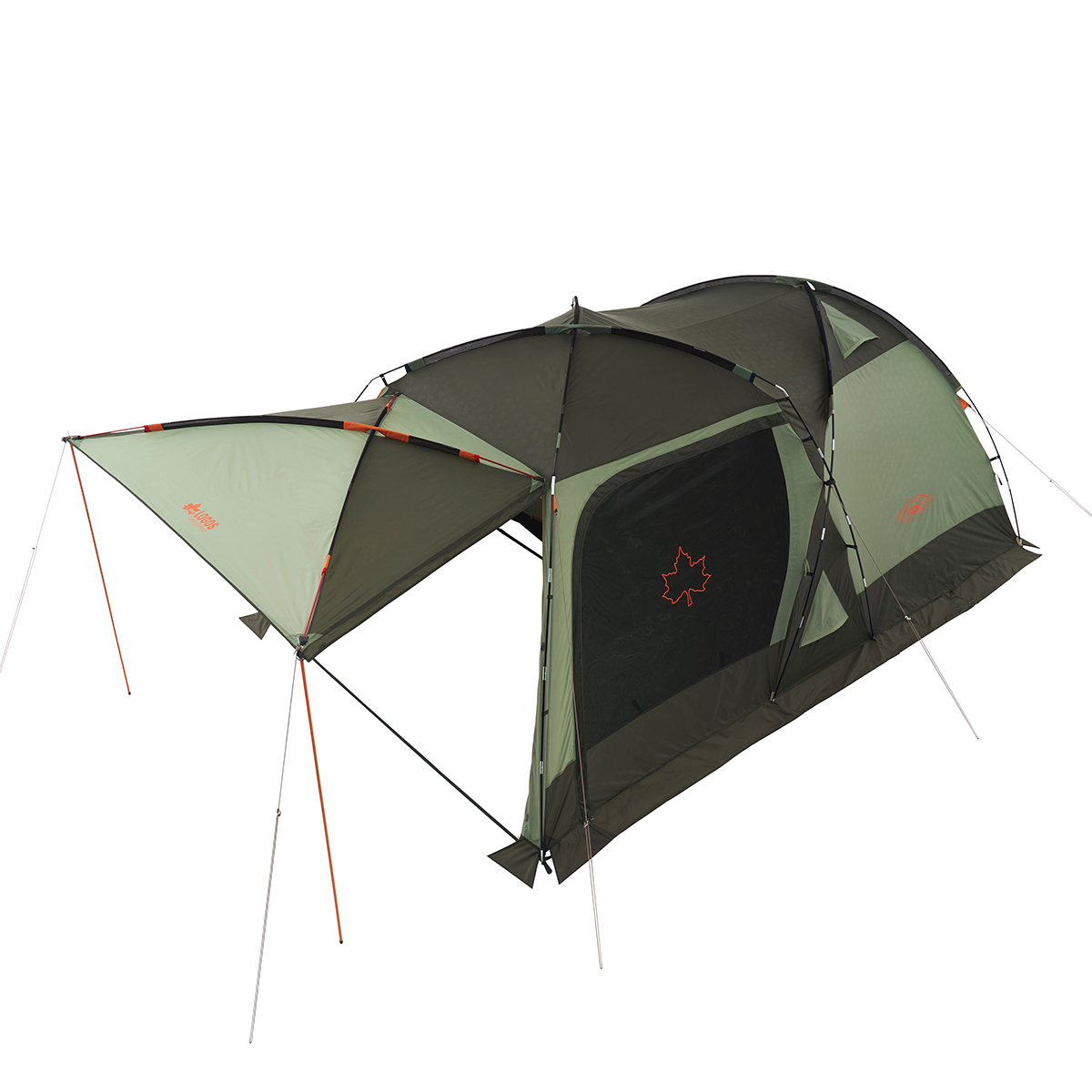
neos PANELスクリーンドゥーブル XL-BB|ギア|テント|2ルームテント|製品情報|ロゴスショップ公式オンライン
ロゴス製品「ギア」>【neos PANELスクリーンドゥーブル XL-BB】の製品詳細ページです。
www.logos.ne.jpSnow Peak Entry 2 Room Elefield
The Elefield is a two-room tent built around what four-person family camping actually needs. The numbers are all confirmed: 15.5 kg total weight, 86×32×34 cm packed, 1,800 mm water resistance, 210 cm interior height. Comparisons are easy because the data exists.
The 210 cm headroom translates directly to quality of life. Standing straight while changing, moving through the entrance without ducking, all the small physical moments of a camping day — they're smoother with that clearance. On rainy days when you're spending hours inside, not having to hunch is worth more than it sounds. This height makes evening dinner prep and putting kids to bed feel manageable rather than awkward.
The 86 cm packed length is the main trade-off. It takes up cargo space in a specific way that requires planning. At 15.5 kg, one person can manage on a short carry, but parking-to-site distances with gravel or elevation involved make two people the better call. Think of it as a large suitcase that's just slightly oversized — not unmanageable, but easier shared. List price on Snow Peak's official EC site: 87,780 yen (~$580 USD), confirmed March 2026.
Ogawa Apollon
The Apollon occupies a specific position in this comparison: the large two-room for families where interior comfort is the primary metric. Based on available product listings and review articles, the tent is rated for five people, priced around 123,000 yen (~$815 USD), weighs about 25 kg, and takes around 25 minutes to pitch. These are reference figures from sales and editorial pages at time of research — not manufacturer-verified specs.
At 25 kg, this tent demands a physical commitment before you even get the poles out. It's not a reasonable solo carry to a distant pitch. Factor in the rest of the family's gear and the weight becomes a real variable to plan around. What you get in return is interior space and bad-weather capability — the tent where your family stays comfortable even when conditions are poor.
The price reflects that premium. But framing it as a luxury purchase misses the point — it's closer to buying better camping hours per trip. For families who camp regularly through spring and fall, or who want a tent that holds up in temperature swings and real weather, the performance advantage shows up fast.
Ogawa Pista 5
The Pista 5 serves as the dome benchmark in this comparison — a clear reference point. Five-person capacity, 270×270×180 cm floor plan. Cross-pole construction means fewer components and a setup process that's easier to hold in your head on a first pitch.
At 270×270 cm, there's comfortable floor space for sleeping — but fill it with five people's worth of gear and the space tightens. The realistic sweet spot is two adults and two or three children, or four adults traveling light. It's not a two-room, so families who need a separate living area won't find it here. Where it shines is sunny-weekend auto-camping, where the simplicity of the design becomes an asset.
The 180 cm height keeps the dome from feeling cave-like, and the skirt extends its usefulness into cooler months. Weight, packed size, water resistance, and price aren't confirmed in this comparison, but the Pista 5 is a natural first 5-person dome for families who find large two-rooms too heavy or complex.
QUICKCAMP Chouva
The Chouva is worth keeping on the radar as a livability-focused option with generous headroom for 4–5 people. From confirmed specs, it targets 4–5 persons with interior height in the 2-meter range — which for family camping, where you're crouching to swap shoes, change a toddler, and shuffle wet things around, translates directly into less fatigue.
At 2 meters, each of those small actions becomes less taxing. That's the Chouva's pitch: tall enough to actually function in. Price, weight, packed size, and water resistance aren't confirmed for this comparison, so the table treats it as an "interior height priority" pick rather than a full spec matchup. It sits between basic domes and the premium two-room market — worth considering if you want the height upgrade without going all-in on a luxury shell.
Snow Peak Land Nest Shelter TP-259
The TP-259 is one of Snow Peak's newer shelter-style options for family-of-four use. Confirmed figures: lowest price 76,690 yen (~$510 USD) on Kakaku.com, 16.5 kg, maximum 4-person capacity.
At 16.5 kg, this is heavier than the Elefield and sits in a weight class that definitely benefits from two people at pack-up. Drive-in campsites make it workable; sites with a long walk from parking add friction. The 4-person maximum is the other thing to note: in a 4–5-person comparison, this tent is fitting rather than roomy. Families whose kids are still small will find it adequate — but if you want capacity to feel generous rather than exact, same-budget options may offer more living space.
Instant and Air Tent Representative Models
Instant and air tents earn their place in this comparison on raw setup speed. Air tents pitching in around 100 seconds are real — they're the answer for late Friday arrivals with restless kids, or for racing a weather front. The difference between a tent that's up in two minutes and one that takes thirty is felt, not just calculated.
The trade-off is unavoidable: large models are heavy and pack bulky. You win on the campsite, you work harder in the parking lot and at home. An Outdoor Life real-world measurement of an instant tent came in at 67×11.5 inches packed and 31.8 lbs — significant. One BE-PAL five-person example runs to about 35×74 cm diameter and 19 kg. Quick to pitch, but not light to carry.
Wind resistance also takes more active management. The fast-setup structure relies more heavily on proper Tent peg/stake driving and Guy line tensioning than pole tents do. That's not a dealbreaker, but it means setup isn't truly finished the moment the tent is standing.
This tent type is best suited to families where Friday-night arrival speed or short-turnaround pack-up is the deciding factor. I've been tempted by this category during periods when fast setup felt critical — and the appeal is real, just narrow.
💡 Tip
In the 4–5-person category, large two-rooms win on interior comfort. But weight changes the calculation: 15 kg is "solo carry if you push through it"; 20+ kg is "plan to split it from the start." That difference shapes how tired you are before the first meal.
Logos's flagship two-room, with pricing ranging from 77,000 yen (~$500 USD) at the Logos store to 47,000 yen (~$310 USD) on Amazon depending on where you buy. 2,000 mm fly, 3,000 mm floor — solid rain credentials. A strong first "proper family tent" candidate.
The 4-person, 15.5 kg, 86×32×34 cm, 210 cm height two-room. Livable headroom and a design that holds up through rainy nights and multi-night trips. List price 87,780 yen (~$580 USD) at Snow Peak.
A 5-person premium two-room at roughly 123,000 yen (~$815 USD), weighing around 25 kg with a ~25-minute setup. Heavy to haul, but built for interior comfort and weather confidence.
The go-to 5-person dome reference. 270×270×180 cm floor plan, cross-pole construction for straightforward setup. No separate living area, but strong for clear-weather family camping.
A 4–5-person shelter with approximately 2-meter interior height. Built around the idea that standing headroom matters — practical for families who spend time changing, cooking, and moving around inside.
Lowest price 76,690 yen (~$510 USD) on Kakaku.com, 16.5 kg, max 4-person capacity. A sensible choice if your family is firmly four. Snow Peak's newer shelter style, with the brand's characteristic reliability. Tighter fit when comparing against five-person use.
Shape-by-Shape: Strengths and Caveats
Dome: Light and Approachable — But Plan for a Separate Living Area
For 4–5-person family tents, domes are the most intuitive design to learn. The pole structure makes visual sense quickly, which means on that first setup, you can figure out what connects where without consulting the instructions repeatedly. As a "teach the family how tents work" platform, domes are hard to beat. You can make meaningful progress solo, and managing kids while pitching doesn't derail the whole operation.
Concretely: the Ogawa Pista 5 at 270×270×180 cm is one of the cleaner examples. Cross-pole construction makes it approachable even for first-timers, and one adult can manage solo; two adults in calm conditions go noticeably faster. At 180 cm interior height, you're not spending the whole trip crouched — a genuine comfort advantage over shorter family domes.
Rain day comfort, though, is a category below two-room designs. Everything — sleeping, eating, gear storage — shares the same room. In good weather that's fine. When rain pins everyone inside and wet rain jackets, muddy shoes, and a cooler all need somewhere to go, the dome's single space shows its limits. The working assumption with a dome should be: the tent handles sleeping; living happens under a tarp or in the car.
Wind performance has less to do with dome shape and more to do with Tent peg/stake quality and guy line placement. Domes are reasonably balanced designs, but leaving the entrance facing the wind or skipping guy lines changes the feel. On exposed coastal or alpine sites, a well-staked dome is actually a solid choice for first-timers — less surface area and a lower profile than a two-room.
Summary: domes are beginner-friendly, manageable with one or two adults for setup, but limited for rainy-day family comfort. The right choice for families starting out with fair-weather camping on a more limited budget.
Two-Room: Best in Rain — Heavier and Bigger
The case for two-room tents is simple: they create livable space even when the weather doesn't cooperate. Separating the sleeping area from the living area means kids can be put to bed while parents are still awake, wet gear stays out of the sleeping space, and the movement around camp has room to breathe. Once you've camped in real weather with a family, the value of that separation is obvious.
The Snow Peak Entry 2 Room Elefield — 210 cm interior height, 15.5 kg, 86×32×34 cm packed — is the clearest example. The arch frame design is logical, and two adults who've read the instructions can realistically set it up the first time. Solo isn't impossible, but the weight and length mean the "unpack and orient" phase takes real effort before the pitching even starts.
The Logos neos PANEL Screen Double XL-BB works the same way — a living area built into the tent means bad-weather confidence is baked in. Dinner prep, changing clothes, somewhere for kids to wait — it all happens in one contained structure. That kind of self-contained camp life suits weekend auto-camping very well.
The trade-offs are real: weight and packed size go up, and on a small pitch, placement options shrink. Packing up a wet two-room is noticeably harder than packing up a wet dome. What you're buying is comfort at the cost of logistics — and for families who camp in actual weather, it's usually worth it.
Wind management requires more care with two-rooms. A large wall area means the tent feels every gust, and guy line tensioning makes a substantial difference in stability. The structural frame is solid, but beginners especially should think of guy lines as part of the finished tent rather than optional.
Two-rooms are beginner-to-intermediate in difficulty, two-person setup is the baseline, and they're the strongest option for rainy-day comfort. Not the right call if you're optimizing for low weight or minimal cargo — but the right call for most families camping seriously through spring and fall.
Tunnel Style: Logical to Pitch — Wind Calls for Guy Lines
Tunnel tents look substantial, but the setup sequence is actually one of the easier ones to learn. Poles go in one direction, arches build a consistent pattern, and there's rarely a "wait, where does this go?" moment. In that sense, large tunnel tents can be surprisingly approachable for beginners. Two adults is the right mental model for pitching — the longer the tent, the more a second set of hands helps with alignment.
Livability is high — close to two-room comfort in terms of interior space. Headroom and depth are achievable across the design's length, and good rain-day usability is common in this category. The interior emphasis puts tunnels closer to two-rooms than domes for families who spend time inside.
Wind, however, requires active attention. A large side profile catches significant force, and the difference between a properly guy-lined tunnel tent and one pitched without is dramatic. I've camped in exposed coastal sites with a tunnel tent and felt uneasy until I added extra guy lines — after that, the stability improved markedly and the overnight feeling shifted entirely. Tunnel tents aren't poorly designed for wind; they're designed to be completed by guy lines.
In practical terms: setup procedure is approachable, but full wind management adds intermediate-level complexity. Brilliant in sheltered woodland settings; more demanding in open exposed terrain where "pitched" and "stable through the night" aren't the same thing.
Tunnels are comfortable in rain, two-person setup friendly, and the highest wind-care priority of the four styles here. A compelling choice for families who want both good living space and a legible setup process — provided they're willing to use their Guy lines properly.
Instant / Air: Fastest Setup — But Heavier and Bulkier to Carry
Instant and air tents exist for one core use case: families who need to be inside fast. Air tents in the 100-second range are real. For a late Friday arrival with a tired child, or setting up while a weather window is closing, that speed changes the texture of the whole experience. I've done late-evening setups where having a tent that goes up quickly was the difference between a smooth start and a frazzled one.
Ease of first pitch is genuinely high — for anyone who finds complex pole systems intimidating, this category wins. Small-to-medium models can be managed by one adult. But 4–5-person large models benefit strongly from two adults — because even though the pitching is fast, laying out the tent, orienting it, pegging it down, and packing it up are all still there. Speed applies to the structure; the surrounding work doesn't disappear.
The catch is predictable: large models are heavy and pack bulky. An Outdoor Life real-world measurement found an instant tent in the 67×11.5 inch, 31.8 lb range. A BE-PAL five-person example runs approximately 35×74 cm diameter, 19 kg. Fast on site; a real load everywhere else.
Wind resistance needs proactive management. Fast-deploy structure tends to rely more on Tent peg/stake and Guy line work than traditionally poled tents. That's not a fatal flaw, but it's worth understanding before you camp in an exposed location — being pitched and being secure are two different things.
ℹ️ Note
Instant and air tents are fast to pitch — but in the 4–5-person large category, they're large objects to live with everywhere except the campsite. For families putting speed first with young kids, they're a strong option. Just don't equate "fast to pitch" with "easy all around."
Core summary: high ease of first pitch and fast rain-day setup; weight, packed size, and wind management are the real costs. Strongest case for Friday-night arrivals and short turnaround tear-downs. The trade-off is real — "faster up" and "easier overall" don't always mean the same thing.
【2025年】ファミリーテントおすすめ33選!達人が2ルームテントを選ぶ理由とは?定番品も多数紹介! | キャンプ・アウトドア情報メディアhinata
ファミリーキャンプの達人・YouTuberのshiromaniさん監修のもと「失敗しないテントの選び方」「愛用アイテム」を紹介します。
hinata.meCategory Breakdown: Setup Ease, Interior Space, Rain & Wind, Portability
Setup Ease: People, Steps, and the Gap from Advertised Times
Setup ease isn't just about how many minutes are on the box. For 4–5-person family tents, the realistic scope includes unloading, laying out the tent, orienting it, pegging the corners, and tensioning any necessary Guy lines. Manufacturer times tend to reflect the pole-raising phase specifically — everything around that step adds time at the real campsite.
Where this gap shows most clearly is with instant and air tents. The speed is genuine — a 100-second air tent is a legitimately fast setup, and with small children who struggle to wait, that matters. I've had late afternoon arrivals where a tent going up fast meant kids were inside before the complaining reached critical mass. But the tent isn't "done" when the structure is up. Large tents still need four corners pegged and tensioned, Guy lines run, and doors oriented before you're actually set for the night.
The Ogawa Pista 5 with its cross-pole dome construction represents the other end: straightforward steps, easy to understand on first attempt, less total complexity. The 270×270×180 cm single room means fewer decisions about what connects where. Compared to the Snow Peak Entry 2 Room Elefield — four arch frames, ridge pole, clip-in inner — the dome involves fewer moving parts. The Elefield is well-organized for a large family tent, but two adults will find it significantly easier than one, both for cleanliness of setup and for actual time.
For any tent four-person or larger, particularly two-room and tunnel designs, setup satisfaction is more about being able to build in time buffers than hitting a minute target. Leave room for the bathroom stop, the misplaced stake bag, and the gear that needs to come out before the tent goes down. If quick pitching is the priority, instant/air; if clear procedure matters, a simple dome; if you want rain-day livability as part of the package, a two-room is worth the extra setup steps.
Space and Height: Sleeping Area and the Value of 170 cm
For floor space, matching the sleeping dimensions to the 180×55 cm per-person benchmark is more useful than going by capacity label. Four adults need 220 cm of width; five need 275 cm. Gear, overnight movement, and morning routines sit on top of those numbers — the tent that's "adequate" on paper can feel genuinely tight once four people's bags are inside.
The Ogawa Pista 5 at 270×270×180 cm is a good reference model because the dimensions are published. Floor space looks generous on paper, but accounting for gear and traffic flow, two adults with two kids and their gear is about right — pushing it to the full five-person label makes the sleeping area feel tight. "It fits five" and "five people live comfortably in it" are different claims.
Interior height follows the same pattern — the numbers diverge from the experience. Above 170 cm, most adults stop having to duck continuously. Above that threshold, actions like helping a kid change clothes, picking up bags while moving through the tent, or doing a morning routine standing up all become noticeably less tiring. The Snow Peak Entry 2 Room Elefield at 210 cm offers real overhead clearance — at 175 cm tall, you have meaningful room above your head, not just "technically standing." Whether you're above 170 cm or at 210 cm matters; whether you're at 150 cm versus 160 cm matters less.
Living room depth rounds this out. The two-room design's strength isn't just floor area — it's that the living area becomes the rain-day refuge. When the weather closes in, the bedroom stays clear because bags and wet gear can move to the living side. The Logos neos PANEL Screen Double XL-BB works this way: two spaces serve two purposes, and the family moves between them rather than piling everything into one room. For family camping, "can everyone function here until morning?" is a more meaningful capacity question than "how many sleeping bags fit on the floor?"
Rain and Wind: Reading Water Resistance Ratings and Running Guy Lines
Water resistance of 1,500 mm or higher is where family tent shopping makes sense to start. The 1,500–2,000 mm range covers typical family camping rain conditions. Specs above that are reassuring, but the material alone doesn't determine real performance — seam quality, panel overlap, floor construction, hem treatment, and Guy line attachment points all contribute to how well the tent performs under sustained rain.
Confirmed examples: the Logos neos PANEL Screen Double XL-BB at 2,000 mm fly and 3,000 mm floor; the Snow Peak Entry 2 Room Elefield at 1,800 mm. Both are credible family camping specs. These numbers hold up in the kind of overnight rain that's common on weekend trips — not a downpour, but not a light drizzle either.
Wind performance comes down largely to Guy line execution. Tunnel and two-room tents in particular show a dramatic difference between "pitched" and "properly tensioned." I've set up in an open site where the tent looked stable visually, but felt unsettled until I ran the guy lines fully — after which the movement stopped and the sleep was fine. It's not that these designs are fragile; it's that they're designed to be completed by their guy lines. That's a fundamental different mindset from thinking of tenting as "poles up, done."
💡 Tip
A tent that performs well in rain isn't just one with a high water resistance rating — it's one that clears the rating threshold, has well-designed panels and hem construction, and comes with enough Guy line points to actually tension properly. For family camping, spec and setup method work together.
Skirts matter for extending the season. Blocking cold air from coming in at ground level is what lets you camp comfortably in spring and fall without a lot of extra gear. The Ogawa Pista 5 has a skirt built in, which is part of what makes it a longer-season dome option. Water resistance sets the floor; Guy lines and skirts determine the ceiling of when and where you can comfortably use the tent.
Portability: Weight and Packed Size Along the Real Carry Path
Portability only fully makes sense when you think about the actual path from car to campsite. Getting it out of the cargo area is one thing. Carrying it across a gravel path, up a slight grade, past the check-in booth, and onto your pitch is another. The difference in that experience between a 10 kg tent and a 19 kg tent is real, even when the walk is only 100 meters.
The weight tiers that tend to matter for 4–5-person tents: the 10 kg class vs. 19 kg class. A BE-PAL example in the 4–5-person range: approximately 10 kg, packed to 25×75 cm diameter. That's a tent that can go ahead of you solo, that slots into cargo areas without strategic Tetris, that one adult can handle without thinking twice. At 19 kg packed to 35×74 cm diameter, the math changes — carrying that while a kid needs a hand is a genuine coordination challenge. I've done a wet pack-up with a tent in that range and felt it in my back the following morning.
The Snow Peak Entry 2 Room Elefield at 15.5 kg with an 86×32×34 cm pack is a middle case. Manageable for a short carry by one person, but the box-like shape and length mean cargo placement needs planning. The physical presence in the loading area is closer to an overstuffed suitcase than a sleeping bag. Instant and air tents offer campsite speed but frequently trade it for long, heavy packs — the Outdoor Life measurement of 67×11.5 inches for an instant tent is a real cargo reality.
Beyond weight, shape matters: a cylindrical tent bag in the 10 kg range is easy to carry on one side; a box-shaped pack of the same weight distributes differently and needs two hands. For family car camping where the trunk is already full of coolers and sleeping bags, those few centimeters of pack width or length can be the difference between fitting and not.
Recommendations by Family Style
First Family Tent: Easy-to-Learn Dome or Compact Tunnel
For a first family tent, the priority is a design where setup is intuitive — where you're not stopping to re-read instructions the second time around. That description fits the dome-leaning Ogawa Pista 5 well. Cross-pole construction, clear spatial logic, no secondary rooms to manage. For a family who hasn't camped together in a tent before, being able to focus on the rhythm of pitching rather than figuring out which pole goes where is genuinely valuable. The 270×270×180 cm floor plan works best, in my experience, with two adults and their gear, plus two kids — the "5-person" label overstates the comfort level when all five people's stuff is inside.
The appeal of this type isn't about being impressive — it's about repeatable ease. Rain days and interior living aren't its strength, but you won't arrive at a late site and feel like the tent is fighting you. With small children, the time parents spend confused about setup is time kids spend unsupervised or upset. Reducing that is worth something.
The alternative step up is the Snow Peak Entry 2 Room Elefield. It's more structure to manage, but the frame logic is still clear enough for newcomers. For families who want to go straight to the tent that will actually serve them on rainy weekends and multi-night trips, it's a legitimate first purchase. My own first instinct was to start simple — but as kids got older, the value shifted quickly from "quick to pitch" to "comfortable to live in for 16 hours." What kind of first tent makes sense depends on whether you want to ease into the learning curve, or jump to the design you'll grow into.
Rainy-Day Coverage: Two-Room or Tunnel as the Core
If rain days are in the brief, the candidate list should center on two-room designs. The standout options are the Logos neos PANEL Screen Double XL-BB and the Snow Peak Entry 2 Room Elefield — both separate sleeping from living, both handle wet gear and wet bodies with room to spare. The Logos especially stands out for its price spread: 77,000 yen (~$500 USD) at the official store, 47,000 yen (~$310 USD) on Amazon (as of March 2026). That kind of range makes the living-space upgrade easier to justify. Add the 2,000 mm fly and 3,000 mm floor and you have a tent built for rain, not just tolerating it.
The Elefield costs more — 87,780 yen (~$580 USD) list price — but the 210 cm interior height does real work at that price point. Standing up straight while everyone gets settled after dinner isn't a luxury; it's what makes the two-hour bedtime routine not feel like an endurance sport. The 15.5 kg weight and 86×32×34 cm pack size are realistic for a tent in this class.
After enough camping in actual weather, the value of the two-room stops feeling like a trade-off and starts feeling like a fixed cost. The rainy morning where everyone stayed dry, the evening when kids were sleeping and adults still had somewhere to be — those moments are what the extra money buys.
ℹ️ Note
For rain camping, evaluate by how the vestibule functions, not just the rated water resistance. A tent that keeps the sleeping area clean and the living area active makes a family of four's overnight significantly easier to manage.
Summer Priority: Mesh Area and Panel Airflow
In summer, the more useful spec to prioritize over square footage is how air moves through the tent. The standout here is the Logos neos PANEL Screen Double XL-BB, which uses DevilBlock ST mesh — explicitly listed in the official product page — giving you insect protection without blocking airflow. Family camping in summer means dealing with bugs and heat arriving simultaneously in the early evening; mesh quality and panel opening design affect both.
Beyond weather resistance, this tent's two-room layout lets you work the living area differently across the day: shade from midday sun through the afternoon, then open the panels for evening airflow. That kind of adaptability reduces the feeling of being managed by your gear. Kids who sweat through the evening matter too — it's not just the sleeping area that needs to breathe, it's wherever they're eating and changing.
Alternatively, a 2-meter interior height design like the QUICKCAMP Chouva offers good summer logic. Hot air rises; more vertical space means less of it sits at body level. Specific specs for the Chouva aren't confirmed here, but the height principle applies broadly. For summer use, mesh area, panel configuration, and vertical headroom matter more than the floor plan number on its own. I'll take a slightly smaller footprint with real airflow over a large floor that becomes an oven.
Fastest Setup: Instant and Air Systems
If pitch time is the top criterion, the answer is instant or air tent. Air tents in the 100-second class are real, and for late Friday arrivals or beating incoming weather, that speed is as good as it sounds. The gap between "tent up" and "kids inside" affects the energy of the whole first night.
First-pitch approachability is also high — for anyone who finds conventional pole systems confusing, this is the most forgiving category. That said, 4–5-person large models benefit from two adults for everything outside the actual pitch: laying out, orienting, pegging, and packing. The structure goes fast; the surrounding work follows its own timeline.
The consistent caveat: large models are heavy and pack bulky. The Outdoor Life real-world numbers — 67×11.5 inches, 31.8 lbs — are what this category looks like at scale. Worth being concrete about before purchase. As an alternative, the Ogawa Pista 5 takes longer than an air tent but keeps the setup procedure short and logical — for families that want to reduce confusion without paying the bulk penalty of an instant tent, it's a useful middle path.
My household went through a phase of maximum setup-speed priority when kids were youngest. Over time the balance shifted — "ten minutes faster to pitch" mattered less than "thirty more comfortable minutes inside." Speed-focused tent buying skews toward families with the youngest kids and tends to shift toward livability as they grow. Both preferences are valid; it's worth being honest about which one you're in.
Budget-First: Finding "Good Enough" Without Overpaying
For budget-conscious buyers, the Logos neos PANEL Screen Double XL-BB at 47,000 yen (~$310 USD) on Amazon is worth taking seriously. A two-room design with 2,000 mm fly and 3,000 mm floor at that price point includes more than "basic coverage" — it includes rain-day vestibule function, summer mesh usability, and the structural quality to use repeatedly. Compared to the Logos official store price of 77,000 yen (~$500 USD), the gap through other retailers is real value. This isn't a tent you're settling for; it's a tent that happens to be priced well.
For simpler budgets, a dome like the Ogawa Pista 5 also pairs well with a cost-conscious approach. Exact pricing wasn't confirmed for this comparison, but the design complexity is lower, which typically correlates with a lower entry price. For families doing a few auto-camping trips per year, a tent where setup clarity is the main feature is a perfectly defensible choice. You don't need a front vestibule to have a good camping trip in fair weather.
The Snow Peak Entry 2 Room Elefield at 87,780 yen (~$580 USD) list is in a different bracket — but it's worth noting that the 210 cm height, support infrastructure, and repairability change the long-term cost calculation. "Cheap to start" and "low total cost" aren't always the same number. After a few rounds of buying and replacing tents as needs changed, I can say that both the "start accessible" approach and the "go bigger and stay" approach have their own logic. If your family's camping frequency is still unknown, prioritize a tent that won't frustrate you when it matters — because a tent that's fine for a while but wrong for a rainy trip tends to get replaced anyway.
Common Questions Before Buying
Q1: Is a 4-person tent too small for a family of four?
Short answer: yes, probably. Rated capacity on family tents leans toward maximum sleeping count, not comfortable living space — kids' sleeping patterns, gear storage, and nighttime movement aren't factored in.
The 180×55 cm per-person benchmark is the useful tool here. Four people laid out need about 220 cm of width. That sounds like enough until you add the small pile of stuff at everyone's head, the change of clothes at the foot, the bag in the corner — and then someone needs to step around everyone to get outside at 3 a.m. With small children who don't sleep neatly, even that calculation is optimistic.
The Ogawa Pista 5 makes this visible. Its 270×270×180 cm floor is genuinely roomy for sleeping. But fill it with five people's gear and you feel the difference — in practice, four people using it comfortably is the realistic description. The "5-person" label is the capacity ceiling, not the everyday comfort zone.
Two-room tents follow the same logic. The Snow Peak Entry 2 Room Elefield is rated for four people and works well for four — because the living room handles gear and keeps the sleeping space open. A four-person single-room dome for four people doesn't have that option. For a family of four, looking at 5–6-person capacity equivalents is the most reliable way to avoid the "thought it would be bigger" letdown after purchase.
Q2: How much water resistance do you actually need?
For family camping, 1,500–2,000 mm is the practical starting range. That covers the kind of rain typical on weekend trips in most regions — not just a drizzle, but not a sustained heavy downpour either. Going above 2,000 mm adds reassurance but isn't always the deciding factor in real-world performance.
Confirmed examples from this comparison: the Snow Peak Entry 2 Room Elefield at 1,800 mm; the Logos neos PANEL Screen Double XL-BB at 2,000 mm fly. Both are credible for family use. Two-room tents have a secondary advantage here — the structure that keeps living space separate from sleeping space also keeps wet gear separated, which adds practical weather comfort beyond raw waterproofing numbers.
One caveat worth knowing: the same "2,000 mm" figure can mean different things depending on how a brand measures it — some report average values, others minimum values. Side-by-side comparisons of the same number across different brands aren't always apples-to-apples. So when evaluating water resistance, looking at the brand's measurement methodology alongside the figure helps you compare more accurately.
Q3: Are instant and air tents weak in wind?
They do have a structural disadvantage in wind, which comes from the fast-deploy design. A simpler frame that goes up quickly tends to have less built-in rigidity, which means more of the tent's wind stability depends on Tent peg/stake depth, Guy line placement, and how well you've oriented the tent relative to the wind direction. Fast-setup tents need thorough anchoring to be safe — that's the core trade-off.
That said, "disadvantaged in wind" doesn't automatically mean "avoid." In practice, proper Guy line tension, orienting lower profiles toward the wind, and not relying solely on the included stakes makes a substantial difference. The structural limitation is real, but it's manageable through setup technique rather than a fixed design flaw.
For family camping, the speed advantage is genuine and not trivial. Air tents at around 100 seconds up are meaningful when you arrive late or the sky is threatening. Wind concerns come down to how much anchoring prep you're willing to do, not whether the tent type is inherently suitable. With good technique, instant and air tents are practical — they just require a more deliberate approach to wind management than poled tents do.
Q4: Is a 20 kg tent realistic for family camping?
For auto-camping, yes — with the right expectations. Large two-room and high-durability tents add weight as part of their design. That's not a flaw; it's a trade-off. More weight typically means more interior space, more weather protection, more stability. The weight itself isn't a verdict.
The useful middle reference is the Snow Peak Entry 2 Room Elefield at 15.5 kg. That's a tent one adult can move solo at short distances — but a gravel path or a parking-to-site walk of any length makes you want help. The 86×32×34 cm packed size has physical presence beyond just the weight. My own experience: even at this weight, a wet pack-up with any elevation change is noticeably draining.
Past 20 kg — the Ogawa Apollon at about 25 kg, for example — you're making an explicit trade: interior quality and weather confidence for effort. On a drive-in campsite where the car is close to the pitch, this is livable. On a site with a walk from parking, it becomes a logistics puzzle.
💡 Tip
Heavy tents make sense for families where the car parks close to the pitch, two adults are available for setup and pack-up, and rain-day interior comfort is the priority. For sites with a meaningful walk from parking, or where one adult is running most of the operation, the 10–15 kg range tends to produce higher overall satisfaction.
The right framing: heavy tents aren't mistakes, they're deliberate trades. In family camping, interior room and vestibule function often contribute more to a good trip than saving a few kilograms on the carry. I've been grateful for a lighter tent and grateful for a roomy one in different situations. The reliable decision factors aren't the weight alone — they're parking distance, site terrain, and how many adults are handling setup.
Summary
Decision Flowchart
When you're unsure where to start, locking in family size, gear volume, number of adults for setup, and target season first will narrow the field faster than working through individual specs. Sleeping capacity points you to a floor area; gear volume determines how much vestibule space you need; adult count guides the setup method; season adds the weather and ventilation layer. Once those are set, style, size, setup method, weather resistance, portability, and site fit all fall into place.
- Family of four, significant gear, two adults for setup, spring and fall use
Two-room designs in focus. The Logos neos PANEL Screen Double XL-BB and Snow Peak Entry 2 Room Elefield both offer bedroom/gear-separation that makes this profile work.
- Family of 4–5, average gear load, sometimes just one adult managing setup, mostly fair weather
Dome or simple structure is the candidate. The Ogawa Pista 5's clear design keeps setup from becoming a problem on its own — it won't fight you on a short-notice weekend trip.
- Young kids, setup speed the top priority, time on site at a premium
Instant or air tent is the anchor, but size and packed weight need to be part of the evaluation from the start.
ℹ️ Note
Sorting your priorities into "setup first," "livability first," or "budget first" before looking at specific models makes the comparison significantly faster. Trying to optimize all three at once is how the shortlist grows instead of shrinks.
For families who want another layer of specificity, the "recommended family tents and how to choose" and "rain camping guide: water resistance benchmarks" sections on this site can help you test your conclusions against a few more scenarios.
Related Articles
The Complete Guide to Choosing a Tent
Before hunting for popular models, understanding tent shapes, materials, and sizing will save you from costly mistakes. Whether you're buying your first tent, deciding between solo and family setups, or rethinking rain and wind protection, this guide lays out the criteria that actually matter.
Best Solo Tents Compared: How to Pick the Right One
Choosing a solo tent is never as simple as going with the lightest option. Weight, ease of setup, livability, waterproofing, and vestibule usability all factor in — skip any of them, and buyer's remorse hits fast. This article covers
How to Choose a Family Tent: A Practical Buying Guide
Picking a family tent based on looks or popularity alone often leads to regret -- it felt smaller than expected, or rainy days were miserable. This guide is for families buying their first tent or outgrowing their current one.
How to Choose an Easy-Setup Tent: A Structure-by-Structure Comparison
Picking a tent based on 'looks easy to set up' or 'I like the style' tends to backfire the moment rain or wind hits on your first overnight. This guide breaks down instant, pop-up, dome, and single-pole designs by real-world usability and overnight performance for first-time buyers and anyone tired of regrettin